


doi: 10.1016/j.ddmec.2007.11.003.
Tuberculosis Infection: Insight from Immunogenomics
Affiliations
- PMID: 18677418
- PMCID: PMC2493064
- DOI: 10.1016/j.ddmec.2007.11.003
Item in Clipboard
Tuberculosis Infection: Insight from Immunogenomics
Drug Discov Today Dis Mech.
2007.
Abstract
Tuberculosis continues to be one of the most important global infectious causes of morbidity and mortality. Development of a more effective vaccine is a high worldwide priority and depends on a thorough understanding of the host response to infection. In this review, we highlight recent advances in our understanding of the innate immune response to MTb infection. We also describe recent discoveries in immunogenetics that are generating insight into the potential development of immunomodulatory therapies.
Figures
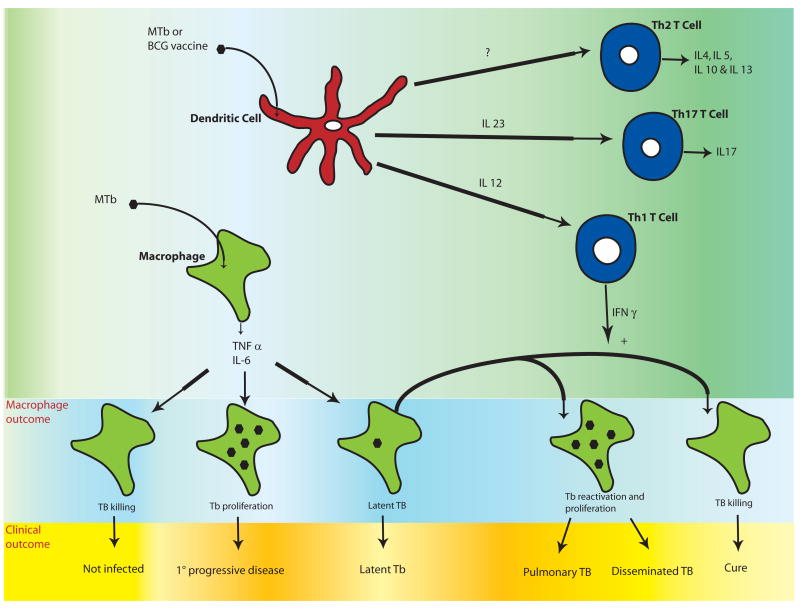
Initial MTb infection of the macrophage results in production of pro-inflammatory cytokines such as IL-6, IL-1β, IL-12, and TNF-α. Unknown factors in host defense lead to a spectrum of initial clinical outcomes including resistance to infection, primary progressive disease, and latency. In latent infection, there is a balance of mycobacterial proliferation and host defense and MTb is contained in granulomas with no clinical symptoms. Ten percent of those with latent MTb infection will eventually develop clinically active disease that manifests as localized pulmonary infection (in 80% of individuals) or disseminated disease. These diverse clinical outcomes may be regulated by variation in the innate immune response of macrophages and/or dendritic cells. T cell responses are shaped by interactions with dendritic cells, which depend on the innate immune response to MTb or BCG. Th1 T cells produce IFN-γ and promote mycobacterial killing of TB-infected macrophages. Th17 T cells secrete IL-17 and may be important for protective vaccine-induced responses. The role of Th2 T cells in host defense to MTB infection is less clear. The combination of innate and adaptive responses influences the macrophage response to TB infection as well as the clinical outcome. Immunomodulatory therapy directed at innate immune receptors could potentially alter clinical outcomes by affecting several steps in disease pathogenesis outlined in this figure.
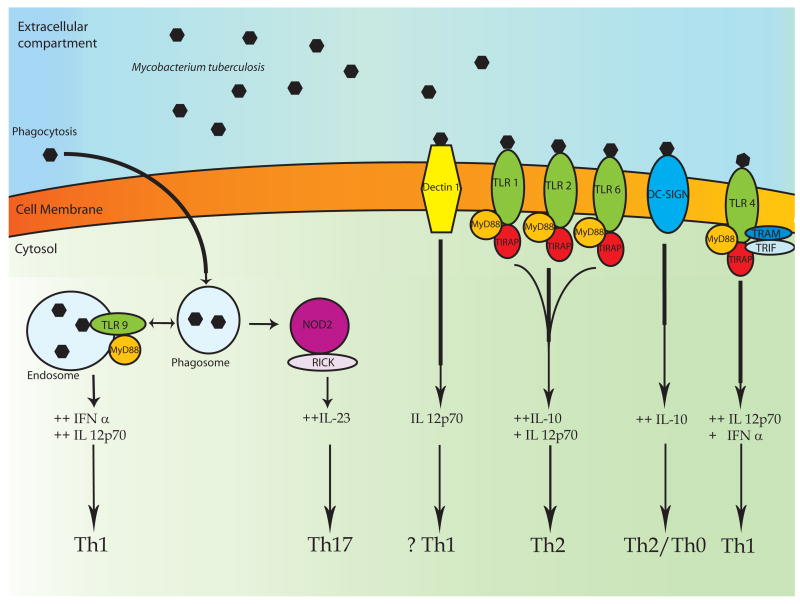
MTb is recognized by PRRs that activate the immune response through detection of mycobacterial molecules. Receptors involved in MTb recognition include several TLRs, NOD2, DC-SIGN, and Dectin-1. As explained in the text, several lines of evidence suggest that the type of adaptive immune response is influenced by which PRR is stimulated on macrophages and dendritic cells. The stimulation of multiple PRRs by MTb raises the possibility that agonists or antagonists of each receptor may selectively alter different aspects of the innate and/or adaptive immune response to MTb and/or BCG vaccination.
References
-
- Colditz GA, et al. Efficacy of BCG vaccine in the prevention of tuberculosis. Meta-analysis of the published literature. Jama. 1994;271(9):698–702. - PubMed
-
- Kaufmann SH. Tuberculosis: back on the immunologists' agenda. Immunity. 2006;24(4):351–357. - PubMed
-
- Flynn JL, Chan J. Immunology of tuberculosis. Annu Rev Immunol. 2001;19:93–129. - PubMed
-
- Casanova JL, Abel L. Genetic dissection of immunity to mycobacteria: the human model. Annu Rev Immunol. 2002;20:581–620. - PubMed
Grants and funding
LinkOut - more resources
Full Text Sources