. 2008 Aug;59(2):183-199.
doi: 10.1016/j.jml.2008.04.001.

Memory for Items and Associations: Distinct Representations and Processes in Associative Recognition

Affiliations

Memory for Items and Associations: Distinct Representations and Processes in Associative Recognition

Norbou G Buchler et al. J Mem Lang. 2008 Aug.

Abstract

In two experiments, participants studied word pairs and later discriminated old (intact) word pairs from foils, including recombined word pairs and pairs including one or two previously unstudied words. Rather than making old/new memory judgments, they chose one of five responses: (1) Old-Old (original), (2) Old-Old (rearranged), (3) Old-New, (4) New-Old, (5) New-New. To tease apart the effects of item familiarity from those of associative strength, we varied both how many times a specific word-pair was repeated (1 or 5) and how many different word pairs were associated with a given word (1 or 5). Participants could discriminate associative information from item information such that they recognized which word of a foil was new, or whether both were new, as well as discriminating recombined studied words from original pairings. The error and latency data support the view that item and associative information are stored as distinct memory representations and make separate contributions at retrieval.


Figures
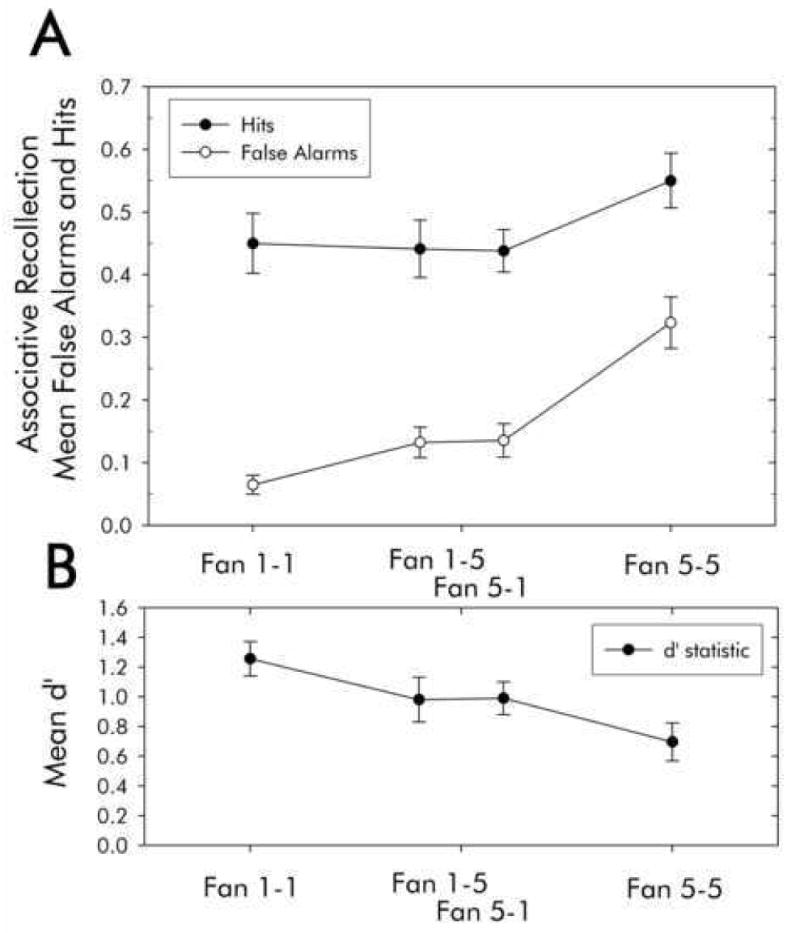
Figure 1
Figure 1
Associative recognition results of Experiment 1. Panel A. Proportion of ‘Old-Old (original)’ hit responses to intact word pairs and ‘Old-Old (original)’ false alarm responses to rearranged word pairs as a function of associative interference (Fan 1-1, [Fan 1-5, Fan 5-1], Fan 5-5). Panel B. Mean d′ statistic as a function of associative interference (fan). The error bars are standard errors of the mean. Panel A. Proportion of ‘Old-Old (original)’ hit responses to intact word pairs and ‘Old-Old (original)’ false alarm responses to rearranged word pairs as a function of associative interference (Fan 1-1, [Fan 1-5, Fan 5-1], Fan 5-5). Panel B. Mean d′ statistic as a function of associative interference. The error bars are standard errors of the mean.
Figure 2
Figure 2
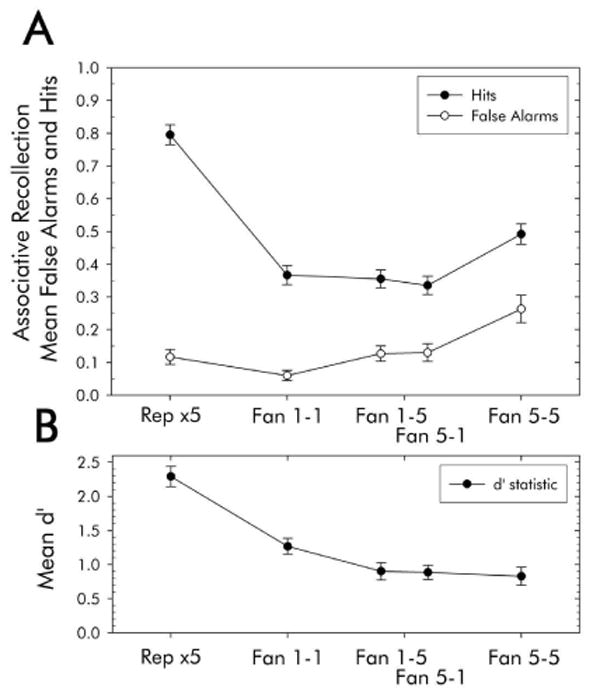
Associative recognition results of Experiment 2. Panel A. Proportion of ‘Old-Old (original)’ hit responses to intact word pairs and ‘Old-Old (original)’ false alarm responses to rearranged word pairs as a function of associative interference (Rep×5, Fan 1-1, [Fan 1-5, Fan 5-1], Fan 5-5). Panel B. Mean d′ statistic as a function of associative interference (fan). The error bars are standard errors of the mean. Panel A. Proportion of ‘Old-Old (original)’ hit responses to intact word pairs and ‘Old-Old (original)’ false alarm responses to rearranged word pairs as a function of increasing associative interference (Rep ×5, Fan 1-1, [Fan 1-5, Fan 5-1], Fan 5-5). Panel B. Mean d′ statistic as a function of associative interference. The error bars are standard errors of the mean.
Figure 3
Figure 3
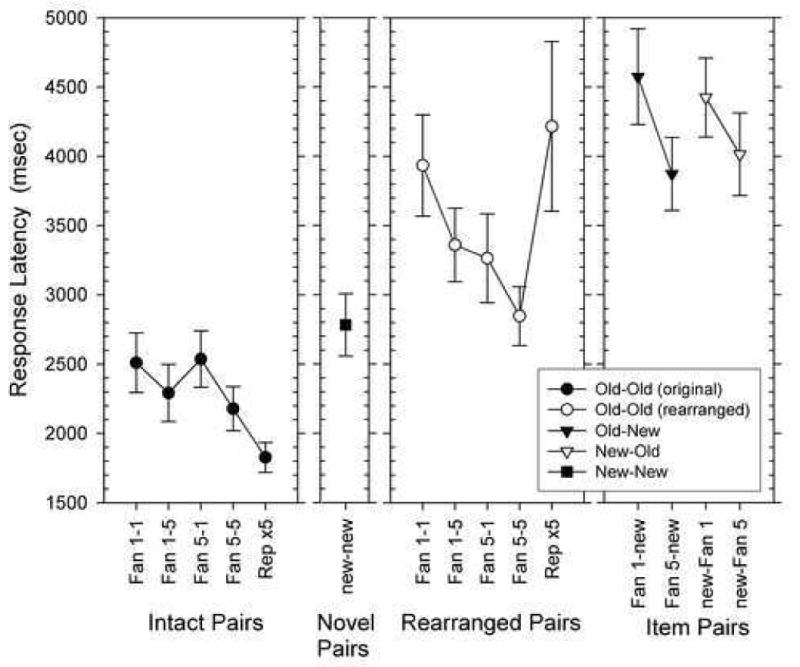
Mean median response latency for correct responses to intact, novel, rearranged, and item tested word pairs. Variability is shown as 95% confidence intervals.
Figure 4
Figure 4
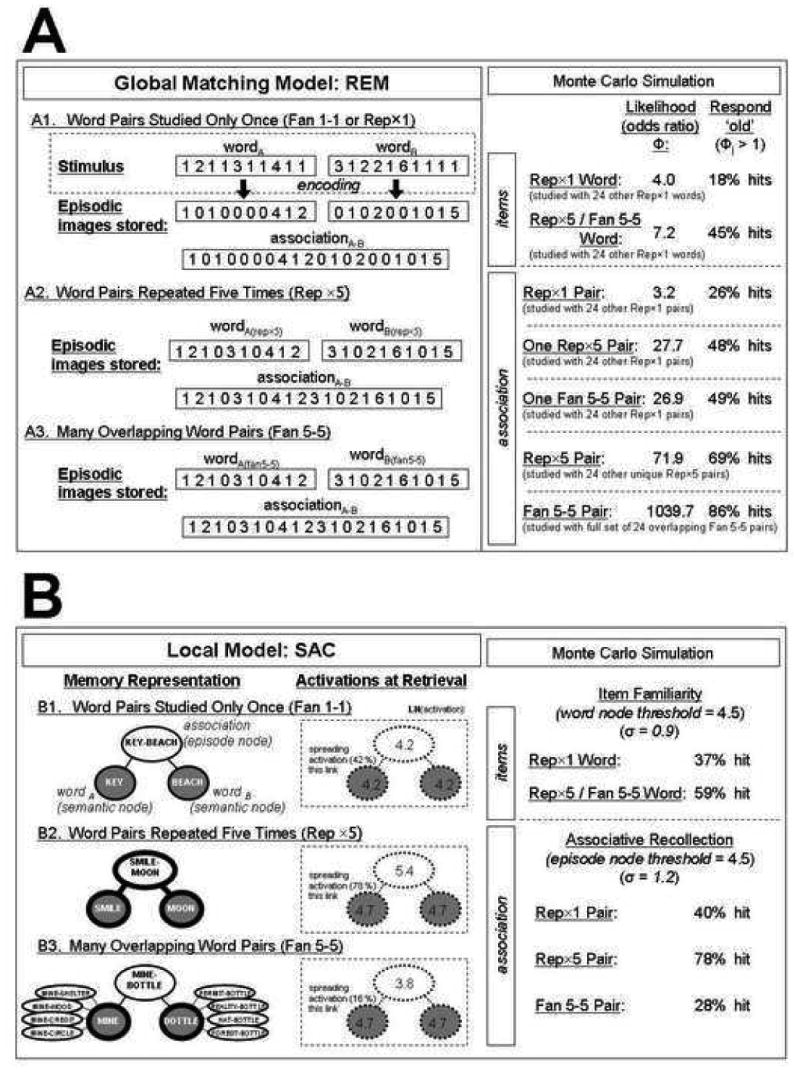
Schematic description of a candidate global model, REM (panel A) and a local model SAC (panel B) of associative recognition. Leftmost section headers delineate the memory representations of item and associative information for three classes studied word pairs (Fan 1-1, Rep ×5, and Fan 5-5) in the REM (sections A1, A2, A3) and SAC (sections B1, B2, B3) models. The results of the Monte Carlo simulation are given on the right.

References

    1. Anderson JR. Retrieval of propositional information from long-term memory. Cognitive Psychology. 1974;6:451–474.
    1. Anderson JR, Bower GH. Human associative memory. Oxford, England: Winston & Sons; 1973.
    1. Anderson JR, Lebiere C, editors. The atomic components of thought. Mahwah, NJ: Erlbaum; 1998.
    1. Anderson JR, Reder LM. The fan effect: New results and new theories. Journal of Experimental Psychology: General. 1999;128:186–197. - PubMed
    1. Buchler NEG, Reder LM. Modeling age-related memory deficits: A two-parameter solution. Psychology and Aging. 2007;22:104–121. - PubMed

LinkOut - more resources