


Leg length discrepancy in total hip arthroplasty: comparison of two methods of measurement
- PMID: 18677480
- PMCID: PMC2899101
- DOI: 10.1007/s00264-008-0633-9
Leg length discrepancy in total hip arthroplasty: comparison of two methods of measurement
Abstract
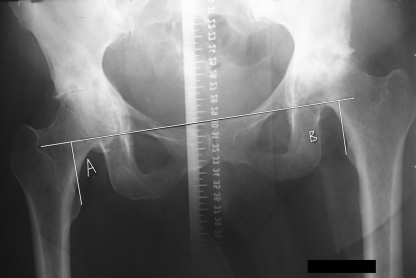
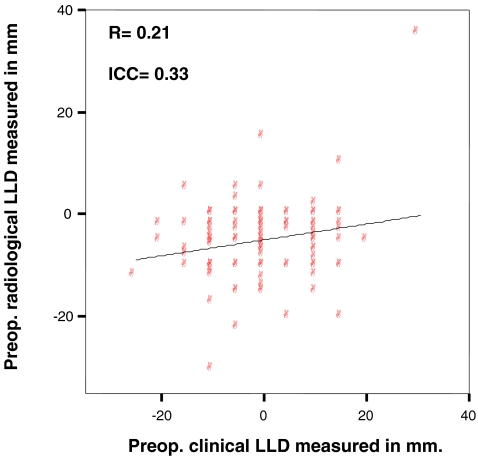
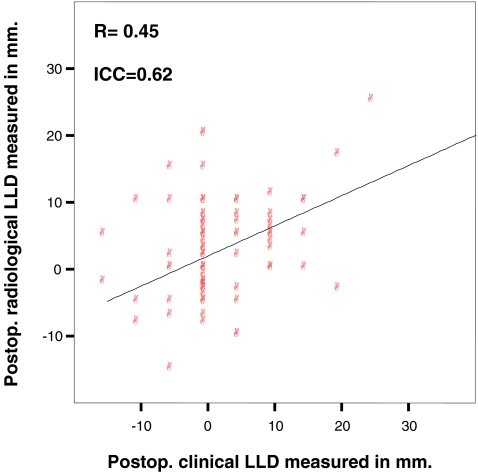
Measurement of leg length discrepancy is an important part in planning a successful total hip arthroplasty (THA). Many clinical and radiological methods with variable degrees of accuracy have been advocated to carry out this measurement. We studied the accuracy of a commonly used clinical method by comparing it to a well-known and reliable radiological method. A total of 139 patients aged 44-89 (mean: 67.5 years) scheduled to undergo THA were examined for clinical and radiological leg length discrepancy measurements before and after the operation by the same observers. There was a poor correlation between the clinical and radiological methods preoperatively [r = 0.21, intra-class correlation coefficient (ICC) = 0.33]. The correlation was better postoperatively (r = 0.45, ICC = 0.62). The clinical method used is not recommended for leg length discrepancy measurement preoperatively. Caution should even be taken when using this method postoperatively. The authors recommend using the radiological method when measuring leg length discrepancy as a part of planning for THA.
Objectif: La mesure de l’inégalité de longueur est une part importante de la planification des prothèses totales de hanche. De nombreuses méthodes cliniques et radiologiques ont été utilisées pour permettre de telles mesures. Nous avons voulu étudier une méthode clinique habituelle comparée à une méthode radiologique fiable. Patients et méthode: 139 patients âgés de 44 à 89 ans (en moyenne 67,5 ans) devant bénéficier d’une prothèse totale de hanche ont été examinés sur le plan clinique et radiologique avec mesure de l’inégalité de longueur avant et après l’intervention chirurgicale par les mêmes observateurs. Résultats: il y a peu de corrélations entre les méthodes cliniques et radiologiques pré-opératoires (r = 0.21, ICC = 0.33). La corrélation est bien meilleure en post-opératoire (r = 0.45, ICC = 0.62). En conclusion, la méthode clinique n’est pas recommandée en pré-opératoire, elle doit être utilisée avec méfiance. En post-opératoire il est recommandé d’utiliser une méthode radiologique afin de mesurer l’inégalité de longueur des membres inférieurs. Celle-ci doit faire partie du planning d’une prothèse totale de hanche.
Figures
References
-
- Aaron A, Weinstein D, Thickman D, Eilert R. Comparison of orthoroentgenography and computed tomography in the measurement of limb-length discrepancy. J Bone Joint Surg Am. 1992;74(6):897–902. - PubMed
-
- Aitken AG, Flodmark O, Newman DE, Kilcoyne RF, Shuman WP, Mark LA. Leg length determination by CT digital radiography. AJR Am J Roentgenol. 1985;144(3):613–615. - PubMed
-
- Amstutz HC, Ma SM, Jinnah RH, Mai L. Revision of aseptic loose total hip arthroplasties. Clin Orthop Relat Res. 1982;170:21–33. - PubMed
-
- Bal BS. A technique for comparison of leg lengths during total hip replacement. Am J Orthop. 1996;25(1):61–62. - PubMed
-
- Beattie P, Isaacson K, Riddle DL, Rothstein JM. Validity of derived measurements of leg-length differences obtained by use of a tape measure. Phys Ther. 1990;70(3):150–157. - PubMed
Publication types
MeSH terms
LinkOut - more resources
Full Text Sources
Medical
