


Message in a nucleus: signaling to the transcriptional machinery
- PMID: 18678250
- PMCID: PMC2642480
- DOI: 10.1016/j.gde.2008.07.007
Message in a nucleus: signaling to the transcriptional machinery
Abstract
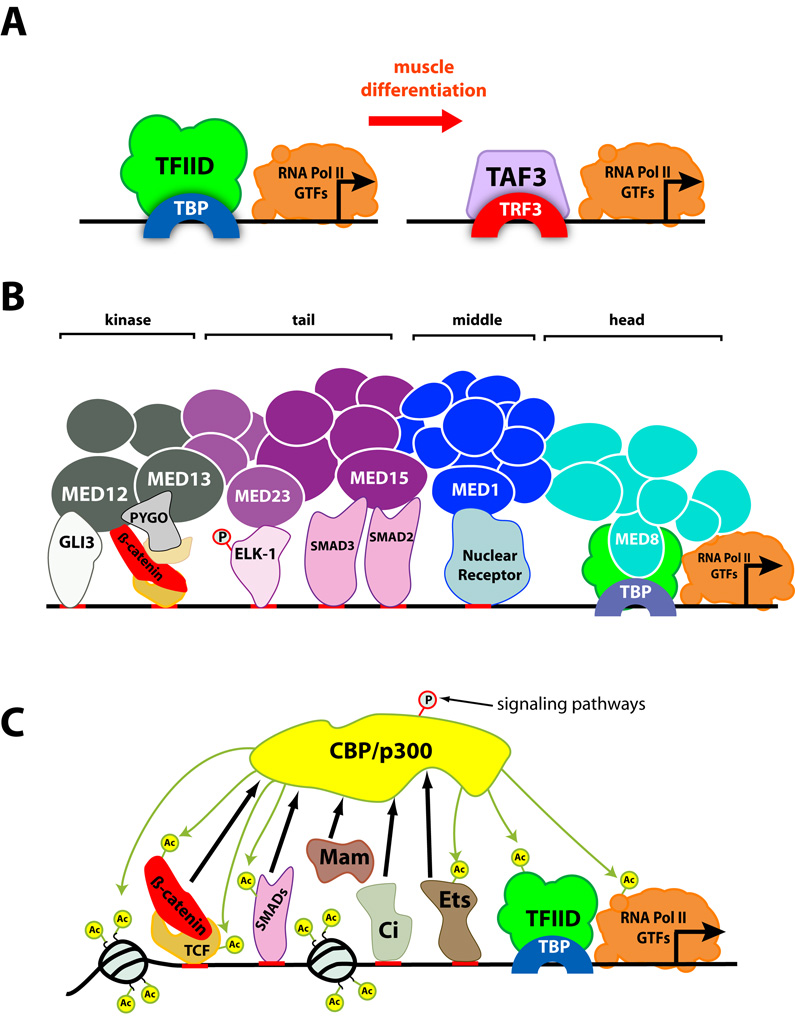
Tissue differentiation and signal transduction involve dramatic changes in gene expression. These changes can be brought about by the expression or activation of sequence-specific transcription factors. In order to regulate their target genes, such factors must navigate the intricate chromatin environment and engage the complex basal transcriptional machinery. We discuss three mechanisms through which signaling pathways can interact with complexes that alter chromatin structure or recruit RNA polymerase II. Signals that promote differentiation may alter the properties of such transcriptional regulatory complexes by incorporating tissue-specific subunits. Alternatively, adaptor subunits specialized to interact with specific transcription factors may allow a single complex to respond to multiple signals. Finally, individual regulatory proteins may integrate a variety of signals, allowing crosstalk between pathways.
Figures
References
-
- Li B, Carey M, Workman JL. The role of chromatin during transcription. Cell. 2007;128:707–719. - PubMed
-
- Naar AM, Lemon BD, Tjian R. Transcriptional coactivator complexes. Annu Rev Biochem. 2001;70:475–501. - PubMed
-
- Thomas MC, Chiang CM. The general transcription machinery and general cofactors. Crit Rev Biochem Mol Biol. 2006;41:105–178. - PubMed
-
- Reina JH, Hernandez N. On a roll for new TRF targets. Genes Dev. 2007;21:2855–2860. - PubMed
-
- Malik S, Roeder RG. Dynamic regulation of pol II transcription by the mammalian Mediator complex. Trends Biochem Sci. 2005;30:256–263. - PubMed
Publication types
MeSH terms
Substances
Grants and funding
LinkOut - more resources
Full Text Sources
