Comparative Study
. 2008 Aug 5;105(31):10693-8.
doi: 10.1073/pnas.0801184105. Epub 2008 Aug 4.

Y-chromosomal evidence of a pastoralist migration through Tanzania to southern Africa

Affiliations
Comparative Study

Y-chromosomal evidence of a pastoralist migration through Tanzania to southern Africa

Brenna M Henn et al. Proc Natl Acad Sci U S A. .

Abstract

Although geneticists have extensively debated the mode by which agriculture diffused from the Near East to Europe, they have not directly examined similar agropastoral diffusions in Africa. It is unclear, for example, whether early instances of sheep, cows, pottery, and other traits of the pastoralist package were transmitted to southern Africa by demic or cultural diffusion. Here, we report a newly discovered Y-chromosome-specific polymorphism that defines haplogroup E3b1f-M293. This polymorphism reveals the monophyletic relationship of the majority of haplotypes of a previously paraphyletic clade, E3b1-M35*, that is widespread in Africa and southern Europe. To elucidate the history of the E3b1f haplogroup, we analyzed this haplogroup in 13 populations from southern and eastern Africa. The geographic distribution of the E3b1f haplogroup, in association with the microsatellite diversity estimates for populations, is consistent with an expansion through Tanzania to southern-central Africa. The data suggest this dispersal was independent of the migration of Bantu-speaking peoples along a similar route. Instead, the phylogeography and microsatellite diversity of the E3b1f lineage correlate with the arrival of the pastoralist economy in southern Africa. Our Y-chromosomal evidence supports a demic diffusion model of pastoralism from eastern to southern Africa approximately 2,000 years ago.


Conflict of interest statement

The authors declare no conflict of interest.

Figures
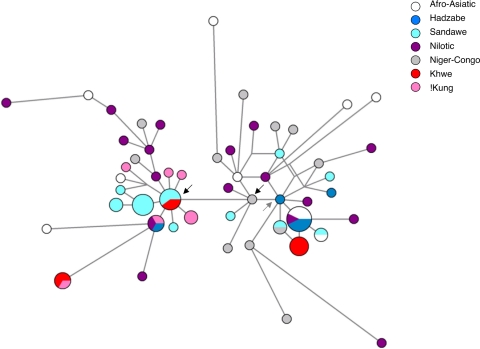
Fig. 1.
Fig. 1.
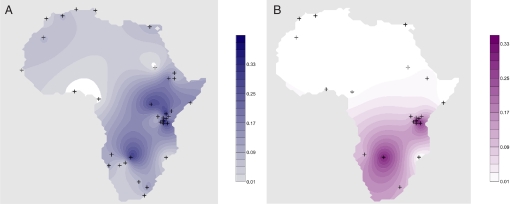
Median-joining network of 10-locus Y-STR haplotypes for E3b1f-M293 positive individuals. Network was generated using Network 4.1.1.1 (Fluxus Engineering). Black arrows indicate roots used for ρ estimates; gray arrow indicates the node giving a minimum ρ estimate for M293*. Networks were processed first by the reduced-median method, and then by the median-joining method (16, 42). DYSA7.2 was removed from the analyses due to an apparently high level of homoplasy. Networks were generated initially without weighting any of the STR loci; then the three most homoplastic mutations were down-weighted (by half) for the final network. Such weighting did not significantly change the structure of the network (data not shown). ε was set to zero. ρ estimates were converted to years using the average Y-STR mutation rate estimated in ref. .
Fig. 2.
Fig. 2.
Contour maps of the frequencies of E3b1-M35*(former) (A) and E3b1f-M293 (B) in Africa. Populations without M293 in B are based on unpublished data. The geographic distributions of M35*(former) and M293 frequencies across Africa were created using the Kringing method in Surfer 8 (Golden Software). Locations of populations in Table 1 are indicated by cross hatches. Because M35* is a paraphyletic haplogroup, the sharing of M35* does not indicate a close genetic relationship. Areas of high frequency are similar in the two maps as 90% of the M35*(former) samples are M293+. M293 is only found in sub-Saharan Africa, indicating a separate phylogenetic history for M35*(former) samples further north.

References

    1. Barbujani G, Bertorelle G. Genetics and the population history of Europe. Proc Natl Acad Sci USA. 2001;98:22–25. - PMC - PubMed
    1. Cavalli-Sforza LL, Menozzi P, Piazza A. Demic expansions and human evolution. Science. 1993;259:639–646. - PubMed
    1. Chikhi L, et al. Clines of nuclear DNA markers suggest a largely neolithic ancestry of the European gene pool. Proc Natl Acad Sci USA. 1998;95:9053–9058. - PMC - PubMed
    1. Richards M, et al. Tracing European founder lineages in the near eastern mtDNA pool. Am J Hum Genet. 2000;67:1251–1276. - PMC - PubMed
    1. Dupanloup I, Bertorelle G, Chikhi L, Barbujani G. Estimating the impact of prehistoric admixture on the genome of Europeans. Mol Biol Evol. 2004;21:1361–1372. - PubMed

Publication types

LinkOut - more resources