Crystallization of Spätzle, a cystine-knot protein involved in embryonic development and innate immunity in Drosophila melanogaster
- PMID: 18678937
- PMCID: PMC2494967
- DOI: 10.1107/S1744309108018812
Crystallization of Spätzle, a cystine-knot protein involved in embryonic development and innate immunity in Drosophila melanogaster
Abstract
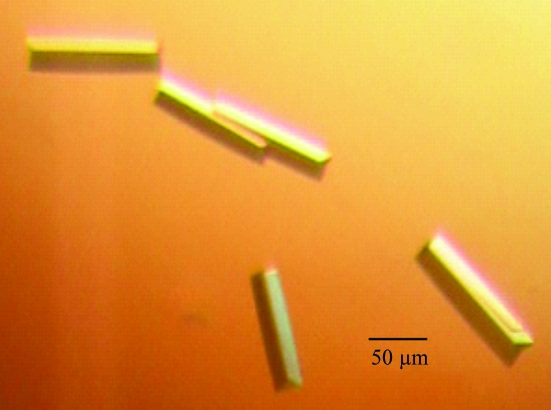
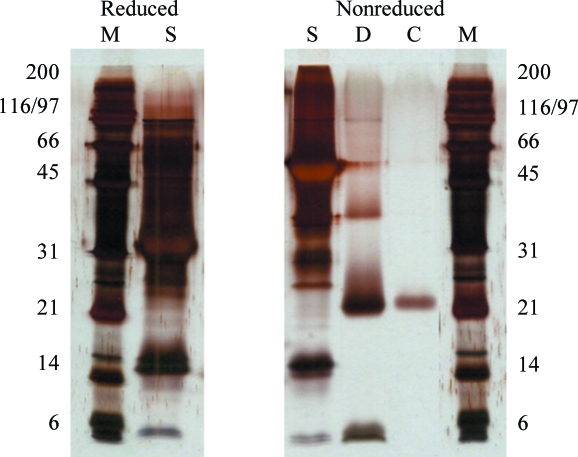
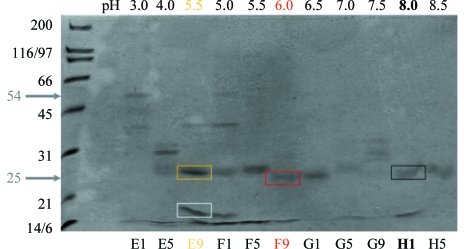
The Spätzle protein is involved in both the definition of the dorsal-ventral axis during embryonic development and in the adult innate immune response. The disulfide-linked dimeric cystine-knot protein has been expressed as a proprotein in inclusion bodies in Escherichia coli and refolded in vitro by rapid dilution. Initial orthorhombic crystals that diffracted to 7 A resolution were obtained after three months by the sitting-drop vapour-diffusion method. Optimization of the crystallization conditions resulted in orthorhombic crystals (space group P2(1)2(1)2(1), with unit-cell parameters a = 53.0, b = 59.2, c = 62.5 A) that diffracted to 2.8 A resolution in-house. The small volume of the asymmetric unit indicated that it was not possible for the crystals to contain the complete pro-Spätzle dimer. Mass spectrometry, N-terminal sequencing and Western-blot analysis revealed that the crystals contained the C-terminal disulfide-linked cystine-knot dimer. Comparison of various crystallization experiments indicated that degradation of the N-terminal prodomain was dependent on the buffer conditions.
Figures

References
-
- Bax, B., Blundell, T. L., Murray-Rust, J. & McDonald, N. Q. (1997). Structure, 5, 1275–1285. - PubMed
-
- DeLotto, Y. & DeLotto, R. (1998). Mech. Dev.72, 141–148. - PubMed
-
- He, X. L. & Garcia, K. C. (2004). Science, 304, 870–875. - PubMed
-
- Hoffmann, A., Funkner, A., Neumann, P., Walther, M., Weininger, U., Schierhorn, A., Balbach, J., Reuter, G. & Stubbs, M. T. (2008). Submitted. - PubMed
Publication types
MeSH terms
Substances
LinkOut - more resources
Full Text Sources
Molecular Biology Databases