


Sexuality and sexual function in long-term survivors of cervical cancer
- PMID: 18681816
- PMCID: PMC2942787
- DOI: 10.1089/jwh.2007.0613
Sexuality and sexual function in long-term survivors of cervical cancer
Abstract
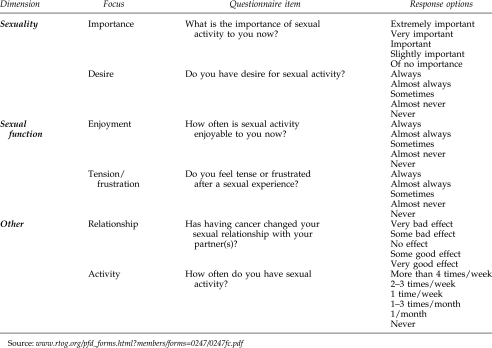
Objectives: The study reported here assesses sexuality and sexual functioning among women treated for invasive cervical cancer over broad portions of the life cycle. Hysterectomy and oophorectomy, two widespread interventions in invasive cervical cancer, have potentially important effects on a woman's self-image and sexuality.
Methods: The investigation focused on women aged 29-69 with histories of invasive cervical cancer (n = 179) from the Connecticut Tumor Registry, 6-29 years postdiagnosis. Logistic regression analysis was used to assess the relative impact of time since cervical cancer diagnosis and treatment received, adjusting for age and social and economic background. Sexuality, sexual function, and potential correlates were assessed using the Sexual Adjustment Scale, the MOS-36, and the Center for Epidemiological Studies-Depression Scale (CES-D).
Results: Strong majorities of women in the study indicated that they were sexually active (81.1%) and both desired (81.4%) and enjoyed (90.9%) sexual activity. Neither time since cervical cancer diagnosis nor age significantly affected sexuality or sexual function. Women with hysterectomies (with or without oophorectomy) less often reported lack of interest in (odds ratio [OR] 0.36, p < 0.05) and lack of desire for (OR 0.26, p < 0.05) sexual activity than women who had not had hysterectomies. Among women with hysterectomies, those with oophorectomies had a greater risk (OR 21.1, p < 0.05) of not enjoying sex but did not differ otherwise from those without oophorectomies.
Conclusions: These findings suggest that cervical cancer survivors generally have a positive attitude toward sexuality and engage in satisfying sexual activity.
Figures
References
-
- American Cancer Society. Cancer facts and figures 2007. Atlanta: American Cancer Society; 2007.
-
- Ries LAG, editor; Eisner MP, editor; Kosary CL, et al., editors. SEER cancer statistics review, 1975–2001. Bethesda, MD: National Cancer Institute; 2004.
-
- Davis RM. Cullin JW. Miller LS. Titus M. Physical rehabilitation. In: Haskell C, editor. Cancer treatment. Philadelphia: W.B. Saunders; 1986. pp. 940–945.
-
- Dobkin PL. Morrow GR. Long-term side effects in patients who have been treated successfully for cancer. J Psychosoc Oncol. 1986;3:23–51.
-
- Poplack DG. Brouwers P. Late CNS sequelae in long-term survivors of childhood leukemia. Proceedings of the fifth national conference on human values and cancer—1987; Atlanta. American Cancer Society; 1987. pp. 35–41.
Publication types
MeSH terms
Grants and funding
LinkOut - more resources
Full Text Sources
Medical
