


Evolutionarily conserved function of a viral microRNA
- PMID: 18684810
- PMCID: PMC2566259
- DOI: 10.1128/JVI.01144-08
Evolutionarily conserved function of a viral microRNA
Abstract
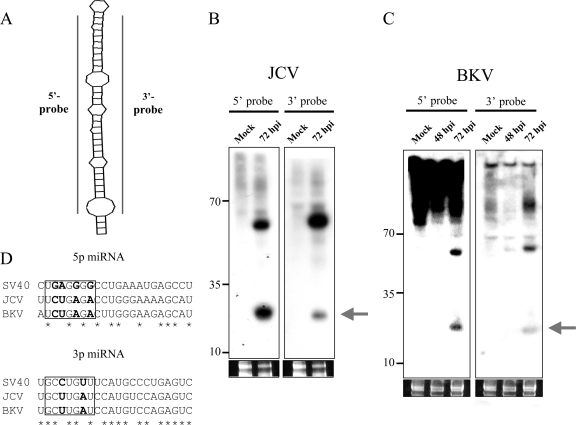
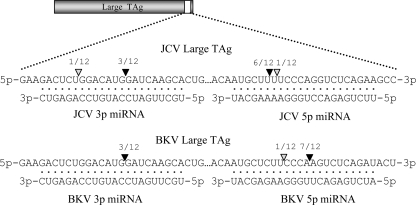
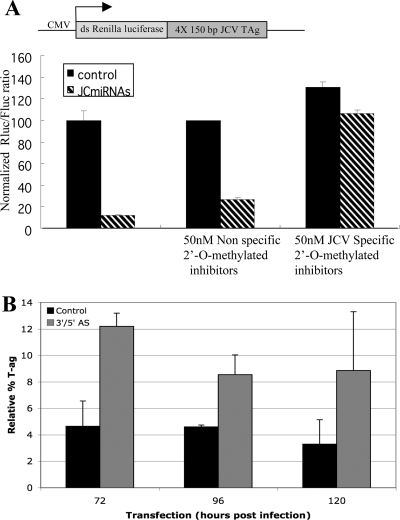
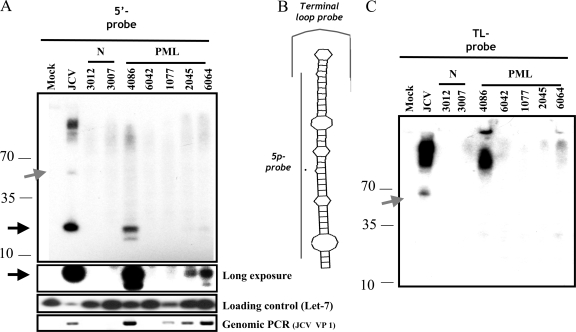
MicroRNAs (miRNAs) are potent RNA regulators of gene expression. Some viruses encode miRNAs, most of unknown function. The majority of viral miRNAs are not conserved, and whether any have conserved functions remains unclear. Here, we report that two human polyomaviruses associated with serious disease in immunocompromised individuals, JC virus and BK virus, encode miRNAs with the same function as that of the monkey polyomavirus simian virus 40 miRNAs. These miRNAs are expressed late during infection to autoregulate early gene expression. We show that the miRNAs generated from both arms of the pre-miRNA hairpin are active at directing the cleavage of the early mRNAs. This finding suggests that despite multiple differences in the miRNA seed regions, the primary target (the early mRNAs) and function (the downregulation of early gene expression) are evolutionarily conserved among the primate polyomavirus-encoded miRNAs. Furthermore, we show that these miRNAs are expressed in individuals diagnosed with polyomavirus-associated disease, suggesting their potential as targets for therapeutic intervention.
Figures
References
-
- Bartel, D. P. 2004. MicroRNAs: genomics, biogenesis, mechanism, and function. Cell 116281-297. - PubMed
-
- Berger, J. R. 2007. Progressive multifocal leukoencephalopathy. Curr. Neurol. Neurosci. Rep. 7461-469. - PubMed
-
- Cullen, B. R. 2006. Viruses and microRNAs: is RNA interference involved in intrinsic antiviral immunity in mammals? Nat. Genet. 38(Suppl.)S25-S30. - PubMed
-
- Filipowicz, W., S. N. Bhattacharyya, and N. Sonenberg. 2008. Mechanisms of post-transcriptional regulation by microRNAs: are the answers in sight? Nat. Rev. Genet. 9102-114. - PubMed
Publication types
MeSH terms
Substances
Grants and funding
LinkOut - more resources
Full Text Sources
Other Literature Sources
Research Materials
