. 2008 Aug 12;105(32):11093-8.
doi: 10.1073/pnas.0804159105. Epub 2008 Aug 6.

The oldest Asian record of Anthropoidea

Affiliations

The oldest Asian record of Anthropoidea

Sunil Bajpai et al. Proc Natl Acad Sci U S A. .

Abstract

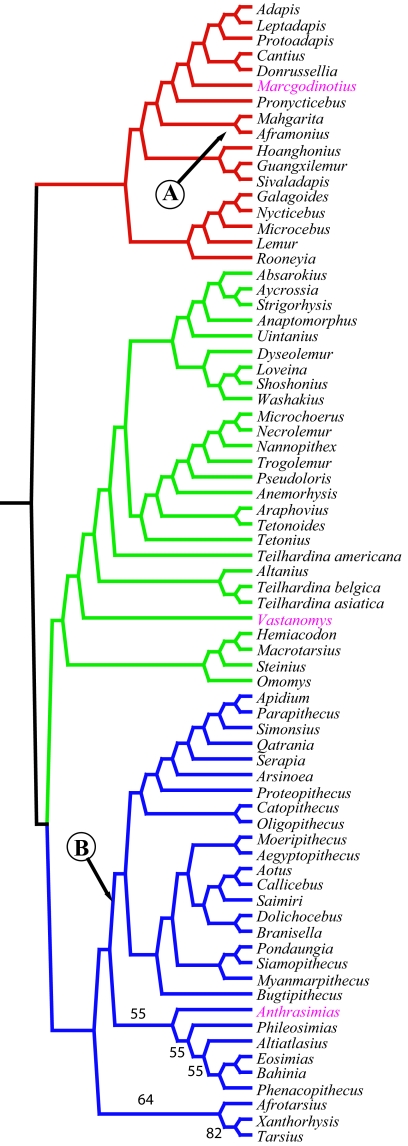
Undisputed anthropoids appear in the fossil record of Africa and Asia by the middle Eocene, about 45 Ma. Here, we report the discovery of an early Eocene eosimiid anthropoid primate from India, named Anthrasimias, that extends the Asian fossil record of anthropoids by 9-10 million years. A phylogenetic analysis of 75 taxa and 343 characters of the skull, postcranium, and dentition of Anthrasimias and living and fossil primates indicates the basal placement of Anthrasimias among eosimiids, confirms the anthropoid status of Eosimiidae, and suggests that crown haplorhines (tarsiers and monkeys) are the sister clade of Omomyoidea of the Eocene, not nested within an omomyoid clade. Co-occurence of Anthropoidea, Omomyoidea, and Adapoidea makes it evident that peninsular India was an important center for the diversification of primates of modern aspect (euprimates) in the early Eocene. Adaptive reconstructions indicate that early anthropoids were mouse-lemur-sized ( approximately 75 grams) and consumed a mixed diet of fruit and insects. Eosimiids bear little adaptive resemblance to later Eocene-early Oligocene African Anthropoidea.


Conflict of interest statement

The authors declare no conflict of interest.

Figures
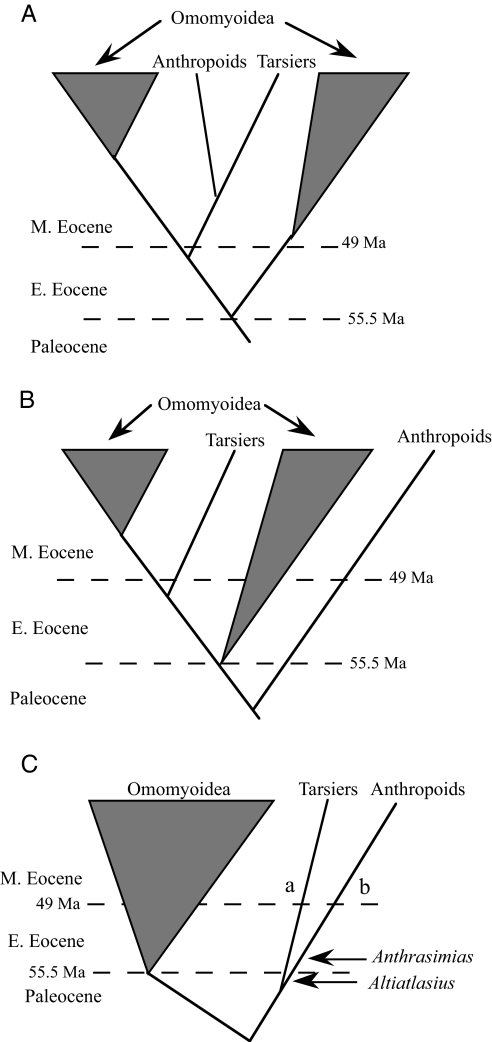
Fig. 1.
Fig. 1.
Schematic representations of three hypotheses about anthropoid and tarsier origins. (A) Anthropoids and tarsiers share a common ancestor within a paraphyletic Omomyoidea. (B) Tarsiers arose from an omomyoid while anthropoids are sister to omomyoids. (C) The tarsier-anthropoid clade is the sister group of omomyoids. References to these views are in the text. Constraints on the branch times of the groups depicted in these schemes are approximate and based on the first appearance of (i) Omomyoidea [earliest Eocene (40)], (ii) Tarsiidae [middle Eocene (41)] or the omomyoid Shoshonius, its proposed sister taxon (22), and (iii) middle Eocene or earlier anthropoids, depending on the assumptions of various authors. Dashed lines represent the dates of the Paleocene-Eocene and early Eocene-middle Eocene boundaries (42). Temporal position of Altiatlasius and Anthrasimias are indicated. a, first appearance of Tarsiidae in Asia; b, hitherto first appearance on eosimiid anthropoids in Asia.
Fig. 2.
Fig. 2.
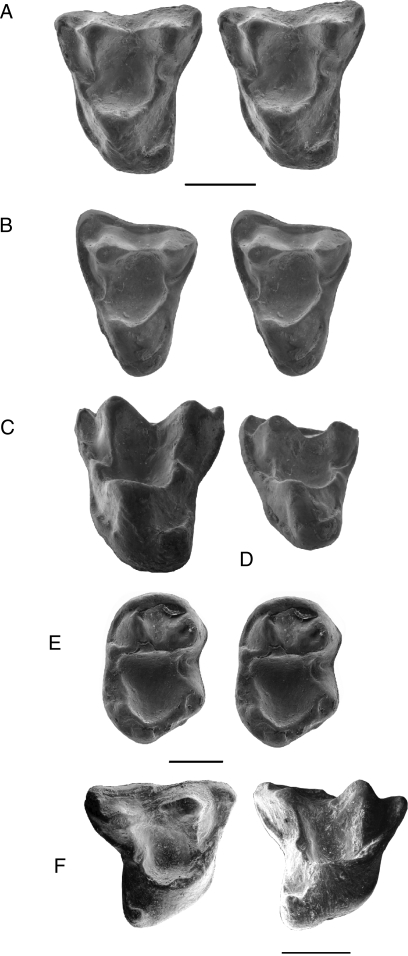
The dentition of Anthrasimias gujaratensis sp. nov. (A) Occlusal stereopair of IITR/SB/VLM 1137, a left upper first molar. (B) Occlusal stereopair of IITR/SB/VLM 1100, a left upper second molar. (C) Lingual view of IITR/SB/VLM 1137. (D) Lingual view of IITR/SB/VLM 1100. (E) Occlusal stereopair of IITR/SB/VLM 1017, a right lower third molar. (F) occlusal and occluso-lingual view of IITR/SB/VLM 1201, a right dP4. (Scale bars, 1 mm.)
Fig. 3.
Fig. 3.
The 50% majority consensus of 11 equally parsimonious trees. Tree length, 148,887; consistency index (CI), 0.230; retention index (RI), 0.554; rescaled CI (RCI), 0.127. Red, Adapoidea; green; Omomyoidea; blue, crown Haplorhini. Branching sequences are supported in 100% of the trees unless indicated by a percentage. Suratius and Asiadapis are not included on the tree. Circled letter A indicates branch placement of Asiadapis when it is run without Suratius included. Circled letter B indicates branch placement of Suratius when Asiadapis is not included. When Suratius and Asiadapis are run together, they are placed together at branch B. The list of characters and their states and character-taxon matrix is provided in supporting information (SI) Text, Figs. S1–S3, and SI Appendices 1 and 2.
Fig. 4.
Fig. 4.
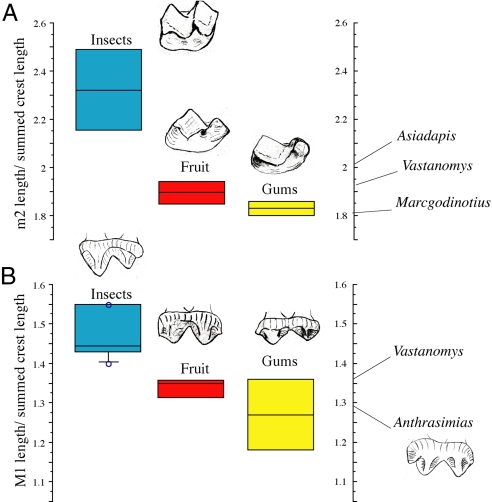
Measurements of shearing crest development on the molar teeth of Vastan primates. (A) Ratio of second lower molar length to summed lengths of six principal M2 shearing crests. (B) Ratio of first upper molar length to summed lengths of four principal buccal shearing crests. Color-coded bars (blue, insects; red, fruit; yellow, gums) indicate principal dietary item (34). Asiadapis, Vastanomys, and Marcgodinotius fall within the range of extant prosimian fruit and gum eaters such as the extant mouse lemur Microcebus, which also eats a substantial amount of insects (Table 2).

References

    1. Miller ER, Gunnell GF, Martin RD. Deep time and the search for anthropoid origins. Yearb Phys Anthropol. 2005;48:60–95. - PubMed
    1. Cartmill M, Kay RF. In: Recent Advances in Primatology: Evolution. Chivers DJ, Joysey KA, editors. London: Academic; 1978. pp. 205–214.
    1. Beard KC, Wang J. The eosimiid primates (Anthropoidea) of the Heti Formation, Yuanqu Basin, Shanxi and Henan Provinces, People's Republic of China. J Hum Evol. 2004;46:401–432. - PubMed
    1. Bajpai S, Kapur VV, Das DP, Tiwari BN. New early Eocene primate (Mammalia) from Vastan Lignite Mine, District Surat (Gujarat), western India. J Paleontol Soc India. 2007;52:231–234.
    1. Bajpai S, et al. Early Eocene primates from Vastan lignite mine, Gujarat, western India. J Paleontol Soc India. 2005;50:43–54.

Publication types

LinkOut - more resources