. 2008 Aug 12;105(32):11340-5.
doi: 10.1073/pnas.0805258105. Epub 2008 Aug 6.

Architecture and inherent robustness of a bacterial cell-cycle control system

Affiliations

Architecture and inherent robustness of a bacterial cell-cycle control system

Xiling Shen et al. Proc Natl Acad Sci U S A. .

Abstract

A closed-loop control system drives progression of the coupled stalked and swarmer cell cycles of the bacterium Caulobacter crescentus in a near-mechanical step-like fashion. The cell-cycle control has a cyclical genetic circuit composed of four regulatory proteins with tight coupling to processive chromosome replication and cell division subsystems. We report a hybrid simulation of the coupled cell-cycle control system, including asymmetric cell division and responses to external starvation signals, that replicates mRNA and protein concentration patterns and is consistent with observed mutant phenotypes. An asynchronous sequential digital circuit model equivalent to the validated simulation model was created. Formal model-checking analysis of the digital circuit showed that the cell-cycle control is robust to intrinsic stochastic variations in reaction rates and nutrient supply, and that it reliably stops and restarts to accommodate nutrient starvation. Model checking also showed that mechanisms involving methylation-state changes in regulatory promoter regions during DNA replication increase the robustness of the cell-cycle control. The hybrid cell-cycle simulation implementation is inherently extensible and provides a promising approach for development of whole-cell behavioral models that can replicate the observed functionality of the cell and its responses to changing environmental conditions.


Conflict of interest statement

The authors declare no conflict of interest.

Figures
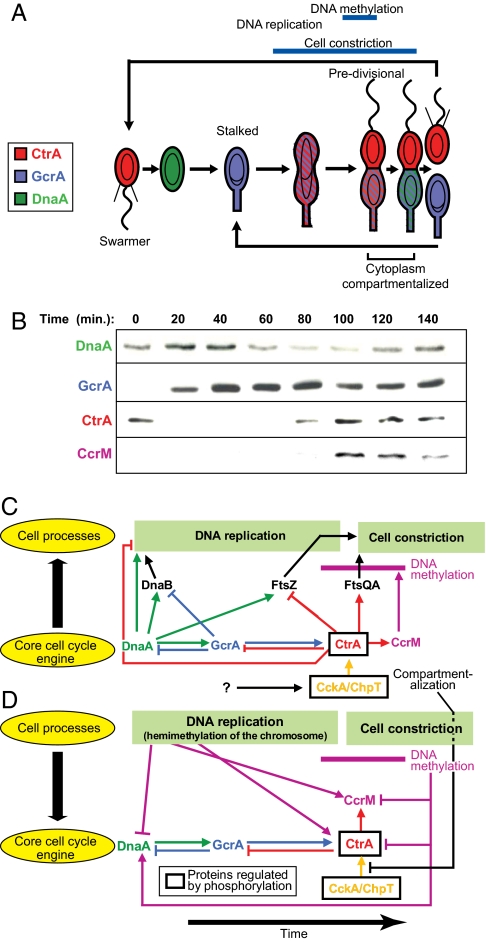
Fig. 1.
Fig. 1.
Genetic circuit that drives cell-cycle progression. (A) Schematic of the C. crescentus cell cycle showing changes in master regulatory protein concentrations that control activation of numerous modular functions that implement the cell cycle. Predivisional cells are compartmentalized ≈20 min before cell separation (6). (B) Western blots showing concentrations of the master regulatory proteins during the cell cycle (8, 26). (C) Schematic of protein interactions that create the cyclical core engine and the regulatory connections from the core engine to the processive DNA replication and cell constriction functions. Events are positioned to indicate their approximate timing. (D) Signals returning from the controlled subsystems synchronize the core engine with the state of cell-cycle progression. The interval of DNA methylation is indicated in C and D by the horizontal purple bar. All of the pathways indicated in C and D are included in the cell-cycle control model.
Fig. 2.
Fig. 2.
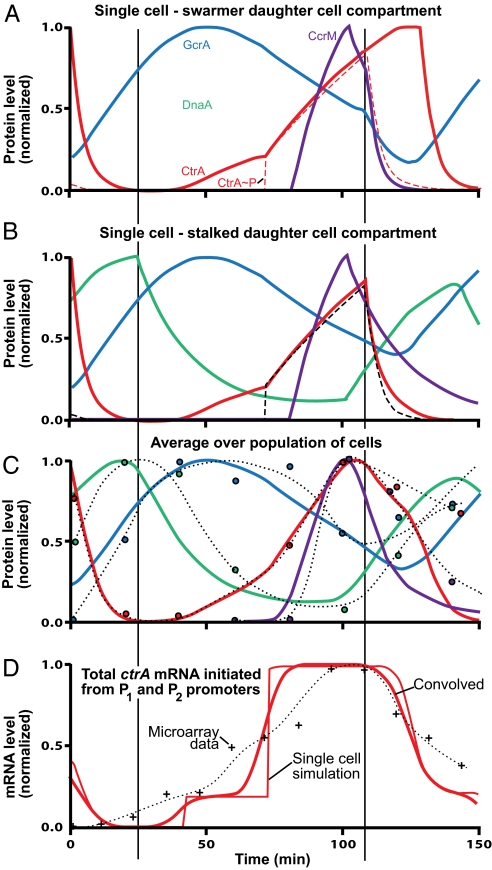
Simulation of protein levels (normalized) during cell-cycle progression. A and B show predicted (normalized) levels of the master regulatory proteins (Fig. 1) tracked into the swarmer and stalked cell compartments, respectively, at the single-cell level. After inner membrane compartmentalization at ≈117 min, protein concentration levels diverge in the stalked and swarmer daughter cell compartments. (C) Circles: observed protein levels in synchronized cells (quantified Western blots, Fig. 1B). (The dotted lines are continuous approximations of the experimental levels.) Curves: simulated protein levels made comparable with experimental observations by averaging results in A and B and convolving with a Gaussian distribution to approximate random variation around an average in different cell's progression through the cell cycle. The errors in the experimental values are approximately ±10% of the peak value. Loss of synchrony degrades experimental data in predivisional cell. (D) +, observed ctrA mRNA levels from Affymetrix microarray assays (20).
Fig. 3.
Fig. 3.
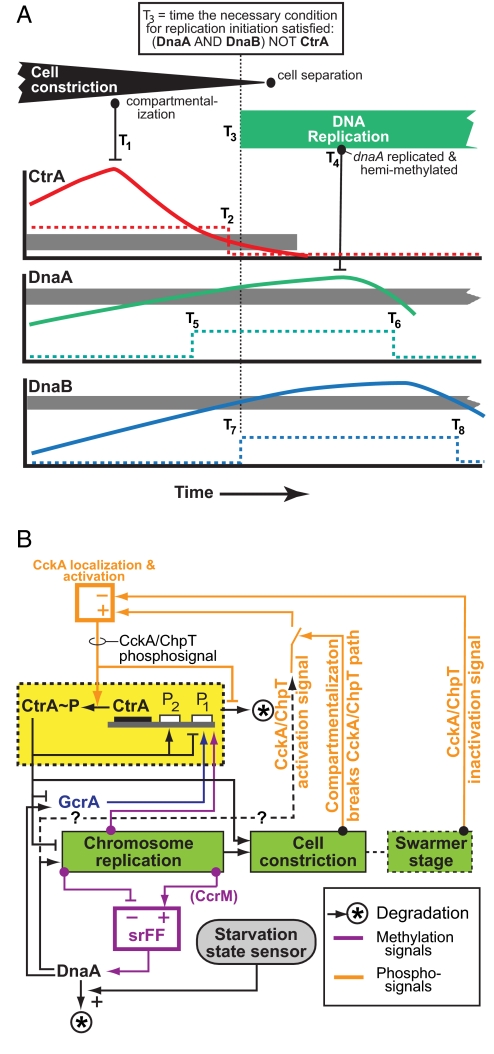
Logic circuit of Caulobacter cell cycle control system. (A) Stalked cell-cycle events affecting control circuit operation in the interval around cell separation. Graphs show protein concentration patterns. Gray bands: “threshold” ranges relating to initiation of DNA replication. [CtrA] above the band represses initiation; below, it does not. The dotted CtrA line illustrates the binary signal abstraction used in the robustness analysis. Thus, T2 approximates the time when [CtrA] transitions from repressing to not-repressing initiation. Other Tis are times of other events. The robustness analysis examined the effect of all patterns of Ti orderings on cell-cycle control. (B) Logical diagram of cell-cycle control system operations. Green rectangles: Serially ordered processive subsystems. Yellow box: cyclical synthesis and destruction of CtrA∼P that is a central element of the circuit. Orange pathways: CckA/ChpT phosphosignal pathways differentially controlled in swarmer and stalked cell compartments that play an essential role in both enabling resynthesis of CtrA∼P when the signal is active and triggering CtrA∼P destruction when it is inactive. Purple: DNA methylation-state based control of DnaA synthesis that creates a logical component functionally similar to a electrical set-reset flipflop (srFF) circuit (8). Carbon or nitrogen starvation halts cell-cycle progression by accelerating DnaA proteolysis (27).

References

    1. Laub MT, Shapiro L, McAdams HH. Systems biology of Caulobacter. Annu Rev Genet. 2007;41:429–441. - PubMed
    1. Chen JC, Stephens C. Bacterial cell cycle: Completing the circuit. Curr Biol. 2007;17:R203–R206. - PubMed
    1. McAdams HH, Shapiro L. A bacterial cell-cycle regulatory network operating in time and space. Science. 2003;301:1874–1877. - PubMed
    1. McGrath PT, Viollier P, McAdams HH. Setting the pace: Mechanisms tying Caulobacter cell-cycle progression to macroscopic cellular events. Curr Opin Microbiol. 2004;7:192–197. - PubMed
    1. Biondi EG, et al. Regulation of the bacterial cell cycle by an integrated genetic circuit. Nature. 3006;444:899–904. - PubMed

Publication types

MeSH terms

LinkOut - more resources