. 2008 Dec;149(12):6065-75.
doi: 10.1210/en.2008-0687. Epub 2008 Aug 7.

Mechanical strain inhibits adipogenesis in mesenchymal stem cells by stimulating a durable beta-catenin signal

Affiliations

Mechanical strain inhibits adipogenesis in mesenchymal stem cells by stimulating a durable beta-catenin signal

Buer Sen et al. Endocrinology. 2008 Dec.

Abstract

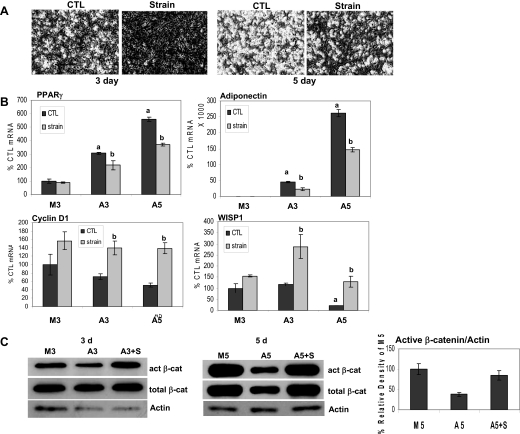
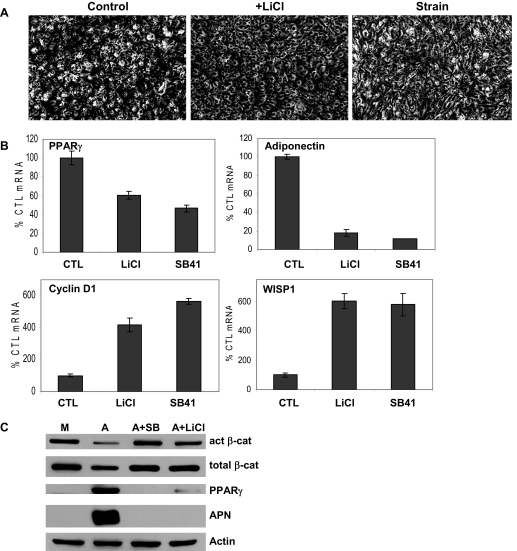
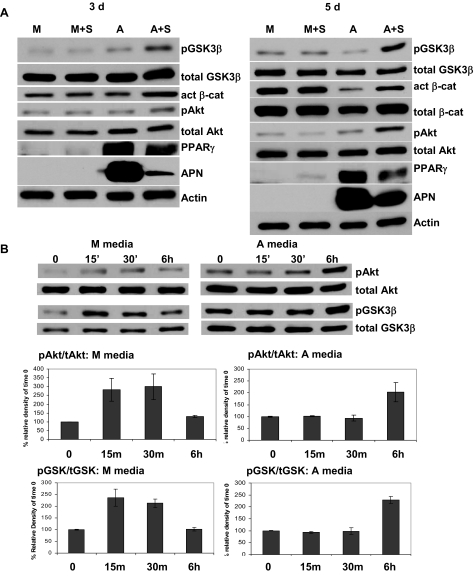
The ability of exercise to decrease fat mass and increase bone mass may occur through mechanical biasing of mesenchymal stem cells (MSCs) away from adipogenesis and toward osteoblastogenesis. C3H10T1/2 MSCs cultured in highly adipogenic medium express peroxisome proliferator-activated receptor gamma and adiponectin mRNA and protein, and accumulate intracellular lipid. Mechanical strain applied for 6 h daily inhibited expression of peroxisome proliferator-activated receptor gamma and adiponectin mRNA by up to 35 and 50%, respectively, after 5 d. A decrease in active and total beta-catenin levels during adipogenic differentiation was entirely prevented by daily application of mechanical strain; furthermore, strain induced beta-catenin nuclear translocation. Inhibition of glycogen synthase kinase-3beta by lithium chloride or SB415286 also prevented adipogenesis, suggesting that preservation of beta-catenin levels was important to strain inhibition of adipogenesis. Indeed, mechanical strain inactivated glycogen synthase kinase-3beta, which was preceded by Akt activation, indicating that strain transmits antiadipogenic signals through this pathway. Cells grown under adipogenic conditions showed no increase in osteogenic markers runt-related transcription factor (Runx) 2 and osterix (Osx); subsequent addition of bone morphogenetic protein 2 for 2 d increased Runx2 but not Osx expression in unstrained cultures. When cultures were strained for 5 d before bone morphogenetic protein 2 addition, Runx2 mRNA increased more than in unstrained cultures, and Osx expression more than doubled. As such, mechanical strain enhanced MSC potential to enter the osteoblast lineage despite exposure to adipogenic conditions. Our results indicate that MSC commitment to adipogenesis can be suppressed by mechanical signals, allowing other signals to promote osteoblastogenesis. These data suggest that positive effects of exercise on both fat and bone may occur during mesenchymal lineage selection.


Figures
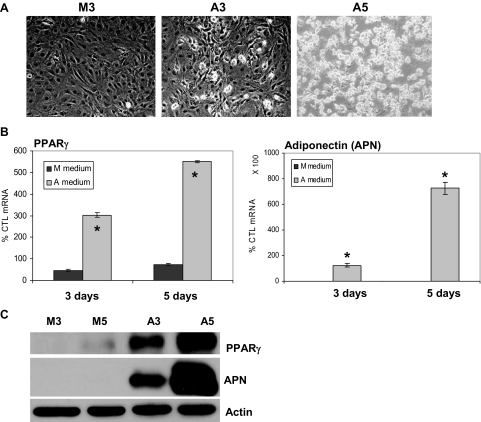
Figure 1
Figure 1
A medium induces rapid adipogenesis of C3H10T1/2 cells. C3H10T1/2 cells were seeded in six-well BioFlex Collagen-I coated plates (100,000 cells per well) in MEMα and cultured in M or A medium for 3 or 5 d. A, Cytoplasmic triglyceride droplets appeared at 3 d under adipogenic conditions, shown at ×40. B, Real-time RT-PCR was performed for PPARγ and adiponectin. mRNA is represented as a percent mRNA level measured in MEMα at d 0 (100%). *, P < 0.001 difference between M and A media on the same day. C, Immunoblot for PPARγ and adiponectin and actin: lanes refer to cells grown in M or A conditions for 3 or 5 d. CTL, Control.
Figure 2
Figure 2
Mechanical loading inhibits adipogenesis and prevents a fall in β-catenin (β-cat). Strain was applied to cells in M or A medium for 3 or 5 d. Panel A, Cytoplasmic triglyceride droplets appeared by 3 d in unstrained cells and continued to increase; strain inhibited this accumulation (magnification, ×40). Panel B, Real-time RT-PCRs performed for PPARγ, adiponectin, cyclin D1, and WISP1 on cells ± strain as indicated. ANOVA: a, Significant difference from M3 unstrained control (CTL) (100%) (P < 0.001); b, significant difference between unstrained and strained condition (P < 0.05). Panel C, Cellular proteins extracted from cells ± strain for the indicated times and analyzed by Western blotting for active (act) and total β-catenin, and actin (loading control). Densitometry compiled from three separate 5-d experiments shows that effects on active β-catenin were significant. A3 or A5, A medium with +S referring to the strained condition at either 3 or 5 d; M3, M medium for 3-d culture.
Figure 3
Figure 3
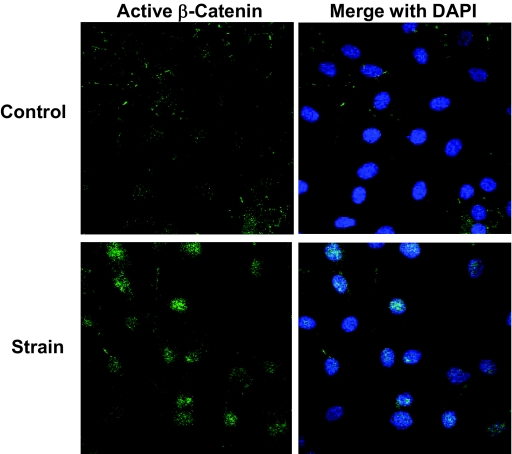
Active β-catenin is increased in strained cultures. Cells ± strain applied daily for 3 d in A medium were immunostained for DAPI and active β-catenin. DAPI nuclear images were merged with active β-catenin in the right of the figure, and showed that strain causes elevation of active β-catenin and its appearance in the nucleus.
Figure 4
Figure 4
Inhibition of GSK3β mimics effects of strain. Inhibitors of GSK3 were added to cells cultured in A medium for 3 d. A, Cytoplasmic triglyceride droplets are shown with bright-field microscopy and compared with effect of strain (magnification, ×40). B, Real-time RT-PCR for mRNA species as noted showed effects of 3 d treatment with LiCl (10 mm) or the GSK3 inhibitor SB415286 (SB41, 20 μm). C, Western blotting of total cellular proteins showed that inhibition of GSK3 prevented events associated with adipogenesis. Act, Active; APN, adiponectin; cat, catenin; CTL, control.
Figure 5
Figure 5
Strain inactivates GSK3β. Cultures in M medium without strain (M) or A medium ± mechanical strain are shown after 3 (left) or 5 d (right). A, Total cellular proteins were blotted with antibodies for phospho-Akt (Ser473, pAkt), phospho-GSK3β (Ser9, pGSK3β), active (act) β-catenin (cat), PPARγ, adiponectin (APN), and actin (loading control). M+S, +strain; likewise A+S. B, On d 3, cells in either M or A medium were strained for 1, 15, and 30 min, or 6 h, and protein was extracted immediately for Western analysis. Below, Graphs show average densitometry from three experiments: both pAkt and pGSK3β increased with strain at 15 and 30 min in M medium but not until 6 h in A medium (P < 0.05).
Figure 6
Figure 6
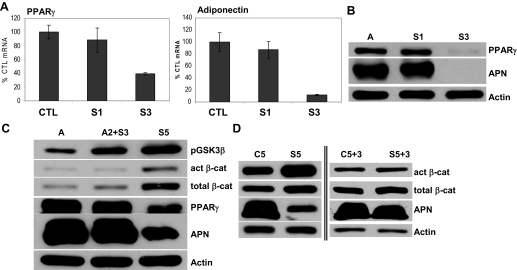
Mechanical inhibition of adipogenesis requires application early and repetitively. A, Strain was begun on the first day of adipogenic stimulus, and either dosed for 1 (S1) or 3 d (S3); mRNA for PPARγ and adiponectin (APN) was analyzed after 3 d in the A medium. Only the S3 condition inhibited adipocytic mRNA (P < 0.05). B, PPARγ and adiponectin protein from 3-d cultures in A medium: S1, Cells strained first day only; S3, strain each day of culture. C, Strain application was delayed for 2 d (A2+S3) or applied daily (S5) and protein analyzed at 5 d. D, Western blotting of total cellular protein of cells cultured in A medium ± strain for 5 d shows expected strain effects (left side of blot); culture for a further 3 d without strain shows equilibration between proteins studied in the two culture conditions (right side of blot). Act, Active; cat, catenin; CTL, control.
Figure 7
Figure 7
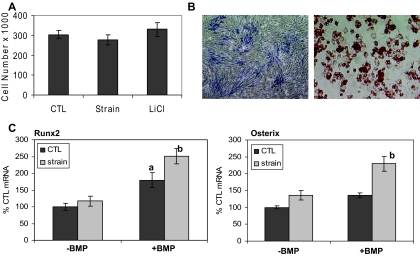
Strain preserves MSCs in a multipotential state. A, Cell number compiled from three separate experiments showed no differences between culture conditions. B, MSCs in M medium stained for alkaline phosphatase by 14 d. Shown in the right panel are cells cultured in the A medium at 5 d stained for oil red O as expected for cells containing lipid. Both are shown at ×40. C, Real-time RT-PCR was performed on cells cultured in A medium × 5 d ± strain (strained groups are shown in gray) and then switched to M ± BMP-2 (300 ng/ml) × 2 d (ANOVA). a, Difference from control (CTL)unstrained (100%) (P < 0.001); b, difference from all other conditions (P < 0.05).

References

    1. Beresford JN 1989 Osteogenic stem cells and the stromal system of bone and marrow. Clin Orthop Relat Res 240:270–280 - PubMed
    1. Pittenger MF, Mackay AM, Beck SC, Jaiswal RK, Douglas R, Mosca JD, Moorman MA, Simonetti, DW, Craig S, Marshak DR 1999 Multilineage potential of adult human mesenchymal stem cells. Science 284:143–147 - PubMed
    1. Park SR, Oreffo RO, Triffitt JT 1999 Interconversion potential of cloned human marrow adipocytes in vitro. Bone 24:549–554 - PubMed
    1. Di Iorgi N, Rosol M, Mittelman SD, Gilsanz V 2008 Reciprocal relation between marrow adiposity and the amount of bone in the axial and appendicular skeleton of young adults. J Clin Endocrinol Metab 93:2281–2286 - PMC - PubMed
    1. Meunier P, Courpron P, Edouard C, Bernard J, Bringuier J, Vignon G 1973 Physiological senile involution and pathological rarefaction of bone. Quantitative and comparative histological data. Clin Endocrinol Metab 2:239–256 - PubMed

Publication types

MeSH terms