


Mechanical strain inhibits adipogenesis in mesenchymal stem cells by stimulating a durable beta-catenin signal
- PMID: 18687779
- PMCID: PMC2613068
- DOI: 10.1210/en.2008-0687
Mechanical strain inhibits adipogenesis in mesenchymal stem cells by stimulating a durable beta-catenin signal
Abstract
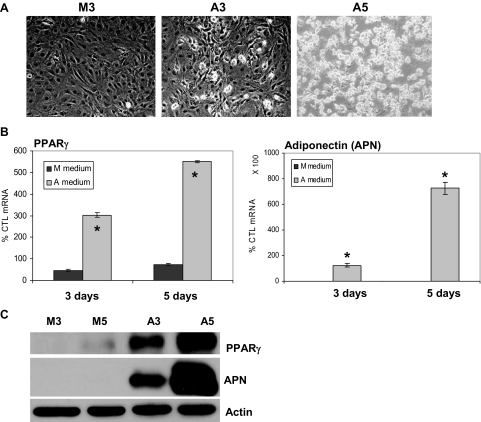
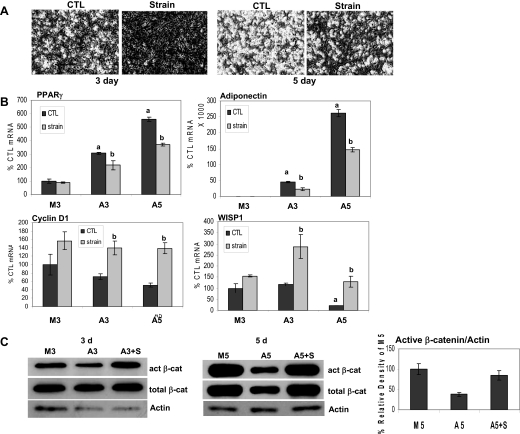
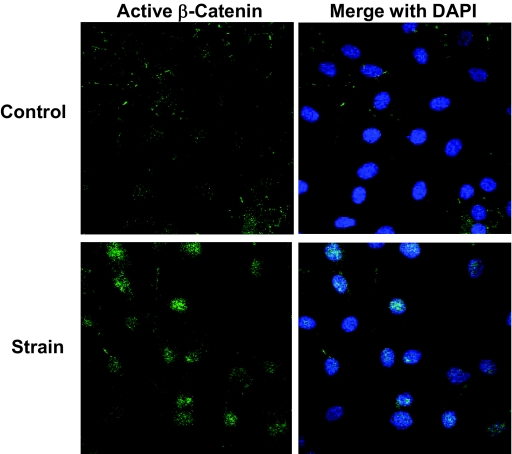
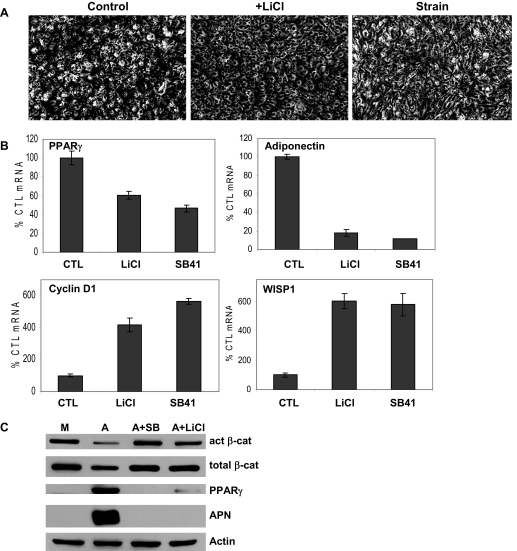
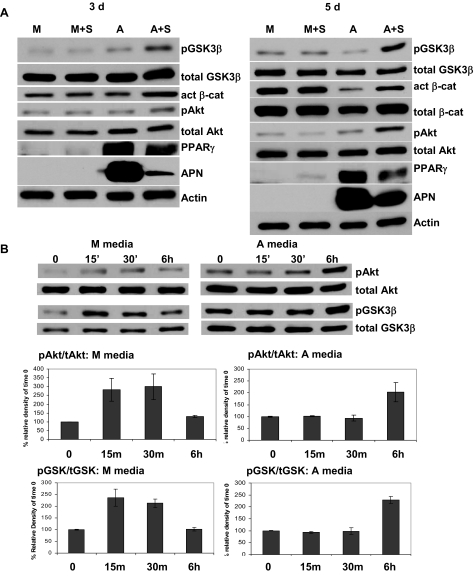
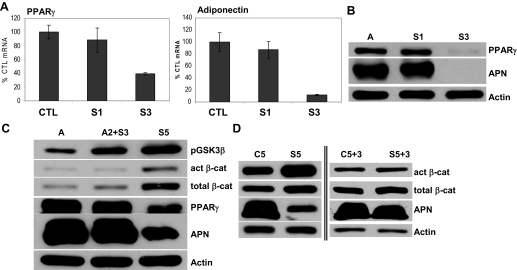
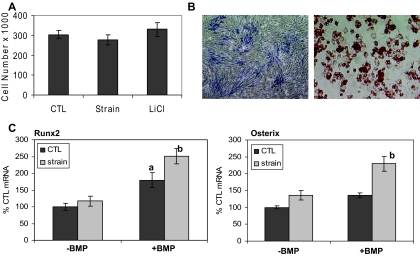
The ability of exercise to decrease fat mass and increase bone mass may occur through mechanical biasing of mesenchymal stem cells (MSCs) away from adipogenesis and toward osteoblastogenesis. C3H10T1/2 MSCs cultured in highly adipogenic medium express peroxisome proliferator-activated receptor gamma and adiponectin mRNA and protein, and accumulate intracellular lipid. Mechanical strain applied for 6 h daily inhibited expression of peroxisome proliferator-activated receptor gamma and adiponectin mRNA by up to 35 and 50%, respectively, after 5 d. A decrease in active and total beta-catenin levels during adipogenic differentiation was entirely prevented by daily application of mechanical strain; furthermore, strain induced beta-catenin nuclear translocation. Inhibition of glycogen synthase kinase-3beta by lithium chloride or SB415286 also prevented adipogenesis, suggesting that preservation of beta-catenin levels was important to strain inhibition of adipogenesis. Indeed, mechanical strain inactivated glycogen synthase kinase-3beta, which was preceded by Akt activation, indicating that strain transmits antiadipogenic signals through this pathway. Cells grown under adipogenic conditions showed no increase in osteogenic markers runt-related transcription factor (Runx) 2 and osterix (Osx); subsequent addition of bone morphogenetic protein 2 for 2 d increased Runx2 but not Osx expression in unstrained cultures. When cultures were strained for 5 d before bone morphogenetic protein 2 addition, Runx2 mRNA increased more than in unstrained cultures, and Osx expression more than doubled. As such, mechanical strain enhanced MSC potential to enter the osteoblast lineage despite exposure to adipogenic conditions. Our results indicate that MSC commitment to adipogenesis can be suppressed by mechanical signals, allowing other signals to promote osteoblastogenesis. These data suggest that positive effects of exercise on both fat and bone may occur during mesenchymal lineage selection.
Figures
References
-
- Beresford JN 1989 Osteogenic stem cells and the stromal system of bone and marrow. Clin Orthop Relat Res 240:270–280 - PubMed
-
- Pittenger MF, Mackay AM, Beck SC, Jaiswal RK, Douglas R, Mosca JD, Moorman MA, Simonetti, DW, Craig S, Marshak DR 1999 Multilineage potential of adult human mesenchymal stem cells. Science 284:143–147 - PubMed
-
- Park SR, Oreffo RO, Triffitt JT 1999 Interconversion potential of cloned human marrow adipocytes in vitro. Bone 24:549–554 - PubMed
-
- Meunier P, Courpron P, Edouard C, Bernard J, Bringuier J, Vignon G 1973 Physiological senile involution and pathological rarefaction of bone. Quantitative and comparative histological data. Clin Endocrinol Metab 2:239–256 - PubMed
Publication types
MeSH terms
Substances
Grants and funding
LinkOut - more resources
Full Text Sources
Research Materials
