


The adolescent brain
- PMID: 18688292
- PMCID: PMC2500212
- DOI: 10.1016/j.dr.2007.08.003
The adolescent brain
Abstract
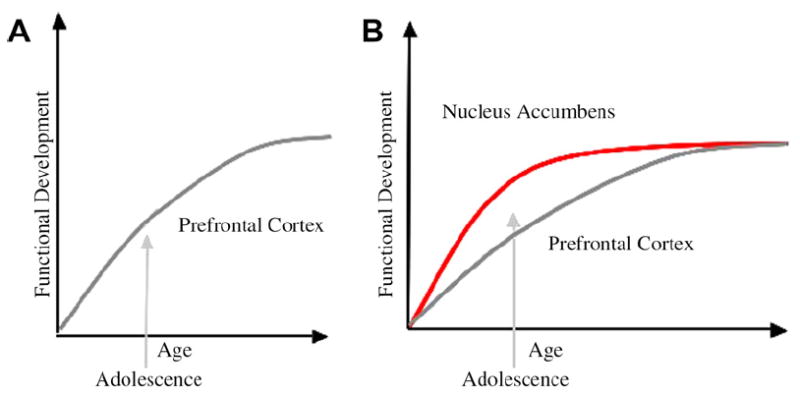
Adolescence is a developmental period characterized by suboptimal decisions and actions that give rise to an increased incidence of unintentional injuries and violence, alcohol and drug abuse, unintended pregnancy and sexually transmitted diseases. Traditional neurobiological and cognitive explanations for adolescent behavior have failed to account for the nonlinear changes in behavior observed during adolescence, relative to childhood and adulthood. This review provides a biologically plausible conceptualization of the neural mechanisms underlying these nonlinear changes in behavior, as a heightened responsiveness to incentives while impulse control is still relatively immature during this period. Recent human imaging and animal studies provide a biological basis for this view, suggesting differential development of limbic reward systems relative to top-down control systems during adolescence relative to childhood and adulthood. This developmental pattern may be exacerbated in those adolescents with a predisposition toward risk-taking, increasing the risk for poor outcomes.
Figures
References
-
- Benthin A, Slovic P, Severson H. A psychometric study of adolescent risk perception. Journal of Adolescence. 1993;16:153–168. - PubMed
-
- Bjorkland DF. The role of conceptual knowledge in the development of organization in children’s memory. In: Brainerd CJ, Pressley M, editors. Basic processes in memory development: Progress in cognitive development research. New York: Springer-Verlag; 1985. pp. 103–142.
-
- Bjorkland DF. How age changes in knowledge base contribute to the development of children’s memory: An interpretive review. Developmental Review. 1987;7:93–130.
-
- Bourgeois JP, Goldman-Rakic PS, Rakic P. Synaptogenesis in the prefrontal cortex of rhesus monkeys. Cerebral Cortex. 1994;4:78–96. - PubMed
Grants and funding
LinkOut - more resources
Full Text Sources