


Receptor actions of synaptically released glutamate: the role of transporters on the scale from nanometers to microns
- PMID: 18689452
- PMCID: PMC2576387
- DOI: 10.1529/biophysj.108.129874
Receptor actions of synaptically released glutamate: the role of transporters on the scale from nanometers to microns
Abstract
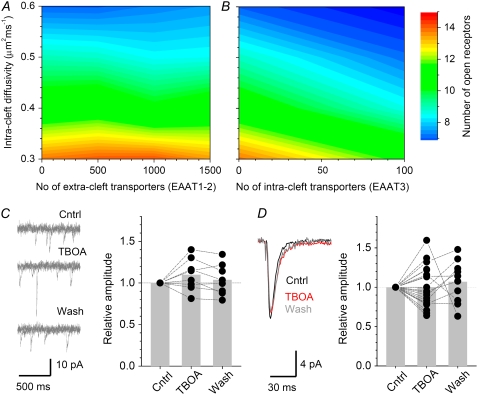
Actions of the excitatory neurotransmitter glutamate inside and outside the synaptic cleft determine the activity of neural circuits in the brain. However, to what degree local glutamate transporters affect these actions on a submicron scale remains poorly understood. Here we focus on hippocampal area CA1, a common subject of synaptic physiology studies. First, we use a two-photon excitation technique to obtain an estimate of the apparent (macroscopic) extracellular diffusion coefficient for glutamate, approximately 0.32 mum(2)/ms. Second, we incorporate this measurement into a Monte Carlo model of the typical excitatory synapse and examine the influence of distributed glutamate transporter molecules on signal transmission. Combined with the results of whole-cell recordings, such simulations argue that, although glutamate transporters have little effect on the activation of synaptic alpha-amino-3-hydroxy-5-methyl-4-isoxazolepropionic acid receptors, this does not rule out the occurrence of up to several dozens of transporters inside the cleft. We further evaluate how the expression pattern of transporter molecules (on the 10-100 nm scale) affects the activation of N-methyl-D-aspartic acid or metabotropic glutamate receptors in the synaptic vicinity. Finally, we extend our simulations to the macroscopic scale, estimating that synaptic activity sufficient to excite principal neurons could intermittently raise extracellular glutamate to approximately 1 muM only at sparse (microns apart) hotspots. Greater rises of glutamate occur only when <5% of transporters are available (for instance, when an astrocyte fails). The results provide a quantitative framework for a better understanding of the relationship between glutamate transporters and glutamate receptor signaling.
Figures




References
-
- Sah, P., S. Hestrin, and R. A. Nicoll. 1989. Tonic activation of NMDA receptros by ambient glutamate enhances excitability of neurons. Science. 246:815–818. - PubMed
-
- Eghbali, M., J. P. Curmi, B. Birnir, and P. W. Gage. 1997. Hippocampal GABA(A) channel conductance increased by diazepam. Nature. 388:71–75. - PubMed
-
- Mitchell, S. J., and R. A. Silver. 2003. Shunting inhibition modulates neuronal gain during synaptic excitation. Neuron. 38:433–435. - PubMed
-
- Semyanov, A., M. C. Walker, D. M. Kullmann, and R. A. Silver. 2004. Tonically active GABA A receptors: modulating gain and maintaining the tone. Trends Neurosci. 27:262–269. - PubMed
Publication types
MeSH terms
Substances
Grants and funding
LinkOut - more resources
Full Text Sources
Miscellaneous
