. 2008 Aug;179(4):2213-28.
doi: 10.1534/genetics.107.085340. Epub 2008 Aug 9.

A complex genetic basis to X-linked hybrid male sterility between two species of house mice

Affiliations

A complex genetic basis to X-linked hybrid male sterility between two species of house mice

Jeffrey M Good et al. Genetics. 2008 Aug.

Abstract

The X chromosome plays a central role in the evolution of reproductive isolation, but few studies have examined the genetic basis of X-linked incompatibilities during the early stages of speciation. We report the results of a large experiment focused on the reciprocal introgression of the X chromosome between two species of house mice, Mus musculus and M. domesticus. Introgression of the M. musculus X chromosome into a wild-derived M. domesticus genetic background produced male-limited sterility, qualitatively consistent with previous experiments using classic inbred strains to represent M. domesticus. The genetic basis of sterility involved a minimum of four X-linked factors. The phenotypic effects of major sterility QTL were largely additive and resulted in complete sterility when combined. No sterility factors were uncovered on the M. domesticus X chromosome. Overall, these results revealed a complex and asymmetric genetic basis to X-linked hybrid male sterility during the early stages of speciation in mice. Combined with data from previous studies, we identify one relatively narrow interval on the M. musculus X chromosome involved in hybrid male sterility. Only a handful of spermatogenic genes are within this region, including one of the most rapidly evolving genes on the mouse X chromosome.


Figures
F<sc>igure</sc> 1.—
Figure 1.—
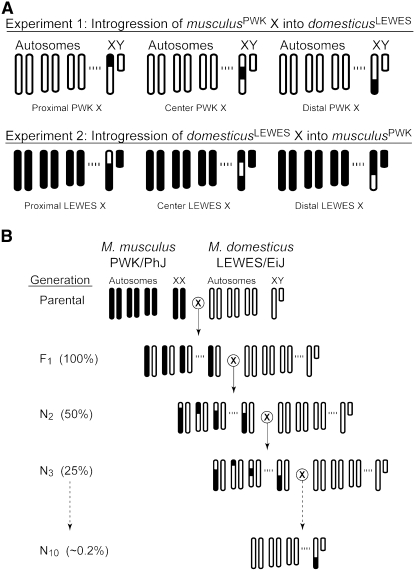
Experimental design for the reciprocal introgression of the X chromosome. (A) Three targeted X chromosome congenic genotypes (proximal, center, and distal) for experiment 1 and experiment 2. For each male genotype, the genetic composition of three autosomes, the X chromosome, and the Y chromosome is given. White chromosomes represent domesticusLEWES and black chromosomes represent musculusPWK. For both experiments the mitochondrial DNA derives from musculusPWK. (B) Example of congenic strain construction for introgression of the distal musculusPWK X chromosome over 10 generations of breeding. Expected levels of heterozygosity for each generation are given in parentheses; at the N10 generation the genomic background will be ∼99.8% homozygous for domesticusLEWES alleles.
F<sc>igure</sc> 2.—
Figure 2.—
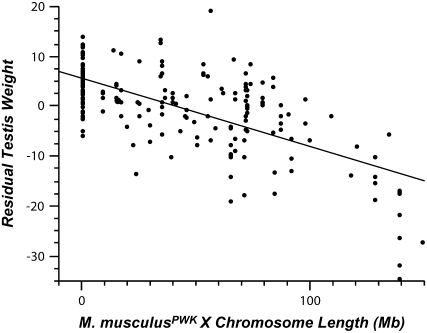
Negative correlation between length of musculusPWK X chromosome introgression and relative testis weight (n = 202 N6–8 males, r2 = 0.45, P < 0.0001). All males are from the N6, N7, or N8 generations of experiment 1. The abscissa depicts the length of introgressed regions regardless of their location on the X chromosome.
F<sc>igure</sc> 3.—
Figure 3.—
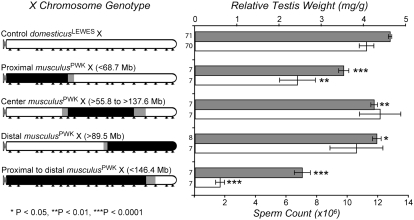
Reduction in relative testis weight and sperm count for four different musculusPWK X chromosome introgressions. All males are from the N6, N7, or N8 generations of experiment 1. Bars indicate average values for relative testis weight (shaded) and sperm count (open), error bars indicate ±1 SE. Different genotypic classes are represented on the left margin with open chromosomal regions deriving from domesticusLEWES and solid chromosomes deriving from musculusPWK. The control genotype (all open) represents backcross males with a domesticusLEWES X chromosome. Sample sizes are given on the left margin. The locations of screened markers are indicated with arrowheads along the bottom. Shading for each genotype indicates uncertainty in recombination breakpoints between surveyed markers. Significance was based on Wilcoxon pairwise comparisons vs. the control backcross males.
F<sc>igure</sc> 4.—
Figure 4.—
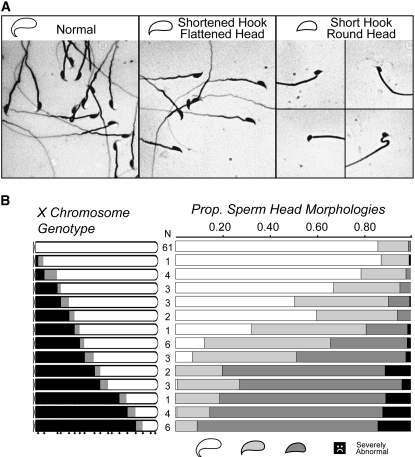
Influence of the musculusPWK X chromosome on abnormal sperm head morphology in experiment 1. (A) Examples of three types of sperm head morphologies observed in N6–8 males from experiment 1. (B) Sperm head morphologies observed for males with progressively large introgressions of musculusPWK X chromosome (solid chromosomes). The first genotypic class represents control backcross males with a domesticusLEWES X chromosome (all open). Sample sizes are given on the left margin and the locations of screened markers are indicated with arrowheads along the bottom. Shading for each genotype indicates uncertainty in recombination breakpoints between surveyed markers. Sperm head morphology is partitioned into four phenotypic classes proceeding from normal to abnormal: (1) normal, (2) flattened head, shortened hook, (3) round head, short or absent hook, and (4) severely abnormal. Severely abnormal head morphologies were grouped together and took on a variety of dramatically altered shapes.
F<sc>igure</sc> 5.—
Figure 5.—
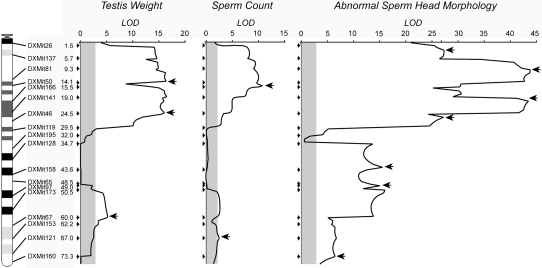
Results for QTL mapping of hybrid male sterility phenotypes in experiment 1. LOD scores are based on CIM analysis of testis weight, sperm count, and the proportion of abnormal sperm in males from the N6, N7, and N8 generations. The physical location, identity, and genetic position (cM) of screened markers are given along the left margin. The significance threshold (α = 0.05) for each trait is shaded and is based on 1000 permutations. Arrows indicate the position of individual QTL that remained significant in MIM models.
F<sc>igure</sc> 6.—
Figure 6.—
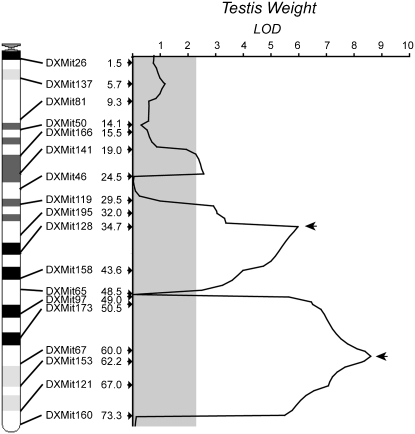
Results for QTL mapping of differences in testis weight between domesticusLEWES and musculusPWK in experiment 2. LOD scores are based on CIM analysis of testis weight in males from the N4, N6, and N8 generations. The physical location, identity, and genetic position (cM) of screened markers are given along the left margin. The significance threshold (α = 0.05; LOD = 2.25) is indicated with shading and is based on 1000 permutations. Arrows indicate the position of individual QTL that remained significant in MIM models.

References

    1. Barbash, D. A., D. F. Siino, A. M. Tarone and J. Roote, 2003. A rapidly evolving MYB-related protein causes species isolation in Drosophila. Proc. Natl. Acad. Sci. USA 100 5302–5307. - PMC - PubMed
    1. Barbash, D. A., P. Awadalla and A. M. Tarone, 2004. Functional divergence caused by ancient positive selection of a Drosophila hybrid incompatibility locus. PLoS Biol. 2 839–848. - PMC - PubMed
    1. Bateson, W., 1909. Heredity and variation in modern lights, pp. 85–101 in Darwin and Modern Science, edited by A. C. Seward. Cambridge University Press, Cambridge, UK.
    1. Besansky, N. J., J. Krzywinski, T. Lehmann, F. Simard, M. Kern et al., 2003. Semipermeable species boundaries between Anopheles gambiae and Anopheles arabiensis: evidence from multilocus DNA sequence variation. Proc. Natl. Acad. Sci. USA 100 10818–10823. - PMC - PubMed
    1. Bolor, H., N. Wakasugi, W. D. Zhao and A. Ishikawa, 2006. Detection of quantitative trait loci causing abnormal spermatogenesis and reduced testis weight in small testis (Smt) mutant mouse. Exp. Anim. 55 97–108. - PubMed

Publication types