. 2008 Sep 18;455(7211):421-4.
doi: 10.1038/nature07186. Epub 2008 Aug 6.

Prolyl 4-hydroxylation regulates Argonaute 2 stability

Affiliations

Prolyl 4-hydroxylation regulates Argonaute 2 stability

Hank H Qi et al. Nature. .

Abstract

Human Argonaute (Ago) proteins are essential components of the RNA-induced silencing complexes (RISCs). Argonaute 2 (Ago2) has a P-element-induced wimpy testis (PIWI) domain, which folds like RNase H and is responsible for target RNA cleavage in RNA interference. Proteins such as Dicer, TRBP, MOV10, RHA, RCK/p54 and KIAA1093 associate with Ago proteins and participate in small RNA processing, RISC loading and localization of Ago proteins in the cytoplasmic messenger RNA processing bodies. However, mechanisms that regulate RNA interference remain obscure. Here we report physical interactions between Ago2 and the alpha-(P4H-alpha(I)) and beta-(P4H-beta) subunits of the type I collagen prolyl-4-hydroxylase (C-P4H(I)). Mass spectrometric analysis identified hydroxylation of the endogenous Ago2 at proline 700. In vitro, both Ago2 and Ago4 seem to be more efficiently hydroxylated than Ago1 and Ago3 by recombinant human C-P4H(I). Importantly, human cells depleted of P4H-alpha(I) or P4H-beta by short hairpin RNA and P4H-alpha(I) null mouse embryonic fibroblast cells showed reduced stability of Ago2 and impaired short interfering RNA programmed RISC activity. Furthermore, mutation of proline 700 to alanine also resulted in destabilization of Ago2, thus linking Ago2 P700 and hydroxylation at this residue to its stability regulation. These findings identify hydroxylation as a post-translational modification important for Ago2 stability and effective RNA interference.


Figures
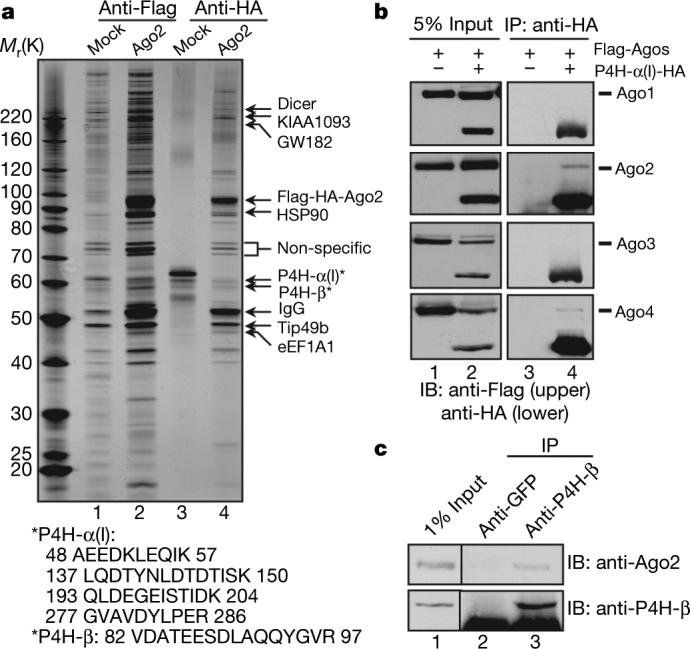
Figure 1
Figure 1. Human Ago2 associates with C-P4H(I) subunits
a, Tandem affinity purification was conducted on cytoplasmic extracts from Mock (lanes 1 and 3) and Flag–HA-tagged Ago2 stable HeLa S3 cells (lanes 2 and 4) with sequential anti-Flag and HA immunoprecipitation. The peptides for P4H-α(I) and P4H-β are shown below. b, Flag–Ago1−4 were co-transfected with empty vector (lanes 1 and 3) or P4H-α(I)-HA (lanes 2 and 4) in 293ET cells. The immunoprecipitates with anti-HA antibody were blotted with anti-Flag and HA antibodies, respectively. IP, immunoprecipitate; IB, immunoblot. c, 293ET cells were immunoprecipitated with anti-GFP or P4H-β antibodies and followed with western blotting with anti-P4H-β and Ago2 antibodies.
Figure 2
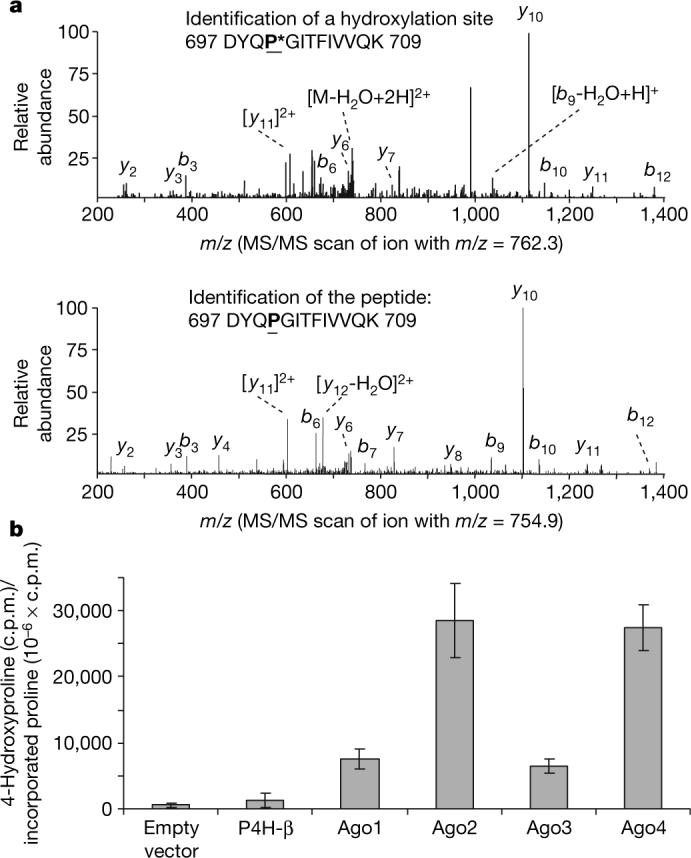
Figure 2. In vivo and in vitro hydroxylation of Ago2
a, Endogenous Ago2 is hydroxylated at proline 700. Endogenous Ago2 was immunoprecipitated with a polyclonal anti-Ago2 antibody and analysed by LC–MS/MS. The MS/MS scanned hydroxylated peptides with ion m/z 762.3 (upper panel) and ion m/z 754.9 (lower panel). b, In vitro hydroxylation of Ago proteins. pcDNA3–Flag-HA-Ago1−4 were in vitro translated in the presence of L-[2,3,4,5-3H]proline. The in vitro translated lysates were incubated with purified recombinant C-P4H(I) enzyme and the reaction cofactors. The amount of 4-hydroxy[3H]proline formed in control, P4H-β and Ago 1−4 was determined as described in Methods. Data are presented as the mean ± standard deviation for three independent experiments.
Figure 3
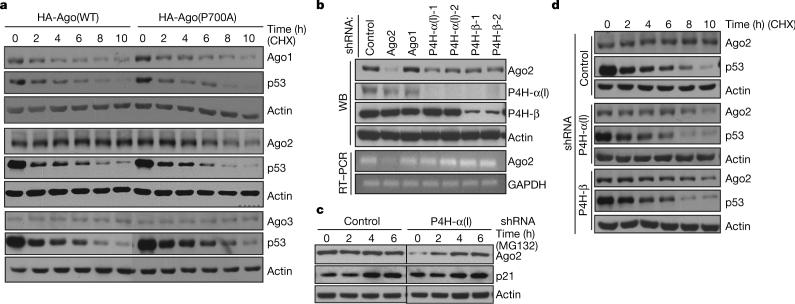
Figure 3. Impaired hydroxylation downregulates Ago2 stability
a, U2OS cells transfected with HA–Ago1, 2, 3 (wild type, WT) and their mutants (P700A) were treated with 50 μg ml−1 of cycloheximide (CHX) for the indicated times. Agos, p53 and actin were detected by western blot. The results shown are representative for three independent experiments. b, U2OS cells were transfected with indicated shRNAs followed by puromycin selection. Western blot with indicated antibodies and RT–PCR were performed. c, P4H-α(I)-depleted and control U2OS cells were treated with 25 μM of MG132 for the indicated times. Endogenous Ago2, p21 and actin were detected by western blot. d, U2OS cells were transfected with P4H-α or -β shRNA followed with puromycin selection. Cells were then treated as in a. Ago2, p53 and actin were monitored by western blot. The results are representative of three independent experiments.
Figure 4
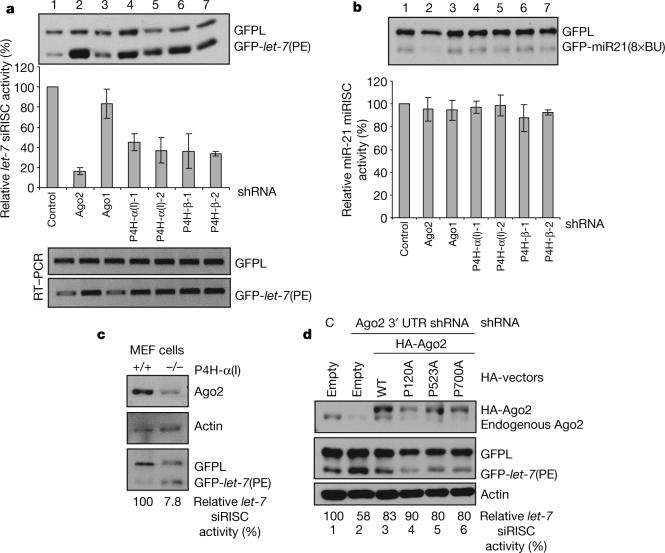
Figure 4. Impaired C-P4H(I) reduced let-7 guided siRISC activity
a, b, U2OS stable cell line expressing GFPL/GFP–let-7 (PE) (a) or GFPL/GFP–miR21(8 × BU) (b) were transfected with indicated shRNAs and selected by puromycin. The expression ratios between GFPL and GPF reporter were calculated and the intact (100%) si/miRISC activity was considered in control shRNA cells. The relative si/miRISC activities under knockdown conditions of the indicated genes were obtained by comparison with the control shRNA transfection. The standard deviations were obtained from three independent experiments. c, Control and P4H-α(I) null MEF cells were transfected with GFPL and GFP–let-7 (PE) plasmids. Ago2, actin and GFP expressions were detected by western blot. d, Ago2(P700A) is catalytically active. GFPL/GFP–let-7 (PE) stable cell line was co-transfected with control shRNA (lane 1) or shRNA targeting the 3′ untranslated region of Ago2 (lanes 2−6) together with empty vector (lanes 1 and 2) or HA–Ago2 constructs as indicated. GFP, Ago2 proteins were detected. let-7 guided siRISC activity was calculated as in a.

References

    1. Peters L, Meister G. Argonaute proteins: mediators of RNA silencing. Mol. Cell. 2007;26:611–623. - PubMed
    1. Robb GB, Rana TM. RNA helicase A interacts with RISC in human cells and functions in RISC loading. Mol. Cell. 2007;26:523–537. - PubMed
    1. Myllyharju J, Kivirikko KI. Collagens, modifying enzymes and their mutations in humans, flies and worms. Trends Genet. 2004;20:33–43. - PubMed
    1. Kivirikko KI, Myllylaä R, Pihlajaniemi T. In: Post Translational Modification of Proteins. Harding JJ, Crabbe MJC, editors. CRC Press; 1992. pp. 1–51.
    1. Cikaluk DE, et al. GERp95, a membrane-associated protein that belongs to a family of proteins involved in stem cell differentiation. Mol. Biol. Cell. 1999;10:3357–3372. - PMC - PubMed

Publication types