. 2008 Sep 2;47(35):9227-33.
doi: 10.1021/bi801102e. Epub 2008 Aug 9.

Conformational relaxation following hydride transfer plays a limiting role in dihydrofolate reductase catalysis

Affiliations

Conformational relaxation following hydride transfer plays a limiting role in dihydrofolate reductase catalysis

David D Boehr et al. Biochemistry. .

Abstract

The catalytic cycle of an enzyme is frequently associated with conformational changes that may limit maximum catalytic throughput. In Escherichia coli dihydrofolate reductase, release of the tetrahydrofolate (THF) product is the rate-determining step under physiological conditions and is associated with an "occluded" to "closed" conformational change. In this study, we demonstrate that in dihydrofolate reductase the closed to occluded conformational change in the product ternary complex (E.THF.NADP (+)) also gates progression through the catalytic cycle. Using NMR relaxation dispersion, we have measured the temperature and pH dependence of microsecond to millisecond time scale backbone dynamics of the occluded E.THF.NADP (+) complex. Our studies indicate the presence of three independent dynamic regions, associated with the active-site loops, the cofactor binding cleft, and the C-terminus and an adjacent loop, which fluctuate into discrete conformational substates with different kinetic and thermodynamic parameters. The dynamics of the C-terminally associated region is pH-dependent (p K a < 6), but the dynamics of the active-site loops and cofactor binding cleft are pH-independent. The active-site loop dynamics access a closed conformation, and the accompanying closed to occluded rate constant is comparable to the maximum pH-independent hydride transfer rate constant. Together, these results strongly suggest that the closed to occluded conformational transition in the product ternary complex is a prerequisite for progression through the catalytic cycle and that the rate of this process places an effective limit on the maximum rate of the hydride transfer step.


Figures
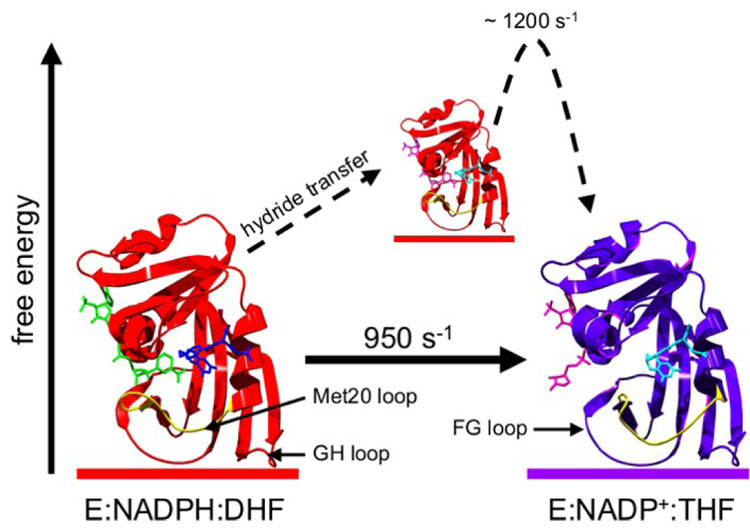
Figure 1
Figure 1
Conformational dynamics in E.coli dihydrofolate reductase govern catalytic turnover. Prior to hydride transfer, the Met20 loop is in a ‘closed’ conformation (left, PDB 1RX2), but adopts an ‘occluded’ conformation following hydride transfer (right, PDB 1RX4). The rate constant for the ‘closed-to-occluded’ transition in E:THF:NADP+ determined by R2 relaxation dispersion (21) is strikingly similar to the maximum pH-independent hydride transfer rate constant (8). NADPH, DHF, NADP+ and THF are colored green, blue, pink and cyan, respectively. The Met20 loop is highlighted in yellow.
Figure 2
Figure 2
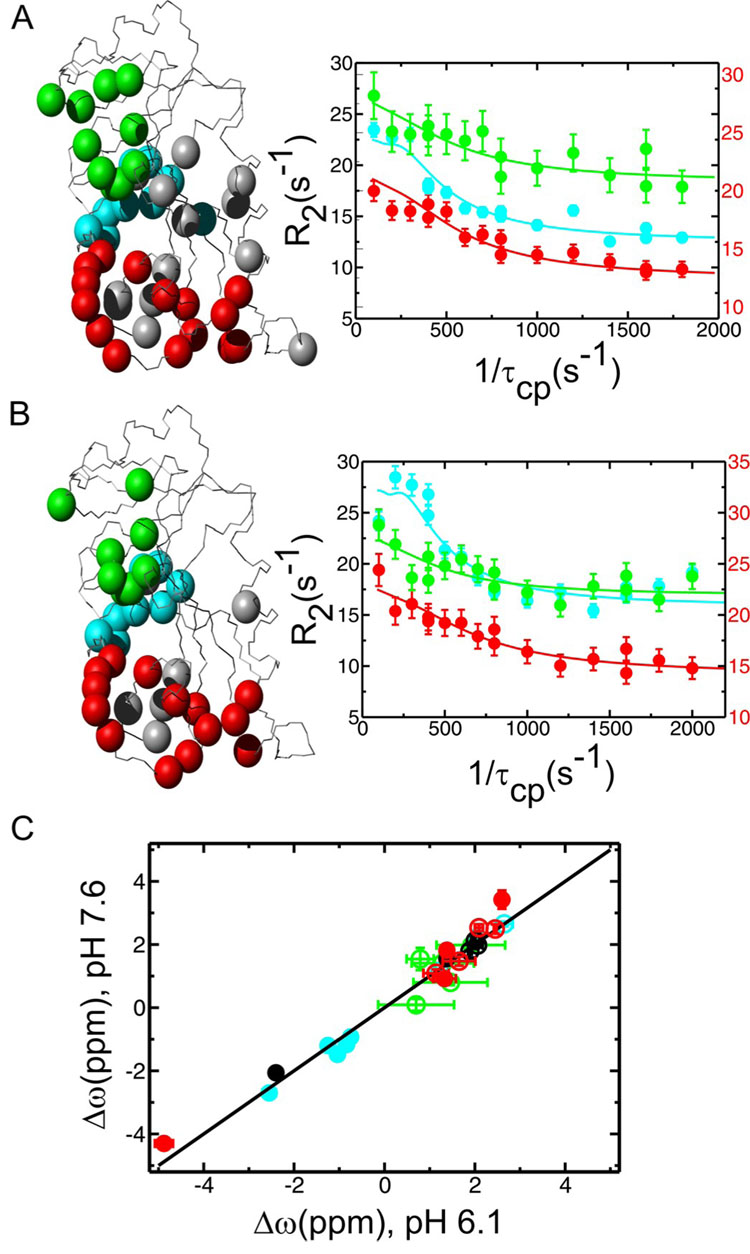
Conformational exchange as measured by R2 relaxation dispersion in the product ternary E:THF:NADP+ complex of DHFR at pHs 7.6 (A) and 6.1 (B). (A and B) Residues displaying conformational exchange (Rex) are highlighted as colored spheres on the E:THF:NADP+ structure (PDB 1RX4) according to the cluster to which they belong (red and grey – active-site loops and associated residues, green – cofactor binding cleft, blue – C-terminal associated region). Representative R2 relaxation dispersion curves from each dynamic cluster are shown on the right (red – Gly121, green – Thr46 and blue – Asp131). Data were collected at two external magnetic fields (1H 500 and 800 MHz), but only 800 MHz field data are shown here for clarity. R2 rate constants for the red Gly121 curves are plotted on the right-hand y-axis to improve clarity. (C) Higher energy substates observed at pH 6.1 and 7.6 are similar as indicated by the 1:1 linear correlation between the dynamic chemical shift differences (Δω) observed in the R2 relaxation dispersion experiments at the two pH conditions. Data points are color coded as above. Filled circles indicate that the sign of Δω could be determined for both pHs using an HMQC/HSQC comparison according to (51). Unfilled circles indicate that the sign could not be determined for one or both pH conditions.
Figure 3
Figure 3
pH dependence of the conformational exchange kinetics in E:THF:NADP+ at 300 K. The rate constants for the excited-to-ground state transition (kBA) for the active-site loops, cofactor binding cleft and C-terminal associated region are plotted in red, green and blue, respectively. The dotted black curve is a simulation of the pH dependence of the hydride transfer rate constant with pKa 6.5 and pH-independent rate constant of 950 s−1 (at 298 K) (8).
Figure 4
Figure 4
Temperature dependence of the conformational exchange kinetics in E:THF:NADP+ at pH 7.6 for the (A) active-site loops and (B) C-terminal associated region. Rate constants for the excited-to-ground state (kBA; ■) and ground-to-excited state (kAB; ▲) transitions, and the equilibrium constant (kBA/kAB;●) are plotted. (C) Thermodynamic comparison of E:FOL:NADP+ and E:THF:NADP+ at 298 K. Thermodynamic barriers were calculated using transition-state theory according to Materials and Methods. Green, blue and red traces represent DG, DH and TDS respectively. E:FOL:NADP+ is a model for the Michaelis complex E:DHF:NADPH.

References

    1. Stroppolo ME, Falconi M, Caccuri AM, Desideri A. Superefficient enzymes. Cell Mol. Life Sci. 2001;58:1451–1460. - PMC - PubMed
    1. Hammes GG. Multiple conformational changes in enzyme catalysis. Biochemistry. 2002;41:8221–8228. - PubMed
    1. Schnell JR, Dyson HJ, Wright PE. Structure, dynamics and catalytic function of dihydrofolate reductase. Ann. Rev. Biophys. Biomol. Struct. 2004;33:119–140. - PubMed
    1. Hammes-Schiffer S, Benkovic SJ. Relating protein motion to catalysis. Ann. Rev. Biochem. 2006;75:519. - PubMed
    1. Sawaya MR, Kraut J. Loop and subdomain movements in the mechanism of Escherichia coli dihydrofolate reductase: crystallographic evidence. Biochemistry. 1997;36:586–603. - PubMed

Publication types

Substances

LinkOut - more resources