


Genetic variation in a member of the laminin gene family affects variation in body composition in Drosophila and humans
- PMID: 18694491
- PMCID: PMC2533007
- DOI: 10.1186/1471-2156-9-52
Genetic variation in a member of the laminin gene family affects variation in body composition in Drosophila and humans
Abstract
Background: The objective of the present study was to map candidate loci influencing naturally occurring variation in triacylglycerol (TAG) storage using quantitative complementation procedures in Drosophila melanogaster. Based on our results from Drosophila, we performed a human population-based association study to investigate the effect of natural variation in LAMA5 gene on body composition in humans.
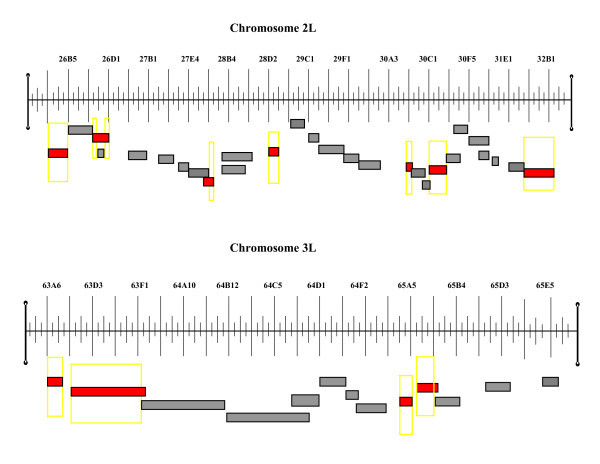
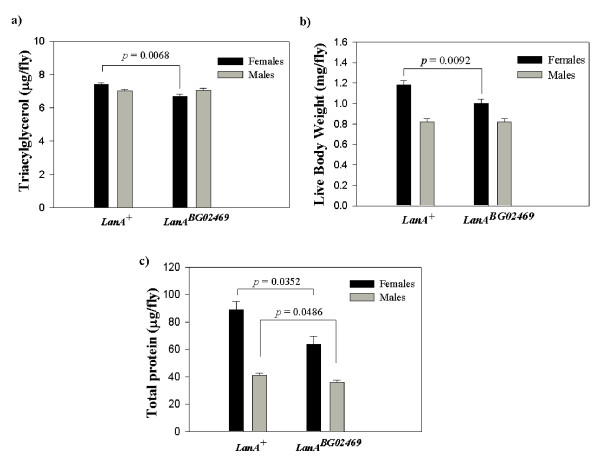
Results: We identified four candidate genes that contributed to differences in TAG storage between two strains of D. melanogaster, including Laminin A (LanA), which is a member of the alpha subfamily of laminin chains. We confirmed the effects of this gene using a viable LanA mutant and showed that female flies homozygous for the mutation had significantly lower TAG storage, body weight, and total protein content than control flies. Drosophila LanA is closely related to human LAMA5 gene, which maps to the well-replicated obesity-linkage region on chromosome 20q13.2-q13.3. We tested for association between three common single nucleotide polymorphisms (SNPs) in the human LAMA5 gene and variation in body composition and lipid profile traits in a cohort of unrelated women of European American (EA) and African American (AA) descent. In both ethnic groups, we found that SNP rs659822 was associated with weight (EA: P = 0.008; AA: P = 0.05) and lean mass (EA: P= 0.003; AA: P = 0.03). We also found this SNP to be associated with height (P = 0.01), total fat mass (P = 0.01), and HDL-cholesterol (P = 0.003) but only in EA women. Finally, significant associations of SNP rs944895 with serum TAG levels (P = 0.02) and HDL-cholesterol (P = 0.03) were observed in AA women.
Conclusion: Our results suggest an evolutionarily conserved role of a member of the laminin gene family in contributing to variation in weight and body composition.
Figures
References
-
- Klein S, Burke LE, Bray GA, Blair S, Allison DB, Pi-Sunyer X, Hong YL, Eckel RH. Clinical implications of obesity with specific focus on cardiovascular disease - A statement for professionals from the American Heart Association Council on Nutrition, Physical Activity, and Metabolism - Endorsed by the American College of Cardiology Foundation. Circulation. 2004;110:2952–2967. - PubMed
-
- Ruden DM, De Luca M, Garfinkel MD, Bynum KL, Lu X. Drosophila nutrigenomics can provide clues to human gene-nutrient interactions. Annu Rev Nutr. 2005;25:499–522. - PubMed
-
- De Luca M, Yi N, Allison DB, Leips J, Ruden DM. Mapping quantitative trait loci affecting variation in Drosophila triacylglycerol storage. Obes Res. 2005;13:1596–1605. - PubMed
-
- Mackay TF, Anholt RR. Of Flies and Man: Drosophila as a Model for Human Complex Traits. Annu Rev Genomics Hum Genet. 2006;7:339–367. - PubMed
Publication types
MeSH terms
Substances
Grants and funding
LinkOut - more resources
Full Text Sources
Molecular Biology Databases
