


Integration of small-angle X-ray scattering data into structural modeling of proteins and their assemblies
- PMID: 18694757
- PMCID: PMC2745287
- DOI: 10.1016/j.jmb.2008.07.074
Integration of small-angle X-ray scattering data into structural modeling of proteins and their assemblies
Abstract
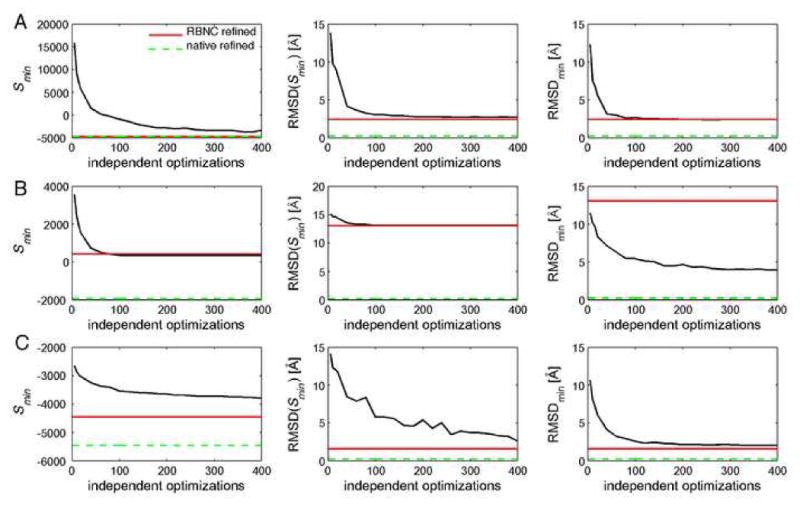
A major challenge in structural biology is to determine the configuration of domains and proteins in multidomain proteins and assemblies, respectively. All available data should be considered to maximize the accuracy and precision of these models. Small-angle X-ray scattering (SAXS) efficiently provides low-resolution experimental data about the shapes of proteins and their assemblies. Thus, we integrated SAXS profiles into our software for modeling proteins and their assemblies by satisfaction of spatial restraints. Specifically, we modeled the quaternary structures of multidomain proteins with structurally defined rigid domains as well as quaternary structures of binary complexes of structurally defined rigid proteins. In addition to SAXS profiles and the component structures, we used stereochemical restraints and an atomic distance-dependent statistical potential. The scoring function is optimized by a biased Monte Carlo protocol, including quasi-Newton and simulated annealing schemes. The final prediction corresponds to the best scoring solution in the largest cluster of many independently calculated solutions. To quantify how well the quaternary structures are determined based on their SAXS profiles, we used a benchmark of 12 simulated examples as well as an experimental SAXS profile of the homotetramer D-xylose isomerase. Optimization of the SAXS-dependent scoring function generally results in accurate models if sufficiently precise approximations for the constituent rigid bodies are available; otherwise, the best scoring models can have significant errors. Thus, SAXS profiles can play a useful role in the structural characterization of proteins and assemblies if they are combined with additional data and used judiciously. Our integration of a SAXS profile into modeling by satisfaction of spatial restraints will facilitate further integration of different kinds of data for structure determination of proteins and their assemblies.
Figures


References
-
- Sali A, Glaeser R, Earnest T, Baumeister W. From words to literature in structural proteomics. Nature. 2003;422:216–25. - PubMed
-
- Robinson CV, Sali A, Baumeister W. The molecular sociology of the cell. Nature. 2007;450:973–82. - PubMed
-
- Alber F, Förster F, Korkin K, Topf M, Sali A. Integrating Diverse Data for Structure Determination of Macromolecular Assemblies. Annu Rev Biochem. 2008 in press. - PubMed
-
- Doniach S. Changes in biomolecular conformation seen by small angle X-ray scattering. Chem Rev. 2001;101:1763–78. - PubMed
-
- Koch MH, Vachette P, Svergun DI. Small-angle scattering: a view on the properties, structures and structural changes of biological macromolecules in solution. Q Rev Biophys. 2003;36:147–227. - PubMed
Publication types
MeSH terms
Substances
Grants and funding
LinkOut - more resources
Full Text Sources
