


Small ubiquitin-related modifier (SUMO)-1, SUMO-2/3 and SUMOylation are involved with centromeric heterochromatin of chromosomes 9 and 1 and proteins of the synaptonemal complex during meiosis in men
- PMID: 18694876
- PMCID: PMC2583944
- DOI: 10.1093/humrep/den300
Small ubiquitin-related modifier (SUMO)-1, SUMO-2/3 and SUMOylation are involved with centromeric heterochromatin of chromosomes 9 and 1 and proteins of the synaptonemal complex during meiosis in men
Abstract
Background: Post-transcriptional modification by SUMOylation is involved in numerous cellular processes including human spermatogenesis. For human male meiosis, we previously showed that the small ubiquitin-related modifier-1 (SUMO-1) protein localizes to chromatin axes in early pachytene spermatocytes, then to kinetochores as meiosis progresses. Here, we delineate possible functional roles based on subcellular localization for SUMO-1 and SUMO-2/3.
Methods: Western and immunoprecipitation analyses were conducted on proteins isolated from the testis of two normal adult fertile men. Combinatorial immunofluorescence and chromosome-specific fluorescence in situ hybridization analyses were performed on male meiocytes obtained during testicular biopsy from four patients undergoing testicular sperm extraction for assisted reproduction technologies.
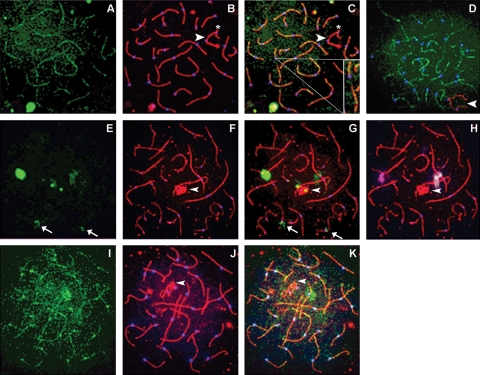
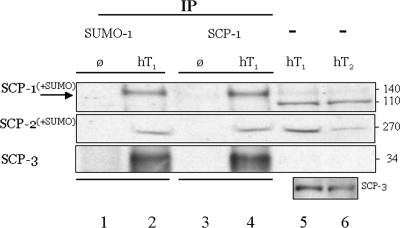
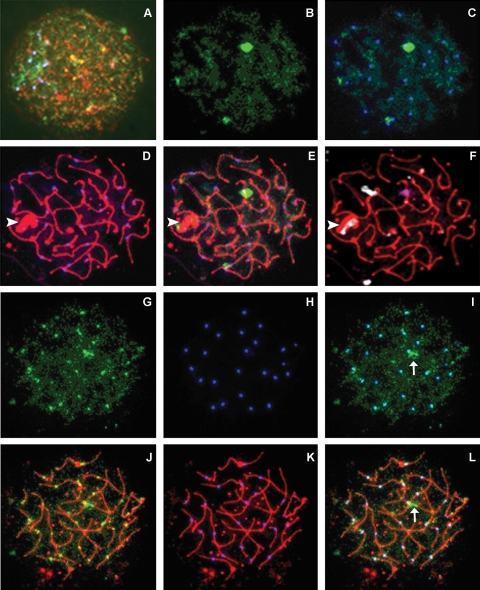
Results: The synaptonemal complex (SC) and SC proteins (SCP)-1 and SCP2, but not SCP3, are SUMOylated by SUMO-1 during the pachytene substage. Likewise, two distinct localization patterns for SUMO-1 are identified: a linear pattern co-localized with autosomal SCs and isolated SUMO-1 near the centromeric heterochromatin of chromosomes 9 and 1. In contrast to SUMO-1, which is not detectable prior to pachytene in normal tissue, SUMO-2/3 is identified as early as leptotene and zygotene and in some, but not all, pachytene cells; no linear patterns were detected. Similar to SUMO-1, SUMO-2/3 localizes in two predominant subnuclear patterns: a single, dense signal near the centromere of human chromosome 9 and small, individual foci co-localized with autosomal centromeres.
Conclusions: Our data suggest that SUMO-1 may be involved in maintenance and/or protection of the autosomal SC. SUMO-2/3, though expressed similarly, may function separately and independently during pachytene in men.
Figures
References
-
- Antonelli A, Gandini L, Petrinelli P, Marcucci L, Elli R, Lombardo F, Dondero F, Lenzi A. Chromosomal alterations and male infertility. J Endocrinol Invest. 2000;23:677–683. - PubMed
-
- Azuma Y, Tan SH, Cavenagh MM, Ainsztein AM, Saitoh H, Dasso M. Expression and regulation of the mammalian SUMO-1 E1 enzyme. FASEB J. 2001;15:1825–1827. - PubMed
-
- Barlow AL, Hultén MA. Combined immunocytogenetic and molecular cytogenetic analysis of meiosis I human spermatocytes. Chromosome Res. 1996;4:562–573. - PubMed
