


Reduced disability and mortality among aging runners: a 21-year longitudinal study
- PMID: 18695077
- PMCID: PMC3175643
- DOI: 10.1001/archinte.168.15.1638
Reduced disability and mortality among aging runners: a 21-year longitudinal study
Erratum in
- Arch Intern Med. 2008 Dec 8;168(22):2496
Abstract
Background: Exercise has been shown to improve many health outcomes and well-being of people of all ages. Long-term studies in older adults are needed to confirm disability and survival benefits of exercise.
Methods: Annual self-administered questionnaires were sent to 538 members of a nationwide running club and 423 healthy controls from northern California who were 50 years and older beginning in 1984. Data included running and exercise frequency, body mass index, and disability assessed by the Health Assessment Questionnaire Disability Index (HAQ-DI; scored from 0 [no difficulty] to 3 [unable to perform]) through 2005. A total of 284 runners and 156 controls completed the 21-year follow-up. Causes of death through 2003 were ascertained using the National Death Index. Multivariate regression techniques compared groups on disability and mortality.
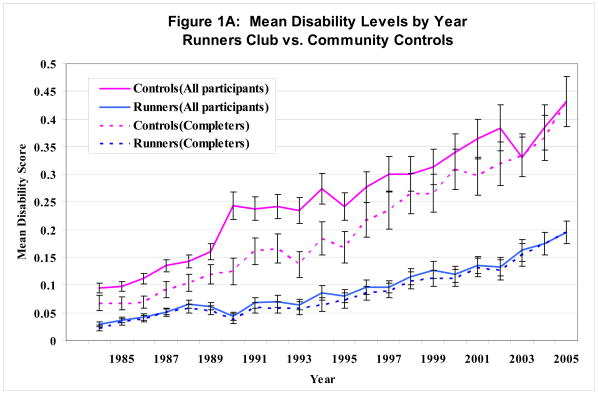
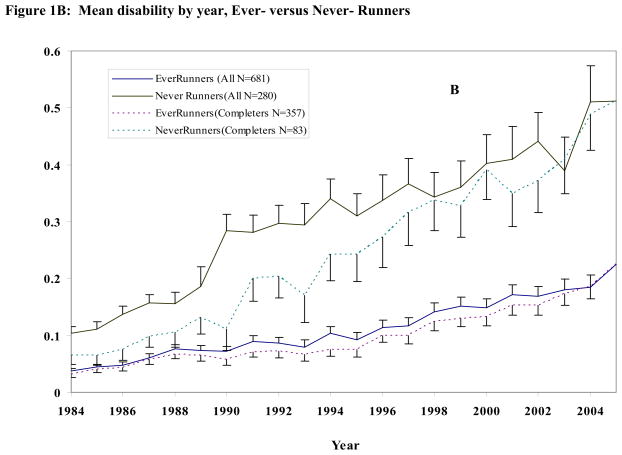
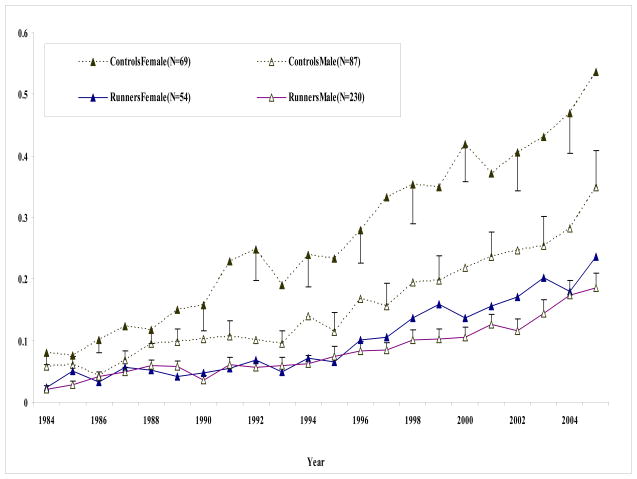
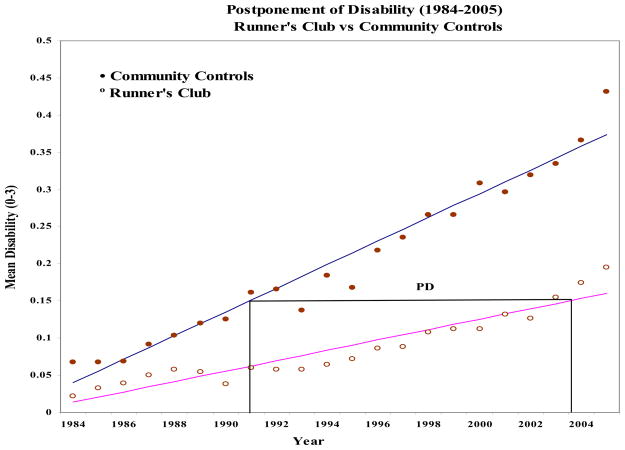
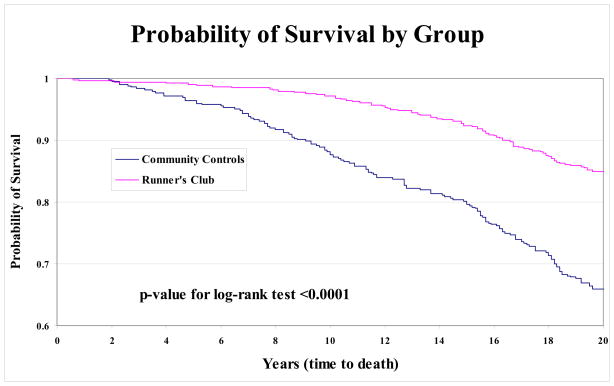
Results: At baseline, runners were younger, leaner, and less likely to smoke compared with controls. The mean (SD) HAQ-DI score was higher for controls than for runners at all time points and increased with age in both groups, but to a lesser degree in runners (0.17 [0.34]) than in controls (0.36 [0.55]) (P < .001). Multivariate analyses showed that runners had a significantly lower risk of an HAQ-DI score of 0.5 (hazard ratio, 0.62; 95% confidence interval, 0.46-0.84). At 19 years, 15% of runners had died compared with 34% of controls. After adjustment for covariates, runners demonstrated a survival benefit (hazard ratio, 0.61; 95% confidence interval, 0.45-0.82). Disability and survival curves continued to diverge between groups after the 21-year follow-up as participants approached their ninth decade of life.
Conclusion: Vigorous exercise (running) at middle and older ages is associated with reduced disability in later life and a notable survival advantage.
Conflict of interest statement
The authors have no competing conflicts of interest to declare.
Figures
Comment in
-
Weighing benefits for older runners.Arch Intern Med. 2008 Oct 13;168(18):1948-9. doi: 10.1001/archinte.168.18.1948. Arch Intern Med. 2008. PMID: 18852394 Review. No abstract available.
-
On running late in life.Arch Intern Med. 2009 Apr 13;169(7):719-20; author reply 720. doi: 10.1001/archinternmed.2009.35. Arch Intern Med. 2009. PMID: 19365008 No abstract available.
-
Incidence of atrial fibrillation among aging runners.Arch Intern Med. 2009 Apr 13;169(7):719. doi: 10.1001/archinternmed.2009.34. Arch Intern Med. 2009. PMID: 19365009 No abstract available.
References
-
- Centers for Disease Control and Prevention (CDC) National and state medical expenditures and lost earnings attributable to arthritis and other rheumatic conditions--United States, 2003. MMWR Morb Mortal Wkly Rep. 2007;56:4–7. - PubMed
-
- Burke Gl, Arnold AM, Bild DE, Cushman M, Fried LP, Newman A, Nunn C, Robbins J. Factors associated with healthy aging: the cardiovascular health study. J Am Geriatr Soc. 2001;49:254–62. - PubMed
-
- Larson EB, Wang L, Bowen JD, McCormick WC, Teri L, Crane P, Kukull W. Exercise is associated with reduced risk for incident dementia among persons 65 years of age and older. Ann Intern Med. 2006;144:73–81. - PubMed
-
- Newman AB, Simonsick EM, Naydeck BL, Boudreau RM, Kritchevsky SB, Nevitt MC, Pahor M, Satterfield S, Brach JS, Studenski SA, Harris TB. Association of long-distance corridor walk performance with mortality, cardiovascular disease, mobility limitation, and disability. JAMA. 2006;295:2018–26. - PubMed
-
- Bijnen FC, Feskens EJ, Caspersen CJ, Nagelkerke N, Mostwerd WL, Kromhout D. Baseline and previous physical activity in relation to mortality in elderly men: the Zutphen Elderly Study. Am J Epidemiol. 1999;150:1289–96. - PubMed
