


Alcohol use and alcohol-related problems before and after military combat deployment
- PMID: 18698065
- PMCID: PMC2680184
- DOI: 10.1001/jama.300.6.663
Alcohol use and alcohol-related problems before and after military combat deployment
Abstract
Context: High rates of alcohol misuse after deployment have been reported among personnel returning from past conflicts, yet investigations of alcohol misuse after return from the current wars in Iraq and Afghanistan are lacking.
Objectives: To determine whether deployment with combat exposures was associated with new-onset or continued alcohol consumption, binge drinking, and alcohol-related problems.
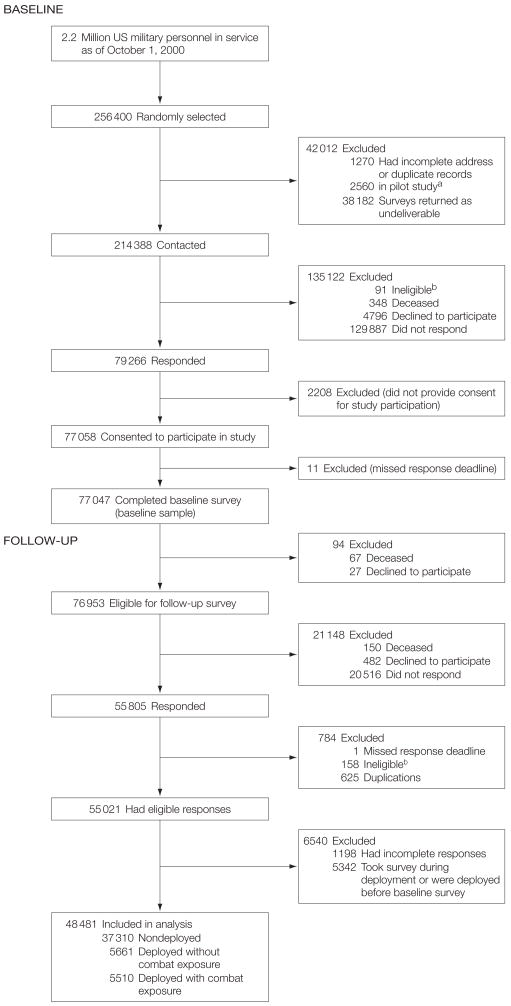
Design, setting, and participants: Data were from Millennium Cohort Study participants who completed both a baseline (July 2001 to June 2003; n=77,047) and follow-up (June 2004 to February 2006; n=55,021) questionnaire (follow-up response rate = 71.4%). After we applied exclusion criteria, our analyses included 48,481 participants (active duty, n = 26,613; Reserve or National Guard, n = 21,868). Of these, 5510 deployed with combat exposures, 5661 deployed without combat exposures, and 37 310 did not deploy.
Main outcome measures: New-onset and continued heavy weekly drinking, binge drinking, and alcohol-related problems at follow-up.
Results: Baseline prevalence of heavy weekly drinking, binge drinking, and alcohol-related problems among Reserve or National Guard personnel who deployed with combat exposures was 9.0%, 53.6%, and 15.2%, respectively; follow-up prevalence was 12.5%, 53.0%, and 11.9%, respectively; and new-onset rates were 8.8%, 25.6%, and 7.1%, respectively. Among active-duty personnel, new-onset rates were 6.0%, 26.6%, and 4.8%, respectively. Reserve and National Guard personnel who deployed and reported combat exposures were significantly more likely to experience new-onset heavy weekly drinking (odds ratio [OR], 1.63; 95% confidence interval [CI], 1.36-1.96), binge drinking (OR, 1.46; 95% CI, 1.24-1.71), and alcohol-related problems (OR, 1.63; 95% CI, 1.33-2.01) compared with nondeployed personnel. The youngest members of the cohort were at highest risk for all alcohol-related outcomes.
Conclusion: Reserve and National Guard personnel and younger service members who deploy with reported combat exposures are at increased risk of new-onset heavy weekly drinking, binge drinking, and alcohol-related problems.
Figures
Comment in
-
Military combat deployment and alcohol use.JAMA. 2008 Dec 10;300(22):2606-7; author reply 2607. doi: 10.1001/jama.2008.764. JAMA. 2008. PMID: 19066377 No abstract available.
-
Combat exposure increases risk of alcohol misuse in military personnel following deployment.Evid Based Ment Health. 2009 May;12(2):60. doi: 10.1136/ebmh.12.2.60. Evid Based Ment Health. 2009. PMID: 19395619 No abstract available.
References
-
- Schuckit MA, Smith TL, Chacko Y. Evaluation of a depression-related model of alcohol problems in 430 probands from the San Diego prospective study. Drug Alcohol Depend. 2006;82(3):194–203. - PubMed
-
- Kozaric-Kovacic D, Ljubin T, Grappe M. Comorbidity of posttraumatic stress disorder and alcohol dependence in displaced persons. Croat Med J. 2000;41(2):173–178. - PubMed
-
- Shipherd JC, Stafford J, Tanner LR. Predicting alcohol and drug abuse in Persian Gulf War veterans: what role do PTSD symptoms play? Addict Behav. 2005;30(3):595–599. - PubMed
-
- Chilcoat HD, Breslau N. Investigations of causal pathways between PTSD and drug use disorders. Addict Behav. 1998;23(6):827–840. - PubMed
-
- McFarlane AC. Epidemiological evidence about the relationship between PTSD and alcohol abuse: the nature of the association. Addict Behav. 1998;23 (6):813–825. - PubMed
Publication types
MeSH terms
Grants and funding
LinkOut - more resources
Full Text Sources
Medical
Miscellaneous
