


Review
doi: 10.3748/wjg.14.4593.
Stem cells for end stage liver disease: how far have we got?
Affiliations
- PMID: 18698672
- PMCID: PMC2738783
- DOI: 10.3748/wjg.14.4593
Item in Clipboard
Review
Stem cells for end stage liver disease: how far have we got?
World J Gastroenterol.
.
Abstract
End stage liver disease (ESLD) is a health problem worldwide. Liver transplantation is currently the only effective therapy, but its many drawbacks include a shortage of donors, operative damage, risk of rejection and in some cases recidivism of the pre-transplant disease. These factors account for the recent growing interest in regenerative medicine. Experiments have sought to identify an optimal source of stem cells, sufficient to generate large amounts of hepatocytes to be used in bioartificial livers or injected in vivo to repair the diseased organ. This update aims to give non-stem cell specialists an overview of the results obtained to date in this fascinating field of biomedical research.
Figures
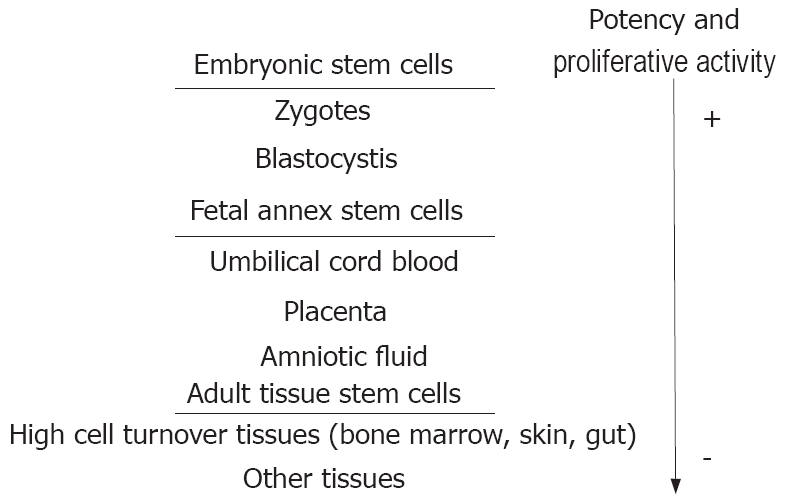
Stem cell hierarchy in humans. While embryonic stem cells are the only ones to be totipotential, adult tissues with high cellular turnover (e.g. skin, gut mucosa and bone marrow) retain a population of stem cells with restricted differentiation potential that constantly supply the tissue of new cells.
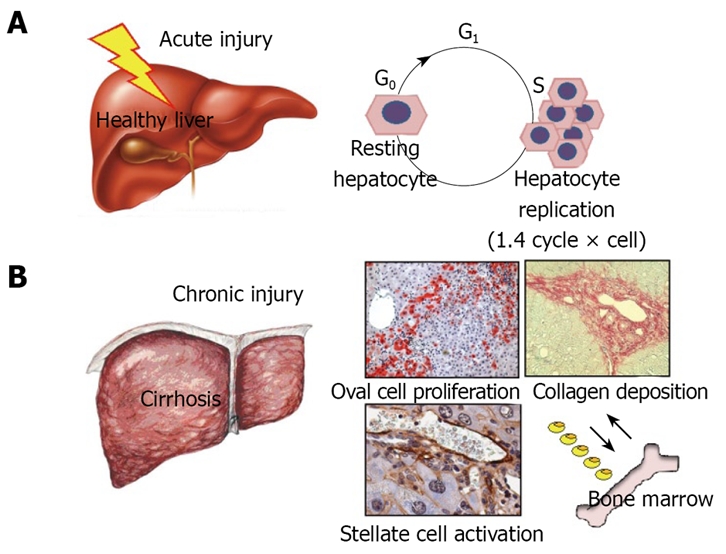
Under physiological conditions, the liver does not need any external source of cells to repair injury, as resting hepatocytes have the ability to re-enter the cell cycle rapidly and efficiently after an injury has occurred (A). In persistent liver injury, as is the case with liver cirrhosis, the sustained proliferative stress prematurely ages the hepatocytes and exhausts their ability to replicate. In this context hepatic progenitor cells, or oval cells as they are called in rodents where they were first described, appear as a rich population of small round cells spreading from the periportal area into the parenchyma. The contribution of bone marrow derived stem cells to tissue regeneration in chronic liver diseases is still debated (B).
References
-
- Heidelbaugh JJ, Bruderly M. Cirrhosis and chronic liver failure: part I. Diagnosis and evaluation. Am Fam Physician. 2006;74:756–762. - PubMed
-
- Francoz C, Belghiti J, Durand F. Indications of liver transplantation in patients with complications of cirrhosis. Best Pract Res Clin Gastroenterol. 2007;21:175–190. - PubMed
-
- Mimeault M, Hauke R, Batra SK. Stem cells: a revolution in therapeutics-recent advances in stem cell biology and their therapeutic applications in regenerative medicine and cancer therapies. Clin Pharmacol Ther. 2007;82:252–264. - PubMed
-
- Furcht L, Hoffman W. The Stem Cell Dilemma: Beacons of Hope or Harbingers of Doom? Arcade Publishing, New York. 2008:284.
Publication types
MeSH terms
LinkOut - more resources
Full Text Sources
Other Literature Sources
Medical
