. 2008 Aug 12:8:231.
doi: 10.1186/1471-2407-8-231.

Tetratricopeptide repeat domain 9A is an interacting protein for tropomyosin Tm5NM-1

Affiliations

Tetratricopeptide repeat domain 9A is an interacting protein for tropomyosin Tm5NM-1

Shenglan Cao et al. BMC Cancer. .

Abstract

Background: Tetratricopeptide repeat domain 9A (TTC9A) protein is a recently identified protein which contains three tetratricopeptide repeats (TPRs) on its C-terminus. In our previous studies, we have shown that TTC9A was a hormonally-regulated gene in breast cancer cells. In this study, we found that TTC9A was over-expressed in breast cancer tissues compared with the adjacent controls (P < 0.00001), suggesting it might be involved in the breast cancer development process. The aim of the current study was to further elucidate the function of TTC9A.

Methods: Breast samples from 25 patients including the malignant breast tissues and the adjacent normal tissues were processed for Southern blot analysis. Yeast-two-hybrid assay, GST pull-down assay and co-immunoprecipitation were used to identify and verify the interaction between TTC9A and other proteins.

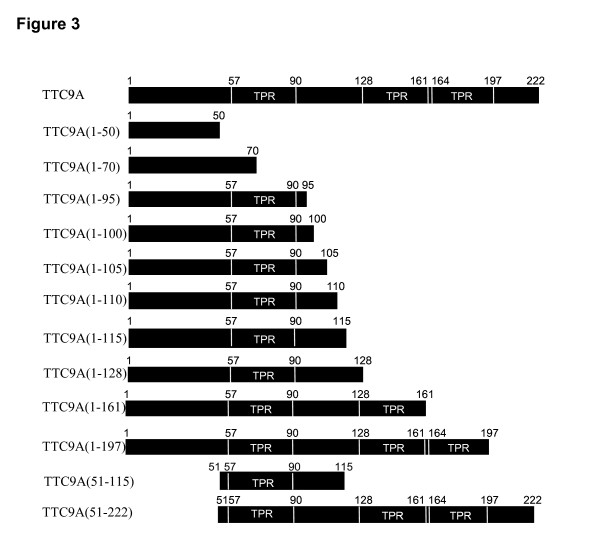
Results: Tropomyosin Tm5NM-1 was identified as one of the TTC9A partner proteins. The interaction between TTC9A and Tm5NM-1 was further confirmed by GST pull-down assay and co-immunoprecipitation in mammalian cells. TTC9A domains required for the interaction were also characterized in this study. The results suggested that the first TPR domain and the linker fragment between the first two TPR domains of TTC9A were important for the interaction with Tm5NM-1 and the second and the third TPR might play an inhibitory role.

Conclusion: Since the primary function of tropomyosin is to stabilize actin filament, its interaction with TTC9A may play a role in cell shape and motility. In our previous results, we have found that progesterone-induced TTC9A expression was associated with increased cell motility and cell spreading. We speculate that TTC9A acts as a chaperone protein to facilitate the function of tropomyosins in stabilizing microfilament and it may play a role in cancer cell invasion and metastasis.


Figures
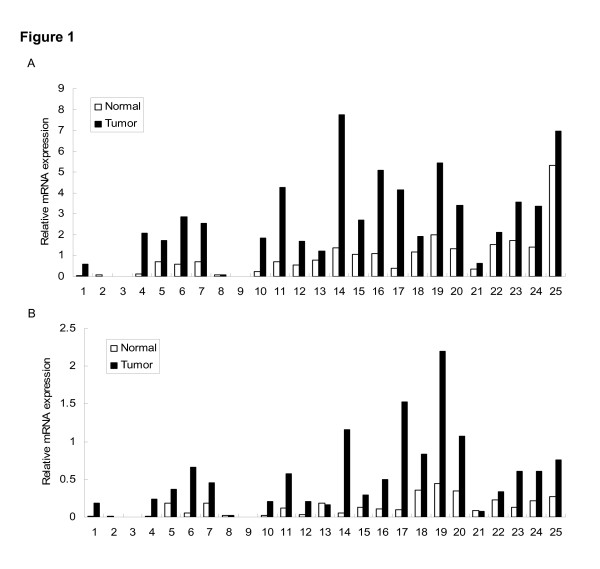
Figure 1
Figure 1
The expression level of TTC9A mRNA was significantly higher in breast cancer tissues than that in the adjacent normal breast tissues. Total RNA was extracted from human breast cancer tissues and the matched adjacent normal breast tissues. Equal amount of RNA from each sample was subjected to reverse transcription and cDNA produced was amplified by PCR using TTC9A, 36B4 or GAPDH primers. 10 μl PCR products were separated on an agarose gel and analyzed by Southern blotting. Band intensity was analyzed by Bio-Rad Molecular Image Analyzer. The figure shows the expression levels of TTC9A in 25 pairs of normal and tumor tissue samples after normalizing to those of 36B4 (A) or GAPDH (B). Each pair of bars represents samples from one patient. The primers used for TTC9A were 5'-CACATGTCTATAACGATTT CC-3' (forward) and 5'-TGCAGGAAACAGGGG ACTCTC-3' (reverse). The primers used to amplify 36B4 gene were 5'-GATTGGCTACCCAACTGTTGCA-3' (forward) and 5'-CAGGGGCAGCAGCCACAAAGGC-3' (reverse). The primers for GAPDH were 5'-TGCACCACCAACTGCTTAG-3' (forward) and 5'-GAGGCAGGGATGATG TTC-3' (reverse).
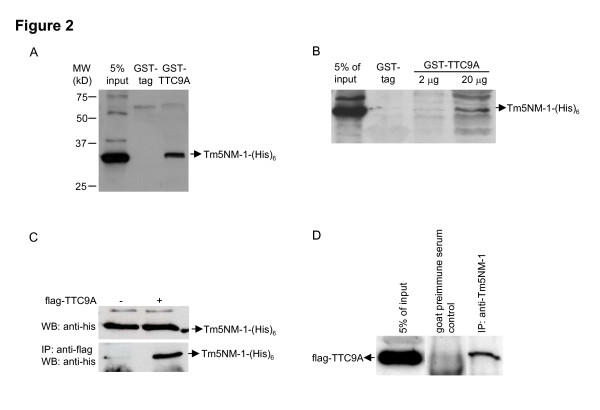
Figure 2
Figure 2
TTC9A binds to Tm5NM-1. (A) GST-TTC9A binds to Tm5NM-1-(His)6. COS-7 cells were transfected with Tm5NM-1-(His)6 expression vector or control vector and total cell lysates were collected at 48 h post-transfection. 60 μg GST-TTC9A protein was immobilized onto Glutathione Sepharose 4B gel (Amersham Biosciences) and 300 μg total cell lysates were used for Tm5NM-1-(His)6 pull-down. The proteins bound to the beads were eluted with 2 × SDS-PAGE sample buffer and were separated on an SDS-PAGE gel. Tm5NM-1-(His)6 was detected using anti-His antibody (Amersham Biosciences). GST protein expressed by empty pGEX-5X-3 vector was included as a negative control. 15 μg total cell lysates (5% of input) were loaded in the first lane to indicate the position of Tm5NM-1-(His)6 band. (B) Tm5NM-1-(His)6 pull-down by GST-TTC9A is concentration-dependent. GST-pull down assay was carried out with 2 μg or 20 μg GST-TTC9A as bait protein. The amount of Tm5NM-1-(His)6 pulled down was proportional to the amount of bait protein used. (C) TTC9A-flag interacted with Tm5NM-1-(His)6. Expression vectors for TTC9A-flag and Tm5NM-1-(His)6 were co-transfected into COS-7 cells. Co-immunoprecipitation was carried out with anti-flag agarose beads (Sigma-Aldrich) and Tm5NM-1 was detected by anti-His antibody (Amersham Biosciences). Upper panel: Tm5NM-1-(His)6 was expressed at similar level in control vector and TTC9A-flag transfected COS-7 cells; lower panel: Tm5NM-1-(His)6 was pulled down by TTC9A-flag. (D) TTC9A-flag interacted with endogenous Tm5NM-1-(His)6. Expression vector for TTC9A-flag was transfected into COS-7 cells. Co-immunoprecipitation was carried out with anti-Tm5NM-1/2 (Chemicon) antibody and TTC9A was detected by anti-flag antibody (Sigma-Aldrich). Co-immunoprecipitation with goat pre-immune serum was included as a negative control.
Figure 3
Figure 3
Truncation constructs of TTC9A protein and their relative binding to Tm5NM-1 based on co-immunoprecipitation experiment.
Figure 4
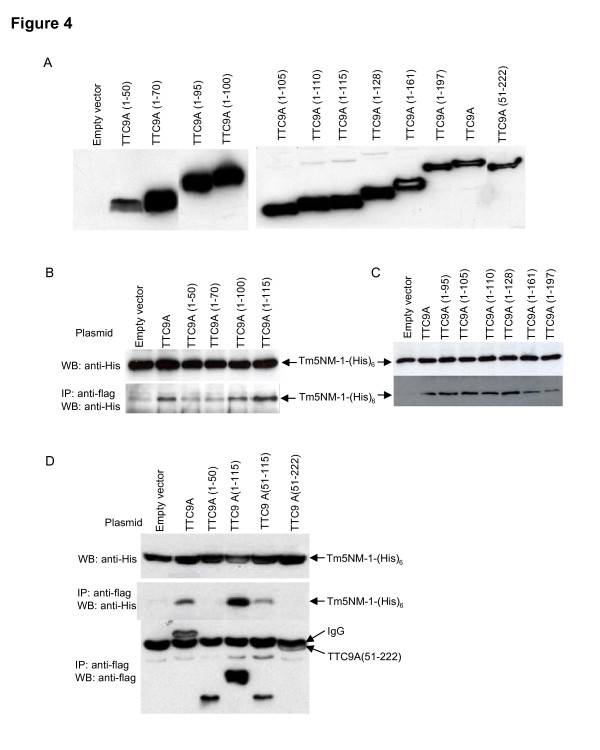
Figure 4
Domains involved in TTC9A and Tm5NM-1 interaction. (A) Western blot analysis of the expression TTC9A truncates in the cell lysates using anti-flag antibody from Sigma-Aldrich. All truncations expressed proteins of predicted sizes. The hollow streak in some of the bands indicates over-saturation of the signal. (B and C) Test of Tm5NM-1-(His)6 pull-down by different TTC9A truncations in pXL-Flag vectors. The TTC9 truncation constructs were transfected into COS-7 cells together with Tm5NM-1-(His)6 expression vector. The interaction between flag-TTC9A truncates and Tm5NM-1-(His)6 was analyzed by co-immunoprecipitation with anti-flag agarose beads (Sigma-Aldrich). The upper panels in B and C are Western blotting analysis of Tm5NM-1 expression in the cell lysates using anti-His antibody (Amersham Biosciences), and the lower panels are the Tm5NM-1-(His)6 co-immunoprecipitated with flag-TTC9A and the truncated proteins. (D) The upper panel is the analysis of Tm5NM-1 expression in the cell lysates; the middle panel is the co-immunoprecipitated Tm5NM-1 with flag-TTC9A and the truncated proteins; the lower panel represents the amount of TTC9A and its truncates pulled down by the anti-flag agarose beads (Sigma-Aldrich) in the co-immunoprecipitation assay.

References

    1. Nagase T, Seki N, Ishikawa K, Ohira M, Kawarabayasi Y, Ohara O, Tanaka A, Kotani H, Miyajima N, Nomura N. Prediction of the coding sequences of unidentified human genes. VI. The coding sequences of 80 new genes (KIAA0201-KIAA0280) deduced by analysis of cDNA clones from cell line KG-1 and brain. DNA Res. 1996;3:321–329. 341–354. - PubMed
    1. Cao S, Iyer JK, Lin V. Identification of tetratricopeptide repeat domain 9, a hormonally regulated protein. Biochem Biophys Res Commun. 2006;345:310–317. - PubMed
    1. Strausberg RLFE, Grouse LH, Derge JG, Klausner RD, Collins FS, Wagner L, et al. Generation and initial analysis of more than 15,000 full-length human and mouse cDNA sequences. Proc Natl Acad Sci USA. 2002;99:16899–16903. - PMC - PubMed
    1. Blatch GL, Lassle M. The tetratricopeptide repeat: a structural motif mediating protein-protein interactions. Bioessays. 1999;21:932–939. - PubMed
    1. Lamb JR, Tugendreich S, Hieter P. Tetratrico peptide repeat interactions: to TPR or not to TPR? Trends Biochem Sci. 1995;20:257–259. - PubMed

Publication types