Comparative Study
. 2008;59(12):3327-46.
doi: 10.1093/jxb/ern199. Epub 2008 Aug 13.

Different mechanisms of adaptation to cyclic water stress in two South Australian bread wheat cultivars

Affiliations
Comparative Study

Different mechanisms of adaptation to cyclic water stress in two South Australian bread wheat cultivars

Ali Izanloo et al. J Exp Bot. 2008.

Abstract

In the South Australian wheat belt, cyclic drought is a frequent event represented by intermittent periods of rainfall which can occur around anthesis and post-anthesis in wheat. Three South Australian bread wheat (Triticum aestivum L.) cultivars, Excalibur, Kukri, and RAC875, were evaluated in one greenhouse and two growth-room experiments. In the first growth-room experiment, where plants were subjected to severe cyclic water-limiting conditions, RAC875 and Excalibur (drought-tolerant) showed significantly higher grain yield under cyclic water availability compared to Kukri (drought-susceptible), producing 44% and 18% more grain compared to Kukri, respectively. In the second growth-room experiment, where plants were subjected to a milder drought stress, the differences between cultivars were less pronounced, with only RAC875 showing significantly higher grain yield under the cyclic water treatment. Grain number per spike and the percentage of aborted tillers were the major components that affected yield under cyclic water stress. Excalibur and RAC875 adopted different morpho-physiological traits and mechanisms to reduce water stress. Excalibur was most responsive to cyclic water availability and showed the highest level of osmotic adjustment (OA), high stomatal conductance, lowest ABA content, and rapid recovery from stress under cyclic water stress. RAC875 was more conservative and restrained, with moderate OA, high leaf waxiness, high chlorophyll content, and slower recovery from stress. Within this germplasm, the capacity for osmotic adjustment was the main physiological attribute associated with tolerance under cyclic water stress which enabled plants to recover from water deficit.


Figures
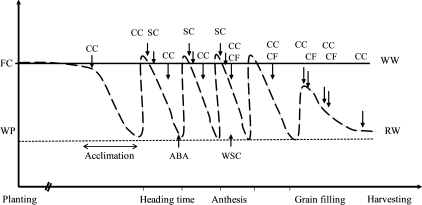
Fig. 1.
Fig. 1.
Schematic diagram of cyclic drought application and the time of trait measurements throughout the experiment. FC, field capacity; WP, wilting point; CC, chlorophyll content; CF, chlorophyll fluorescence; SC, stomatal conductance; ABA, abscisic acid, and WSC, water-soluble carbohydrates.
Fig. 2.
Fig. 2.
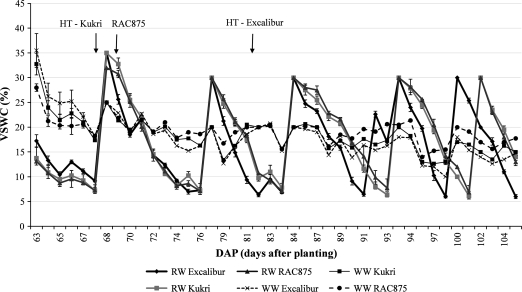
The volumetric soil water content (Vw/V) during RW and WW treatments (data from the second experiment). Water stress was started from 53 DAP for Kukri and RAC875, while it was started from 61 DAP for Excalibur. To synchronize the time of watering, all cultivars were watered at 68 DAP. VSWC measurements were started 63 DAP. HT is the heading time.
Fig. 3.
Fig. 3.
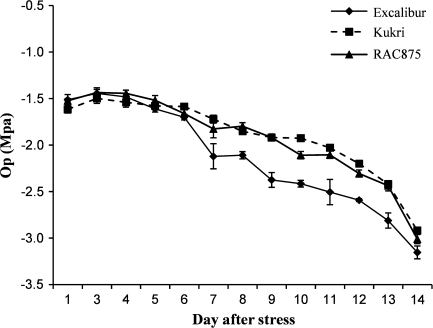
Decrease in osmotic potential with successive water stress in Excalibur, Kukri, and RAC875.
Fig. 4.
Fig. 4.
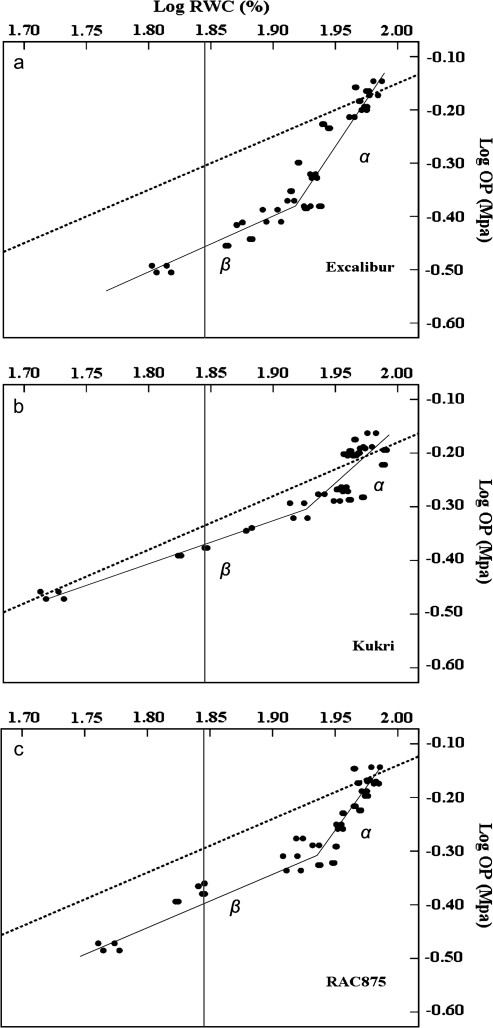
The linear regressions of osmotic potential (OP) and relative water content (RWC) in log scale. Relationship between RWCand OPfor flag leaves of Excalibur (a), Kukri (b), and RAC875 (c). The dashed line is the response of an ideal osmometer and the solid line is the actual fit for RWCversus OP. The vertical grey line is the logarithm of RWC=70%. There are two linear phases: in the first phase (α), there was little change in RWCas OPdeclined, while in the second phase (β), RWCdeclined linearly with OP. Three cultivars were grouped according to their response to high (a), low (b), and medium (c) osmotic adjustment (OA).
Fig. 5.
Fig. 5.
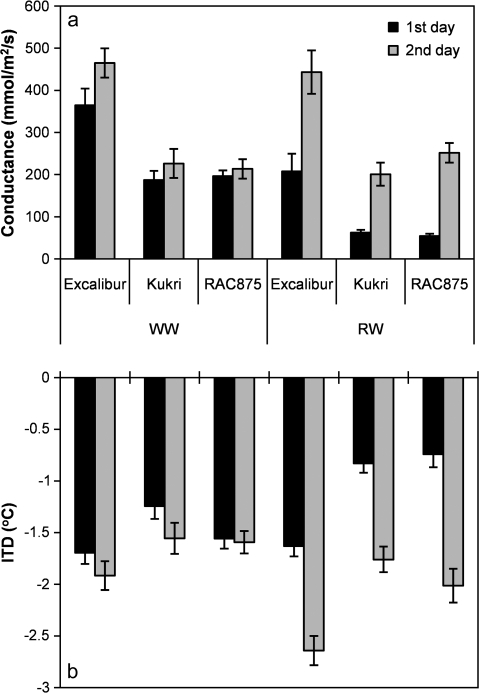
The average stomatal conductance of plants in Experiments I and II for the first and second days after re-watering. In Experiment I, measurements were done in one period, but in Experiment II three periods of measurements were performed (a). Leaf initial temperature differences (ITD) after re-watering (b). ITD was calculated by subtracting the temperature of the ambient air of the leaf temperature. Error bars are SE of means.
Fig. 6.
Fig. 6.
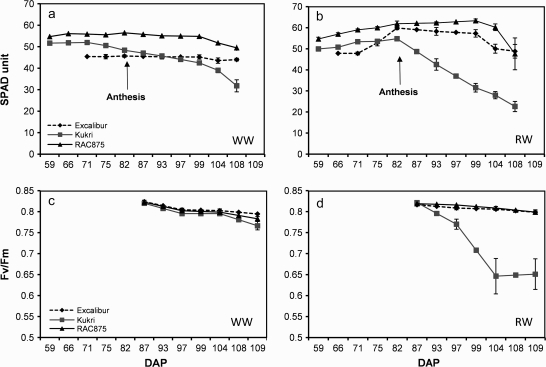
Chlorophyll content and fluorescence (Fv/Fmratio) in Excalibur, Kukri, and RAC875 for Experiment II. The measurements were done on the same flag leaves during plant growth under and during the grain-filling period. The chlorophyll content under WW and RW treatments (a, b); large error bar on day 108 for RAC875 under RW treatment resulted from developing senescence in flag leaves. Fv/Fm under WW and RW treatments (c, d). Error bars are SE of means.
Fig. 7.
Fig. 7.
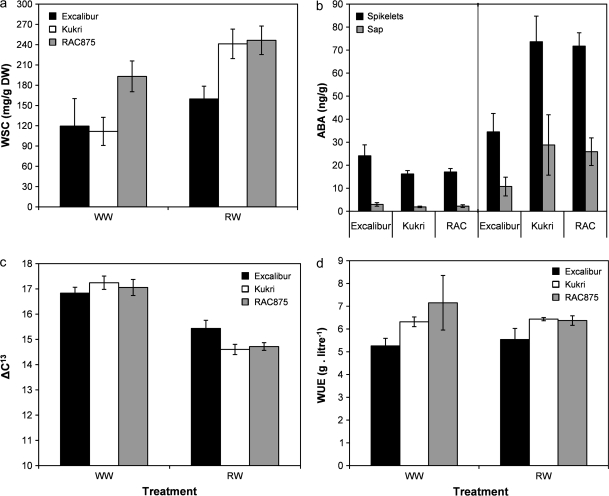
Drought-related traits for Excalibur, Kukri, and RAC875 under WW and RW treatments in Experiment II. (a) Values for water-soluble stem carbohydrates (WSC); stem samples were taken 5 d after anthesis. (b) ABA concentration in floral tissue and xylem sap; when tissue was collected, plants/lines experienced severe water stress during RW treatment whereas plants under WW conditions remained unstressed. (c) Values for carbon isotope discrimination on grains, pos-harvest and (d) values for agronomic WUE for Excalibur, Kukri, and RAC875 under WW and RW treatments. Error bars are SE of means.

References

    1. Ali M, Jensen CR, Mogensen VO, Andersen MN, Henson IE. Root signalling and osmotic adjustment during intermittent soil drying sustain grain yield of field grown wheat. Field Crops Research. 1999;62:35–52.
    1. Araus JL, Alegre L, Tapia L, Calafell R. Relationship between leaf structure and gas exchange in wheat leaves at different insertion levels. Journal of Experimental Botany. 1986;37:1323–1333.
    1. Araus JL, Amaro T, Voltas J, Nakkoul H, Nachit MM. Chlorophyll fluorescence as a selection criterion for grain yield in durum wheat under Mediterranean conditions. Field Crops Research. 1998;55:209–223.
    1. Babu RC, Pathan MS, Blum A, Nguyen HT. Comparison of measurement methods of osmotic adjustment in rice cultivars. Crop Science. 1999;39:150–158.
    1. Barr HD, Weatherley PE. A re-examination of the relative turgidity technique for estimating water deficit in leaves. Australian Journal of Biological Science. 1962;15:413–428.

Publication types