


Activation of ATP/UTP-selective receptors increases blood flow and blunts sympathetic vasoconstriction in human skeletal muscle
- PMID: 18703581
- PMCID: PMC2614056
- DOI: 10.1113/jphysiol.2008.155432
Activation of ATP/UTP-selective receptors increases blood flow and blunts sympathetic vasoconstriction in human skeletal muscle
Abstract
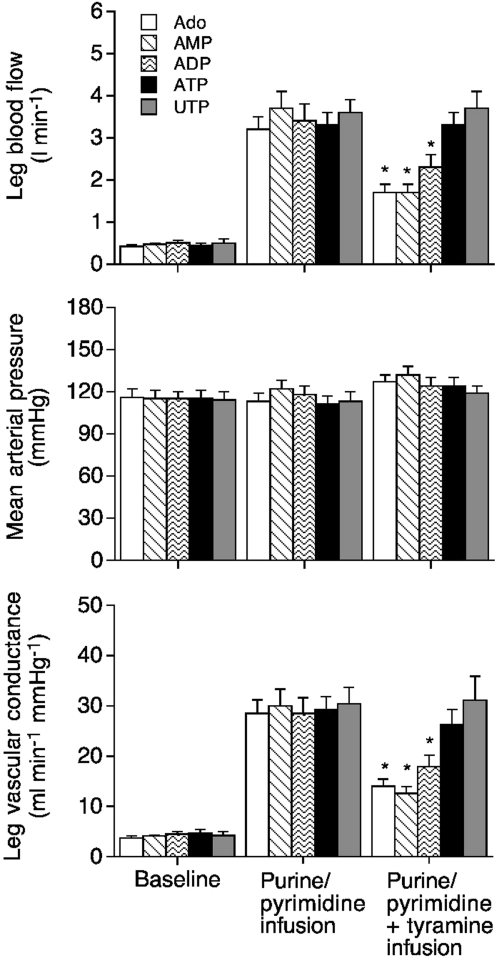
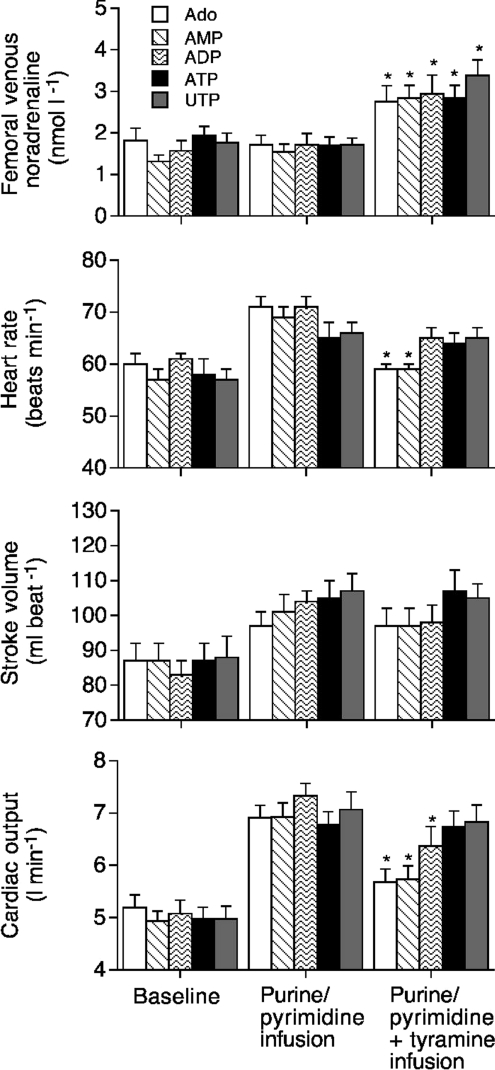
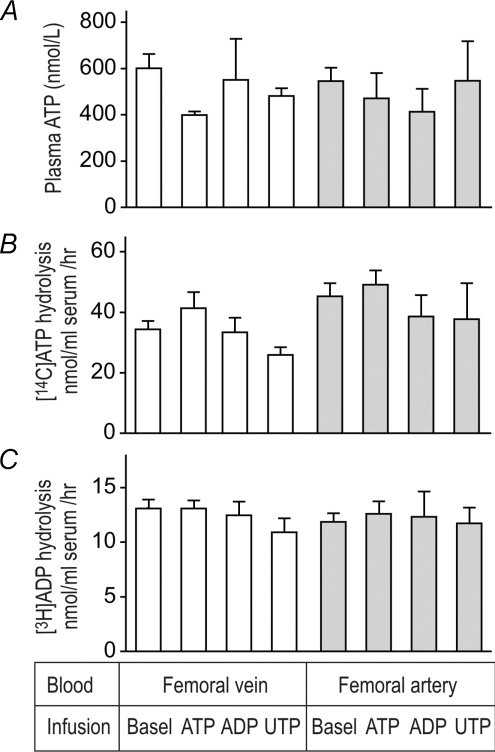
Sympathetic vasoconstriction is blunted in the vascular beds of contracting skeletal muscle in humans, presumably due to the action of vasoactive metabolites (functional sympatholysis). Recently, we demonstrated that infusion of ATP into the arterial circulation of the resting human leg increases blood flow and concomitantly blunts alpha-adrenergic vasoconstriction in a similar manner to that during moderate exercise. Here we tested the hypothesis that ATP, rather than its dephosphorylated metabolites, induces vasodilatation and sympatholysis in resting skeletal muscle via activation of ATP/UTP-selective receptors. To this aim, we first measured leg blood flow (LBF), mean arterial pressure (MAP), cardiac output , leg arterial-venous (a-v) O(2) difference, plasma ATP and soluble nucleotidase activities during intrafemoral artery infusion of adenosine, AMP, ADP, ATP or UTP in nine healthy males. Comparison of the doses of nucleotides and adenosine required for a similar increase in LBF from approximately 0.5 l min(-1) at baseline to approximately 3.5 l min(-1) (without altering MAP but increasing Q significantly) revealed the following rank order of vasoactive potency: ATP (100) = UTP (100) >> adenosine (5.8) > ADP (2.7) > AMP (1.7). The infusions did not cause any shifts in plasma ATP level or soluble serum nucleotidase activities. Combined infusion of the vasodilatory compounds and the sympathetic vasoconstrictor drug tyramine increased plasma noradrenaline in all hyperaemic conditions, but only caused leg and systemic vasoconstriction and augmented O(2) extraction during adenosine, AMP and ADP infusion (LBF from 3.2 +/- 0.3 to 1.8 +/- 0.2 l min(-1); 3.7 +/- 0.4 to 1.7 +/- 0.2 l min(-1) and 3.3 +/- 0.4 to 2.4 +/- 0.3 l min(-1), respectively, P < 0.05). These findings in humans suggest that the vasodilatory and sympatholytic effects of exogenous ATP in the skeletal muscle vasculature are largely mediated via ATP itself rather than its dephosphorylated metabolites, most likely via binding to endothelial ATP/UTP-selective P2Y(2) receptors. These data are consistent with a role of ATP in skeletal muscle hyperaemia in conditions of increased sympathetic nerve drive such as exercise or hypoxia.
Figures
Comment in
-
Tripartite function of ATP in vascular signalling.J Physiol. 2008 Oct 15;586(20):4783-4. doi: 10.1113/jphysiol.2008.162404. J Physiol. 2008. PMID: 18854430 Free PMC article. No abstract available.
References
-
- Abbracchio MP, Burnstock G, Boeynaems JM, Barnard EA, Boyer JL, Kennedy C, Knight GE, Fumagalli M, Gachet C, Jacobson KA, Weisman GA. International Union of Pharmacology LVIII: update on the P2Y G protein-coupled nucleotide receptors: from molecular mechanisms and pathophysiology to therapy. Pharm Rev. 2006;58:281–341. - PMC - PubMed
-
- Bogert LW, van Lieshout JJ. Non-invasive pulsatile arterial pressure and stroke volume changes from the human finger. Exp Physiol. 2005;90:437–446. - PubMed
-
- Buckwalter JB, Naik JS, Valic Z, Clifford PS. Exercise attenuates α-adrenergic-receptor responsiveness in skeletal muscle vasculature. J Appl Physiol. 2001;90:172–178. - PubMed
-
- Burnstock G, Kennedy C. A dual function for adenosine 5′-triphosphate in the regulation of vascular tone. Excitatory cotransmitter with noradrenaline from perivascular nerves and locally released inhibitory intravascular agent. Circ Res. 1986;58:319–330. - PubMed
-
- Busse R, Edwards G, Feletou M, Flemming I, Vanhoutte PM, Weston AH. EDHF: bringing the concepts together. Trends Pharmacol Sci. 2002;23:374–380. - PubMed
Publication types
MeSH terms
Substances
LinkOut - more resources
Full Text Sources
Other Literature Sources
Miscellaneous
