


Longitudinal cerebral blood flow and amyloid deposition: an emerging pattern?
- PMID: 18703614
- PMCID: PMC2570023
- DOI: 10.2967/jnumed.108.051946
Longitudinal cerebral blood flow and amyloid deposition: an emerging pattern?
Abstract
Although cerebral amyloid deposition may precede cognitive impairment by decades, the relationship between amyloid deposition and longitudinal change in neuronal function has not, to our knowledge, been studied. The aim of this article was to determine whether individuals without dementia with high and low amyloid burden show different patterns of longitudinal regional cerebral blood flow (rCBF) changes in the years preceding measurement of amyloid deposition.
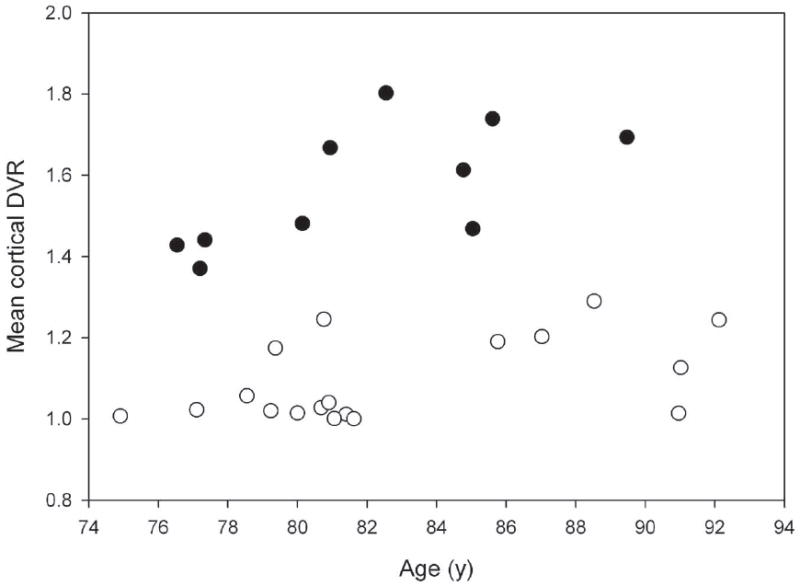
Methods: Twenty-eight participants without dementia (mean age+/-SD, 82.5+/-4.8 y; 6 mildly impaired) from the Baltimore Longitudinal Study of Aging underwent yearly resting-state (15)O-H(2)O PET scans for up to 8 y. (11)C-PIB images of amyloid deposition were acquired on average 10.8+/-0.8 y after the first CBF scan. (11)C-PIB distribution volume ratios of regions of interest were estimated by fitting a reference-tissue model to the measured time-activity curves. On the basis of mean cortical distribution volume ratios, participants were divided into groups with high or low (11)C-PIB retention. Differences in longitudinal rCBF changes between high- and low-(11)C-PIB groups were investigated by voxel-based analysis.
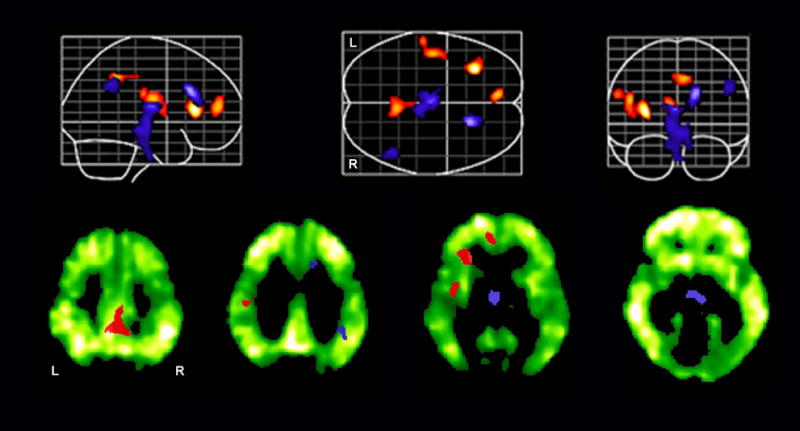
Results: Longitudinal rCBF changes differed significantly between high- (n=10) and low- (n=18) (11)C-PIB groups (P <or= 0.001). Greater longitudinal decreases in rCBF in the high-(11)C-PIB group than in the low-(11)C-PIB group were seen in right anterior to middle cingulate, right supramarginal gyrus, left thalamus, and midbrain bilaterally. Greater increases in rCBF over time in the high-(11)C-PIB group were found in left medial and inferior frontal gyri, right precuneus, left inferior parietal lobule, and left postcentral gyrus.
Conclusion: In this group of older adults without dementia, those with high (11)C-PIB show greater longitudinal declines in rCBF in certain areas, representing regions with greater decrements in neuronal function. Greater longitudinal increases in rCBF are also observed in those with higher amyloid load and may represent an attempt to preserve neuronal function in these regions.
Conflict of interest statement
Figures
References
-
- Klunk WE, Engler H, Nordberg A, et al. Imaging brain amyloid in Alzheimer’s disease with Pittsburgh Compound-B. Ann Neurol. 2004 Mar;55(3):306–319. - PubMed
-
- Petersen RC, Morris JC. Mild cognitive impairment as a clinical entity and treatment target. Arch Neurology. 2005 Jul;62(7):1160–1163. discussion 1167. - PubMed
-
- Mintun MA, Larossa GN, Sheline YI, et al. [11C]PIB in a nondemented population: potential antecedent marker of Alzheimer disease. Neurology. 2006 Aug 8;67(3):446–452. - PubMed
-
- Rowe CC, Ng S, Ackermann U, et al. Imaging {beta}-amyloid burden in aging and dementia. 2007;68:1718–1725. - PubMed
-
- Kemppainen NM, Aalto S, Wilson IA, et al. PET amyloid ligand [11C]PIB uptake is increased in mild cognitive impairment. Neurology. 2007 May 8;68(19):1603–1606. - PubMed
Publication types
MeSH terms
Grants and funding
LinkOut - more resources
Full Text Sources
