


doi: 10.1152/ajpgi.90213.2008.
Epub 2008 Aug 14.
High dietary inorganic phosphate enhances cap-dependent protein translation, cell-cycle progression, and angiogenesis in the livers of young mice
Affiliations
- PMID: 18703640
- PMCID: PMC2575911
- DOI: 10.1152/ajpgi.90213.2008
Item in Clipboard
High dietary inorganic phosphate enhances cap-dependent protein translation, cell-cycle progression, and angiogenesis in the livers of young mice
Am J Physiol Gastrointest Liver Physiol.
2008 Oct.
Abstract
Inorganic phosphate (P(i)) plays a key role in diverse physiological functions. Recent studies have indicated that P(i) affects Akt signaling through the sodium-dependent phosphate cotransporter. Akt signaling, in turn, plays an important role in liver development; however, the effects of high dietary P(i) on the liver have not been investigated. Here, we examined the effects of high dietary phosphate on the liver in developing mice. We found that high dietary P(i) increased liver mass through enhancing Akt-related cap-dependent protein translation, cell cycle progression, and angiogenesis. Thus careful regulation of P(i) consumption may be important in maintaining normal development of the liver.
Figures
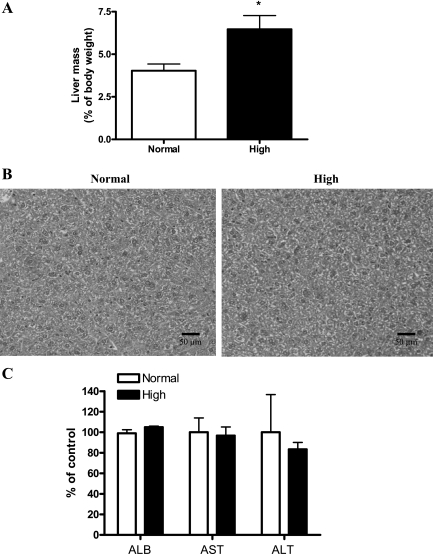
Effects of high dietary inorganic phosphate (Pi) on liver mass and function. Two-week-old transgenic mice were fed a normal- or high-Pi diet for 4 wk. A: liver mass as a percentage of body mass. B: histopathology of the livers. Original magnification was ×400. Scale bar = 50 μm. C: changes in the levels of serum albumin (ALB), aspartate aminotransferase (ATS) and alanine aminotransferase (ALT). *P < 0.05 compared with normal diet group (means ± SE, n = 5).

Pi level and NPT-2b protein expression in the liver of young mice. Two-week-old transgenic mice were fed a normal- or high-Pi diet for 4 wk. A: expression of Na/Pi transporter (NPT)-2b protein in the liver. B: bands of NPT-2b were further analyzed by densitometer. C: Pi level in the liver tissue. *P < 0.05 compared with normal diet group (means ± SE, n = 5).
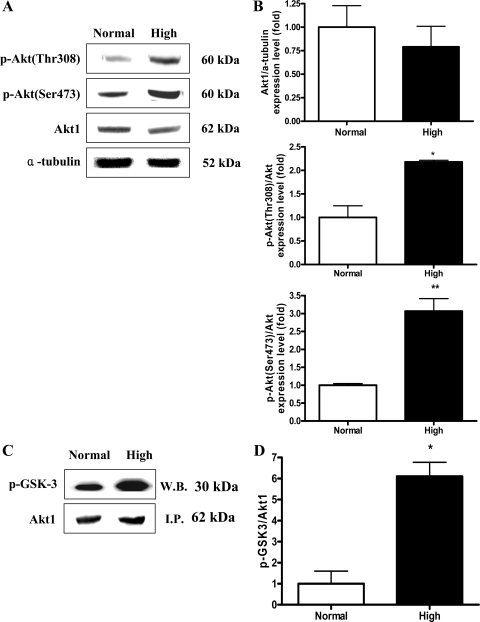
Western blot (W.B.) analysis of Akt and phospho-Akt protein expressions and Akt kinase assay in the liver of young mice. Two-week-old transgenic mice were fed a normal- or high-Pi diet for 4 wk. A: expression of Akt and phospho-Akt proteins in the liver. B: bands of interests were further analyzed by densitometer. C: Akt kinase activity was measured in the liver homogenates. Protein was immunoprecipitated (I.P.) with Akt-specific antibody, and GSK-3 protein was used as a substrate. The immunoblotting of Akt1 was used as a control. D: bands of interests were further analyzed by densitometer. *P < 0.05, **P < 0.01 compared with normal-diet group (means ± SE, n = 5).
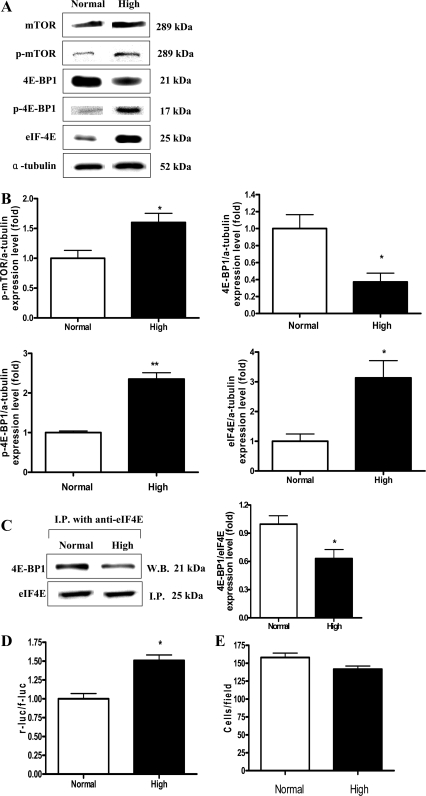
Western blot analysis of Akt downstream signals, measurement of dual luciferase activity, immunoprecipitation assay, and liver cell size in the liver of young mice. Two-week-old transgenic mice were fed a normal- or high-Pi diet for 4 wk. Liver tissue homogenates were subjected to further analysis. A: expression of mammalian target of rapamycin (mTOR), phospho-mTOR (p-mTOR), eukaryotic initiation factor 4E (eIF-4E), 4 eIF binding protein (4E-BP1), and phospho-4E-BP1 (p-4E-BP1) in the liver. B: bands of interest were further analyzed by densitometer. C: immunoprecipitation analysis of eIF-4E and 4E-BP1 levels. D: luciferase activities were measured for the determination of the ratios between cap-dependent and cap-independent protein translations in the liver. r-luc, Renilla luciferase; f-luc; firefly luciferase. E: hepatocyte number per field in liver sections. The cell numbers were counted at ×400 magnification. *P < 0.05, **P < 0.01 compared with normal-diet group (means ± SE, n = 5).
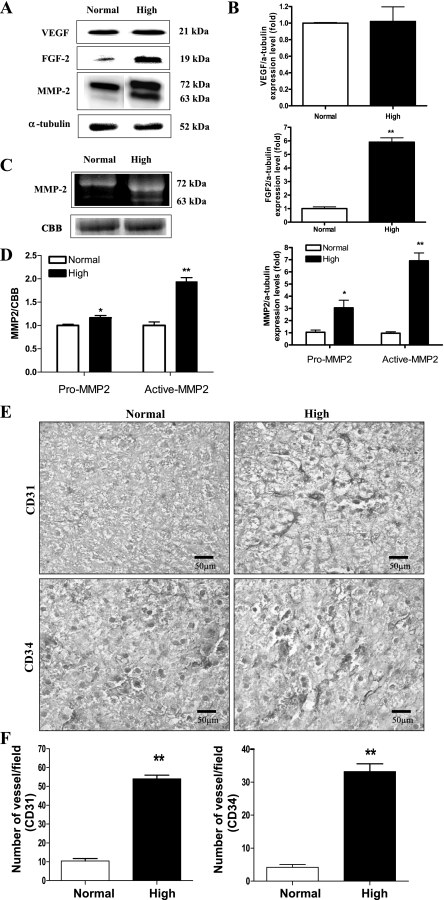
Analysis of angiogenic factors expression in the liver of young mice. Two-week-old transgenic mice were fed a normal- or high-Pi diet for 4 wk. A: expression of matrix metalloproteinase-2 (MMP-2), fibroblast growth factor 2 (FGF-2), and vascular endothelial growth factor (VEGF) proteins in the liver. B: bands of interest were further analyzed by densitometry. C: gelatin zymography assay for the activity of MMP-2. D: zymographic band intensities were quantified by densitometry. Equivalent protein loading was confirmed by staining the gels with Coomassie brilliant blue R-250 (CBB). E: immunohistochemistry (IHC) of CD31 and CD34 in the liver. Dark brown color represents the CD31 and CD34 proteins in the liver. Original magnification was ×400. Scale bar = 50 μm. F: microvessel density quantification was determined by counting the number of CD31- or CD34-positive vessels per field of view at ×400 magnification. *P < 0.05, **P < 0.01 compared with normal-diet group (means ± SE, n = 5).
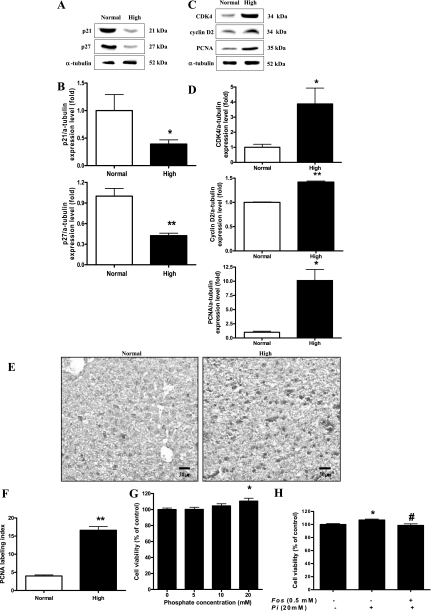
Effects of Pi on cell cycle progression in the liver. Two-week-old transgenic mice were fed a normal- or high-Pi diet for 4 wk. A: expression of p21 and p27 proteins in the liver. B: bands of interest were further analyzed by densitometry. C: expression of cyclin D2, cyclin-dependent kinase 4 (CDK4), and proliferating cell nuclear antigen (PCNA) proteins in the liver. D: bands of interest were further analyzed by densitometer. *P < 0.05, **P < 0.01 compared with normal-diet group (means ± SE, n = 5). E: IHC of PCNA in the liver. Dark brown color represents PCNA protein in the liver. Original magnification was ×200. Scale bar = 50 μm. F: comparison of PCNA labeling index in the liver of young mice. PCNA-positive staining was determined by counting 3 randomly chosen fields per section, determining the percentage of DAB-positive cells per 100 cells at ×400 magnification. G: WB-F344 cells were incubated for 48 h with various concentration of Pi, and then, the cell viability was measured by MTT assay. H: WB-F344 cells were pretreated with 0.5 mM foscarnet (Fos) phosphate transport inhibitor for 30 min and then treated with 20 mM of Pi. After 48-h incubation with Pi, the cell viability was measured using MTT assay. Values represent the means ± SE of 3 independent experiments. *P < 0.05 compared with control, #P < 0.05 compared with Pi treatment.
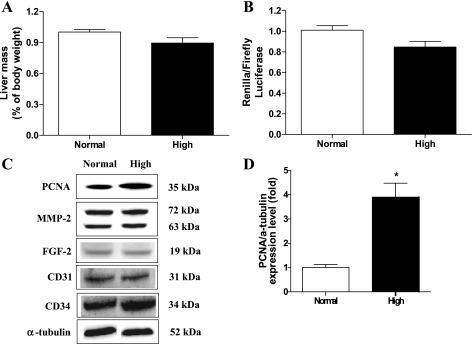
Effects of high-Pi diet at 2 wk on the liver of developing mice. Two-week-old transgenic mice were fed a normal- or high-Pi diet for 2 wk. A: liver mass as a percentage of body mass. B: luciferase activities were measured for the determination of the ratios between cap-dependent and cap-independent protein translations in the liver. C: expression of PCNA, FGF-2, MMP-2, CD31, and CD34 proteins in the liver. D: bands of interest were further analyzed by densitometry. *P < 0.05, compared with normal diet group (means ± SE, n = 5).
References
-
- Asnaghi L, Bruno P, Priulla M, Nicolin A. mTOR: a protein kinase switching between life and death. Pharmacol Res 50: 545–549, 2004. - PubMed
-
- Beck GR Jr, Moran E, Knecht N. Inorganic phosphate regulates multiple genes during osteoblast differentiation, including Nrf2. Exp Cell Res 288: 288–300, 2003. - PubMed
-
- Bremnes RM, Camps C, Sirera R. Angiogenesis in non-small cell lung cancer: the prognostic impact of neoangiogenesis and the cytokines VEGF and bFGF in tumours and blood. Lung Cancer 51: 143–158, 2006. - PubMed
-
- Calvo MS Dietary phosphorus, calcium metabolism, and bone. J Nutr 123: 1627–1633, 1993. - PubMed
Publication types
MeSH terms
Substances
Grants and funding
LinkOut - more resources
Full Text Sources
Molecular Biology Databases
Research Materials
Miscellaneous
