


Cardiovascular risk factors and incident Alzheimer disease: a systematic review of the literature
- PMID: 18703981
- PMCID: PMC3689425
- DOI: 10.1097/WAD.0b013e318187541c
Cardiovascular risk factors and incident Alzheimer disease: a systematic review of the literature
Abstract
Objective: The purpose of this study was to conduct a systematic review of the literature of cardiovascular factors pertaining to incident Alzheimer disease (AD).
Methods: A systematic literature review was conducted of all studies of cardiovascular risk factors for incident AD listed in PubMed in English from 2000 to 2007. Risk factors included hypertension, diabetes, exercise, alcohol intake, smoking, B complex vitamins, homocysteine, stroke, atrial fibrillation, apolipoprotein E (APOE), lipids, and diet. Inclusion criteria consisted of diagnoses of incident AD and longitudinal studies with cohorts of 500 or more.
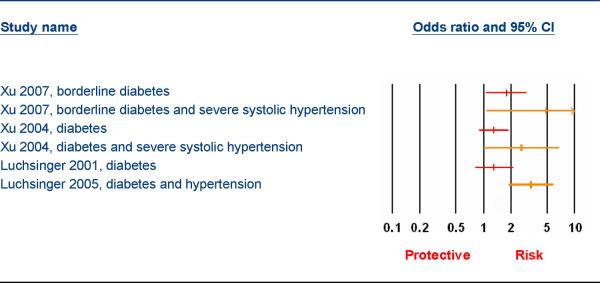
Results: Individual clinically defined risk factors such as hypertension and diabetes were not significantly associated with increased risk for AD. The strength of the association for hypertension could be considerably strengthened by changing criteria such as midlife measurements or using higher cutoffs for systolic blood pressure. APOE epsilon4 was the most consistent risk factor. Interactions between risk factors modify risk particularly for hypertension and diabetes. Interactions modifying risk were also found for exercise and physical function, APOE epsilon4, diabetes, and cholesterol.
Conclusions: In this review, the evidence that single clinically defined cardiovascular risk factors are significantly associated with incident AD is inconsistent at best. The strength of the association of cardiovascular risk factors and AD can be influenced greatly by changing the parameters of measurement of risk factors and by identifying interactions between the factors.
Figures
References
-
- Fratiglioni L, Paillard-Borg S, Winblad B. An active and socially integrated lifestyle in late life might protect against dementia. Lancet Neurol. 2004;3:343–53. - PubMed
-
- Hendrie HC, Albert MS, Butters MA, et al. The NIH Cognitive and Emotional Health Project Report of the Critical Evaluation Study Committee. Alzheimer's & Dementia. 2006;2:12–32. - PubMed
-
- Jedrziewski MK, Lee VM-Y, Trojanowski JQ. Lowering the risk of Alzheimer's disease: Evidence-based practices emerge from new research. Alzheimer's & Dementia. 2005;1:152–60. - PubMed
-
- Grodstein F. Cardiovascular risk factors and cognitive function. Alzheimer's & Dementia. 2007;3:S16–22. - PubMed
-
- Bennett DA. Postmortem indices linking risk factors to cognition: results from the Religious Order Study and the Memory and Aging Project. Alzheimer Dis Assoc Disord. 2006;20:S63–8. - PubMed
Publication types
MeSH terms
Grants and funding
LinkOut - more resources
Full Text Sources
Medical
Miscellaneous
