


Effect of microgravity on gene expression in mouse brain
- PMID: 18704384
- PMCID: PMC2651838
- DOI: 10.1007/s00221-008-1523-5
Effect of microgravity on gene expression in mouse brain
Abstract
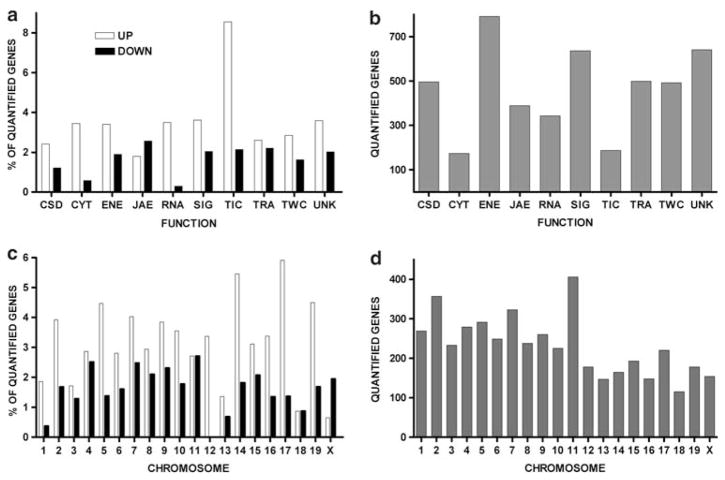
Changes in gravitational force such as that experienced by astronauts during space flight induce a redistribution of fluids from the caudad to the cephalad portion of the body together with an elimination of normal head-to-foot hydrostatic pressure gradients. To assess brain gene profile changes associated with microgravity and fluid shift, a large-scale analysis of mRNA expression levels was performed in the brains of 2-week control and hindlimb-unloaded (HU) mice using cDNA microarrays. Although to different extents, all functional categories displayed significantly regulated genes indicating that considerable transcriptomic alterations are induced by HU. Interestingly, the TIC class (transport of small molecules and ions into the cells) had the highest percentage of up-regulated genes, while the most down-regulated genes were those of the JAE class (cell junction, adhesion, extracellular matrix). TIC genes comprised 16% of those whose expression was altered, including sodium channel, nonvoltage-gated 1 beta (Scnn1b), glutamate receptor (Grin1), voltage-dependent anion channel 1 (Vdac1), calcium channel beta 3 subunit (Cacnb3) and others. The analysis performed by GeneMAPP revealed several altered protein classes and functional pathways such as blood coagulation and immune response, learning and memory, ion channels and cell junction. In particular, data indicate that HU causes an alteration in hemostasis which resolves in a shift toward a more hyper-coagulative state with an increased risk of venous thrombosis. Furthermore, HU treatment seems to impact on key steps of synaptic plasticity and learning processes.
Figures
References
-
- Amin MS, Wang HW, Reza E, Whitman SC, Tuana BS, Leenen FH. Distribution of epithelial sodium channels and mineral-ocorticoid receptors in cardiovascular regulatory centers in rat brain. Am J Physiol Regul Integr Comp Physiol. 2005;289:R1787–R1797. - PubMed
-
- Angulo E, Noé V, Casadó V, Mallol J, Gomez-Isla T, Lluis C, Ferrer I, Ciudad CJ, Franco R. Up-regulation of the Kv34 potassium channel subunit in early stages of Alzheimer’s disease. J Neurochem. 2004;91:547–557. - PubMed
-
- Belichenko PV. Quantitative analysis of dendritic spines of pyramidal neurons in the layers of the sensorimotor cortex of rats exposed to the Cosmos-1667 biosputnik. Biull Eksp Biol Med. 1998;105:736–738. - PubMed
-
- Bleeker MW, Hopman MT, Rongen GA, Smits P. Unilateral lower limb suspension can cause deep venous thrombosis. Am J Physiol Regul Integr Comp Physiol. 2004;286:R1176–R1177. - PubMed
-
- Brooke RE, Atkinson L, Batten TF, Deuchars SA, Deuchars J. Association of potassium channel Kv34 subunits with pre- and post-synaptic structures in brainstem and spinal cord. Neuroscience. 2004;126:1001–1010. - PubMed
Publication types
MeSH terms
Grants and funding
LinkOut - more resources
Full Text Sources
Other Literature Sources
Molecular Biology Databases
