


Tibial post wear in posterior-stabilized knee replacements is design-dependent
- PMID: 18704615
- PMCID: PMC2565057
- DOI: 10.1007/s11999-008-0422-1
Tibial post wear in posterior-stabilized knee replacements is design-dependent
Abstract
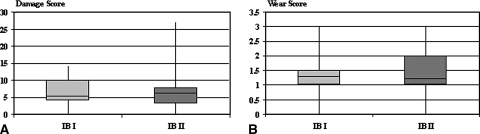
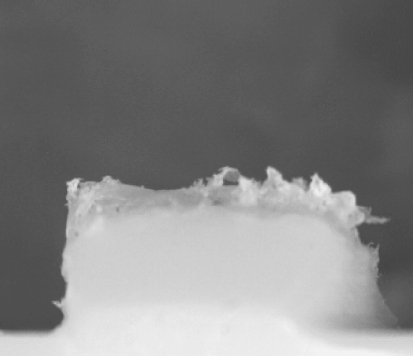
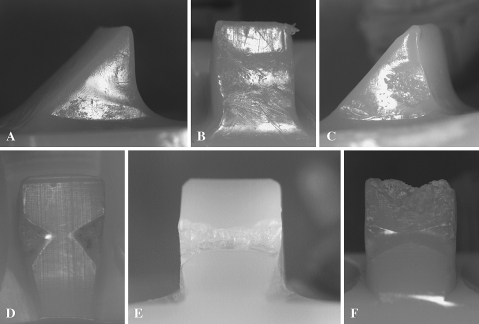
Polyethylene tibial post wear in posterior-stabilized knee designs is a major problem. The Insall-Burstein II (IB PS II) reportedly has severe anterior wear of the post in retrieved implants. We hypothesized the more anterior placement in the IB PS II would be reflected in greater wear at the anterior face than the IB PS I. We examined 234 retrieved inserts using subjective scales to grade post damage and wear. Of the IB PS II inserts, 38% demonstrated severe wear compared with only 25% of IB PS I inserts. The most prevalent damage location for the IB PS II was the anterior face, whereas the IB PS I sustained wear mainly on the medial face. While the IB PS post was not designed to constrain posterior femoral displacement, our observations confirm contact in hyperextension or other paradoxic anterior tibial translation is common and design-dependent. Minimizing wear and damage through proper post placement and changes in implant design to anticipate contact on the anterior post should be considered for future posterior stabilized knee replacements. These changes cannot occur in isolation, however, because changes in post placement and design also depend on their relation to the shape and location of the tibial bearing surfaces.
Figures
References
-
- {'text': '', 'ref_index': 1, 'ids': [{'type': 'PubMed', 'value': '12479337', 'is_inner': True, 'url': 'https://pubmed.ncbi.nlm.nih.gov/12479337/'}]}
- Banks SA, Harman MK, Hodge WA. Mechanism of anterior impingement damage in total knee arthroplasty. J Bone Joint Surg Am. 2002;84(Suppl 2):37–42. - PubMed
-
- {'text': '', 'ref_index': 1, 'ids': [{'type': 'DOI', 'value': '10.1016/j.arth.2004.04.011', 'is_inner': False, 'url': 'https://doi.org/10.1016/j.arth.2004.04.011'}, {'type': 'PubMed', 'value': '15483794', 'is_inner': True, 'url': 'https://pubmed.ncbi.nlm.nih.gov/15483794/'}]}
- Banks SA, Hodge WA. Design and activity dependence of kinematics in fixed and mobile-bearing knee arthroplasties. J Arthroplasty. 2004;19:809–816. - PubMed
-
- {'text': '', 'ref_index': 1, 'ids': [{'type': 'DOI', 'value': '10.1016/j.arth.2004.02.026', 'is_inner': False, 'url': 'https://doi.org/10.1016/j.arth.2004.02.026'}, {'type': 'PubMed', 'value': '15284990', 'is_inner': True, 'url': 'https://pubmed.ncbi.nlm.nih.gov/15284990/'}]}
- Clarke HD, Math KR, Scuderi GR. Polyethylene post failure in posterior stabilized total knee arthroplasty. J Arthroplasty. 2004;19:652–657. - PubMed
-
- {'text': '', 'ref_index': 1, 'ids': [{'type': 'PubMed', 'value': '9111404', 'is_inner': True, 'url': 'https://pubmed.ncbi.nlm.nih.gov/9111404/'}]}
- Diduch DR, Insall JN, Scott WN, Scuderi GR, Font-Rodriguez D. Total knee replacement in young, active patients. Long-term follow-up and functional outcome. J Bone Joint Surg Am. 1997;79:575–582. - PubMed
-
- {'text': '', 'ref_index': 1, 'ids': [{'type': 'PubMed', 'value': '2805502', 'is_inner': True, 'url': 'https://pubmed.ncbi.nlm.nih.gov/2805502/'}]}
- Ewald F. The Knee Society total knee arthroplasty roentgenographic evaluation and scoring system. Clin Orthop Relat Res. 1989;248:9–12. - PubMed
Publication types
MeSH terms
Substances
LinkOut - more resources
Full Text Sources
Medical
