. 2008 Jul;9(4):403-23.
doi: 10.1111/j.1364-3703.2008.00472.x.

Phytoplasmas: bacteria that manipulate plants and insects

Affiliations

Phytoplasmas: bacteria that manipulate plants and insects

Saskia A Hogenhout et al. Mol Plant Pathol. 2008 Jul.

Abstract

Taxonomy: Superkingdom Prokaryota; Kingdom Monera; Domain Bacteria; Phylum Firmicutes (low-G+C, Gram-positive eubacteria); Class Mollicutes; Candidatus (Ca.) genus Phytoplasma.

Host range: Ca. Phytoplasma comprises approximately 30 distinct clades based on 16S rRNA gene sequence analyses of approximately 200 phytoplasmas. Phytoplasmas are mostly dependent on insect transmission for their spread and survival. The phytoplasma life cycle involves replication in insects and plants. They infect the insect but are phloem-limited in plants. Members of Ca. Phytoplasma asteris (16SrI group phytoplasmas) are found in 80 monocot and dicot plant species in most parts of the world. Experimentally, they can be transmitted by approximately 30, frequently polyphagous insect species, to 200 diverse plant species.

Disease symptoms: In plants, phytoplasmas induce symptoms that suggest interference with plant development. Typical symptoms include: witches' broom (clustering of branches) of developing tissues; phyllody (retrograde metamorphosis of the floral organs to the condition of leaves); virescence (green coloration of non-green flower parts); bolting (growth of elongated stalks); formation of bunchy fibrous secondary roots; reddening of leaves and stems; generalized yellowing, decline and stunting of plants; and phloem necrosis. Phytoplasmas can be pathogenic to some insect hosts, but generally do not negatively affect the fitness of their major insect vector(s). In fact, phytoplasmas can increase fecundity and survival of insect vectors, and may influence flight behaviour and plant host preference of their insect hosts.

Disease control: The most common practices are the spraying of various insecticides to control insect vectors, and removal of symptomatic plants. Phytoplasma-resistant cultivars are not available for the vast majority of affected crops.


Figures
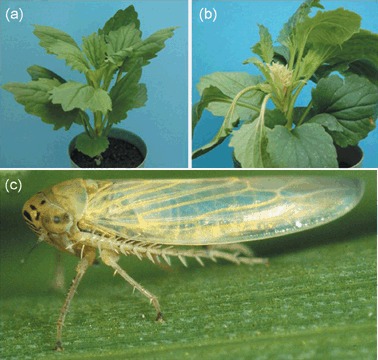
Figure 1
Figure 1
(a) Healthy China aster. (b) AY‐WB‐infected China aster. Note the witches’ broom symptoms. (c) Macrosteles quadrilineatus, the leafhopper‐vector of AY‐WB. (Photos in A and B are reprinted from Zhang J., Hogenhout S.A., Nault L.R., Hoy C.W. and Miller S.A. (2004). Molecular and symptom analyses of phytoplasma strains from lettuce reveal a diverse population. Phytopathology, 94, 842–849. with permission of the journal.)
Figure 2
Figure 2
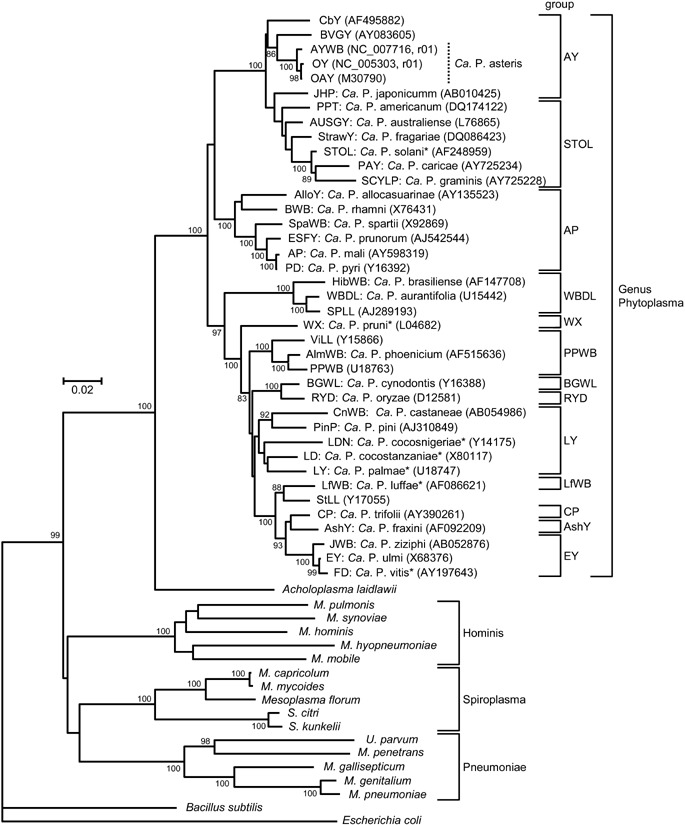
Phytoplasmas comprise a single clade that diverges from Acholeplasma spp. A phylogenetic tree was constructed by the neighbour‐joining method (Saitou and Nei, 1987) using 16S rRNA gene sequences from phytoplasmas, acholeplasma, mycoplasmas, spiroplasmas, Mesoplasma florum, Ureaplasma parvum, Bacillus subtilis and Escherichia coli (outgroup). Numbers on branches are the bootstrap values (only values > 80% are shown). GenBank accession numbers are given in parentheses. Asterisks indicate the proposed provisional names (IRPCM, 2004). The phylogeny presented here is consistent with IRPCM (2004) and the MolliGen database (http://cbi.labri.fr/outils/molligen/) (Barre et al., 2004). Abbreviations: AlloY, allocasuarina yellows; AlmWB, Almond witches’ broom; AP, apple proliferation; AshY, ash yellows; AUSGY, Australian grapevine yellows; AY, aster yellows; AY‐WB, aster yellows phytoplasma strain witches’ broom; BGWL, Bermuda grass white leaf; BVGY, Buckland valley grapevine yellows; BWB, buckthorn witches’ broom; Ca. P., Candidatus Phytoplasma; CbY, Chinaberry yellows; CnWB, chestnut witches’ broom; CP, clover proliferation; ESFY, European stone fruit yellows; EY, elm yellows; FD, flavescence dorée of grapevine; HibWB, Hibiscus witches’ broom; JHP, Japanese Hydrangea phyllody; JWB, jujube witches’ broom; LD, coconut lethal yellowing; LDN, coconut lethal yellowing; LY, coconut lethal yellowing; LfWB, loofah witches’ broom; M., Mycoplasma; OY, onion yellows; PAY, papaya; PD, pear decline; PPT, potato purple top wilt; PPWB, Caribbean pigeon pea witches’ broom; RYD, rice yellow dwarf; S., Spiroplasma; SCYLP, sugarcane yellow leaf syndrome; SpaWB, spartium witches’ broom; SPLL, sweet potato little leaf; STOL, stolbur; StrawY, strawberry yellows; ViLL, Vigna little leaf; WBDL, witches’ broom disease of lime; WX, western X‐disease.
Figure 3
Figure 3
The phytoplasma life cycle involves replication in plants and insects. (a) Schematic illustration of the different stages of phytoplasma movement through the plant and leafhopper hosts. Phytoplasmas are indicated as dark red dots and the movement of the phytoplasmas is indicated with dark red arrows. Leafhoppers acquire phytoplasmas from the plant phloem (ph). Phytoplasmas that are ingested with plant sap move through the stylet's food canal and the intestinal tract, and invade epithelial and muscle cells of the oesophagus (Es), anterior midgut (Amg), mid midgut (Mmg), filter chamber (Fc), Malpighian tubules (Mt) and hindgut (Hg). Similarly to spiroplasmas (Özbek et al., 2003), phytoplasmas probably cross the basal lamina to enter the haemolymph (He), from where they can move to the salivary glands (Sg). They multiply in secretory salivary gland cells and then are transported along with the saliva to the salivary duct (Sd). Phytoplasmas are introduced back into the phloem tissue of host plants during feeding and salivation of leafhoppers. (b–e) Electron micrographs of phytoplasmas (arrowheads) in the plant phloem and in various leafhopper tissues as indicated in (a). (b) AY‐WB in adjacent sieve elements (se1) close to the nucleus (n) of an aster leaf; the arrow indicates a sieve pore between the sieve plates (sp), and asterisks indicate possibly dividing phytoplasma cells. (c) AY‐WB (arrowheads) in a midgut epithelial cell of the leafhopper vector M. quadrilineatus; asterisks indicate less dense areas of the cytoplasm. (d) Accumulations of maize bushy stunt phytoplasma (MBSP, arrowheads) in the cytoplasm of a cell in the muscle layer around the midgut of the leafhopper vector D. maidis; note that phytoplasmas are located close to the nucleus (n). (e) MBSP (arrowheads) in the cytoplasm of a salivary gland secretory cell in D. maidis; arrow indicates phytoplasma close to a secretory vesicle (sv). Other abbreviations: bl, basal lamina; Br, brain; Cng, compound nerve ganglion; mv, microvilli; pm, plasma membrane; sm, secretory material; Sp, salivary pump; St, stylet; Xy, xylem. Scale bars, 1 µm.
Figure 4
Figure 4
Organization and localization of repeats in phytoplasma genomes. (a) Potential mobile units (PMUs) of the AY‐WB chromosome. (b) A PMU‐like region encoding the virulence protein SAP11. The chromosome is presented as a black line. ORFs are represented as block arrows in which paralogous genes in figures A and B have the same colours, with the exception of the grey‐coloured arrows that represent unique genes. Conserved 395‐bp regions upstream of tra5 genes are indicated as grey vertical transparent ovals (see Fig. 5a for alignment). The locations and directions of the ~330‐bp conserved repeats (rep) are indicated in closed black arrowheads (see Fig. 5b for alignment). The names of the ORFs with predicted functions are indicated above the arrows, with ORFs of predicted membrane‐targeted proteins indicated with an asterisk and predicted secreted proteins with ‘s’. The tra5 ORFs of PMU4 and the SAP11 PMU‐like region contain separate A and B ORFs that may produce a full‐length transposases upon single frameshifting events. The three transcripts predicted for PMU1 are indicated as thin grey arrows beneath the PMU1 region ((a) was modified from Bai et al., 2006, with permission from the American Society for Microbiology).
Figure 5
Figure 5
Alignments of conserved repeats in PMUs and PMU‐like regions. (a) Alignment of the conserved 395‐bp upstream sequences of the tra5 genes of PMU1, PMU3, PMU4 and the SAP11 PMU‐like region (vertical transparent ovals in Fig. 4). (b) Alignment of the conserved ~330‐bp repeats that flank PMU1 and are present in PMU3, PMU4 and the SAP11 PMU‐like region (closed black arrowheads in Fig. 4). Conserved nucleotides are indicated with an asterisk above the alignments, and missing nucleotides are indicated with dashes. The positions of nucleotides within the repeat regions are indicated in the ruler line beneath the alignments.
Figure 6
Figure 6
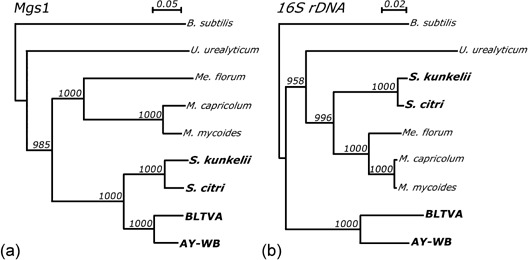
Evidence for horizontal gene transfer of mgs1 among the plant‐associated mollicutes. (a) The tree of the Mgs1 protein sequences shows clustering of the plant‐associated mollicutes. (b) The tree of 16S rRNA gene nucleotide sequences shows that the phytoplasmas (BLTVA and AY‐WB) form a separate cluster from the mycoplasmas, mesoplasmas, spiroplasmas and ureaplasmas, consistent with published phylogenetic analyses and differences in codon usage and metabolic activities among the mollicutes, see also Fig. 2 (Razin et al., 1998). Alignments were generated with ClustalX 1.83 (Thompson et al., 1997). Gaps were excluded from the trees that were generated by the neighbour‐joining method (Saitou and Nei, 1987) of ClustalX. Bootstrap values of 1000 replicates are indicated at the branches. The trees were rooted with the B. subtilis sequences. The insect‐transmitted plant‐associated mollicutes (AY‐WB, BLTVA, S. kunkelii and S. citri) are highlighted in bold font.
Figure 7
Figure 7
Immunodominant membrane proteins (IDPs) of phytoplasma were classified into three distinct types. (a) Gene organizations around the genes encoding three IDPs. The gene organization of types 1, 2 and 3 were described using sequence from SPWB (U15224), WX (AF533231) and OY‐W (AB124806), respectively. (b) Schematic representation of the putative translocation products of three IDPs. Transmembrane regions are shown as blue regions and non‐transmembrane regions are shown as pink regions. The N‐terminal transmembrane region of Amp (type 3) is cleaved during protein localization (Kakizawa et al., 2004), and the cleavage site is indicated with a filled triangle. Abbreviations: C, C terminus; N, N terminus; aa, amino acids. (c) Schematic representation of the hypothetical transmembrane structures of three types of IDP. Abbreviations and colour lines are same as B.
Figure 8
Figure 8
The transmissibility of OY phytoplasma by leafhoppers (left column) was completely consistent with the formation of the Amp–microfilament complex (right column). + and –: OY‐Amp protein does or does not, respectively, form a complex with these insects’ microfilament (Suzuki et al., 2006).

References

    1. Abramovitch, R.B. , Anderson, J.C. and Martin, G.B. (2006) Bacterial elicitation and evasion of plant innate immunity. Nat. Rev. Mol. Cell Biol. 7, 601–611. - PMC - PubMed
    1. Achaz, G. , Coissac, E. , Netter, P. and Rocha, E.P. (2003) Associations between inverted repeats and the structural evolution of bacterial genomes. Genetics, 164, 1279–1289. - PMC - PubMed
    1. Adam, S.A. , Adam, E.J. , Chi, N.C. and Visser, G.D. (1995) Cytoplasmic factors in NLS‐mediated targeting to the nuclear pore complex. Cold Spring Harb. Symp. Quant. Biol. 60, 687–694. - PubMed
    1. Akimaru, J. , Matsuyama, S. , Tokuda, H. and Mizushima, S. (1991) Reconstitution of a protein translocation system containing purified SecY, SecE, and SecA from Escherichia coli . Proc. Natl Acad. Sci. USA, 88, 6545–6549. - PMC - PubMed
    1. Ammar, E.‐D. and Hogenhout, S. A. (2006) Mollicutes associated with arthropods and plants In: Insect Symbiosis, Vol. 2 (Kostas B. and Miller T., eds), pp. 97–118. CRC Press, Taylor and Francis Group, Boca Raton, FL, USA.

LinkOut - more resources