


Review
doi: 10.1111/j.1364-3703.2007.00465.x.
Phytophthora infestans: the plant (and R gene) destroyer
Affiliations
- PMID: 18705878
- PMCID: PMC6640234
- DOI: 10.1111/j.1364-3703.2007.00465.x
Item in Clipboard
Review
Phytophthora infestans: the plant (and R gene) destroyer
Mol Plant Pathol.
2008 May.
Erratum in
- Mol Plant Pathol. 2008 Sep;9(5):727
Abstract
Phytophthora infestans remains a problem to production agriculture. Historically there have been many controversies concerning its biology and pathogenicity, some of which remain today. Advances in molecular biology and genomics promise to reveal fascinating insight into its pathogenicity and biology. However, the plasticity of its genome as revealed in population diversity and in the abundance of putative effectors means that this oomycete remains a formidable foe.
Figures
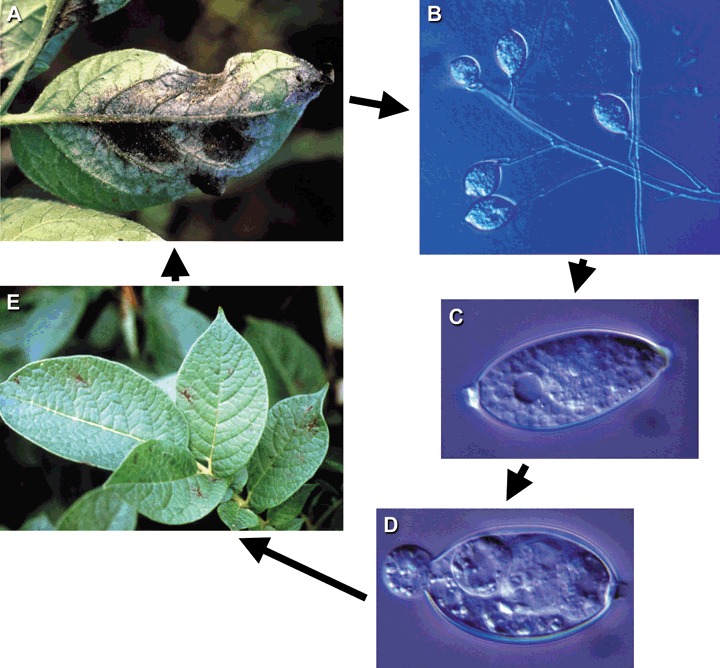
Asexual life cycle of P. infestans. (A,B) Sporangiophores grow out of diseased tissue. (C) Sporangia are released into the atmosphere for aerial dispersal during a drop in relative humidity, or they can be dispersed in water splashes. (D) Indirect germination releases zoospores, which, after encystment and germination on host tissue, produce lesions (E) visible after 2–4 days.
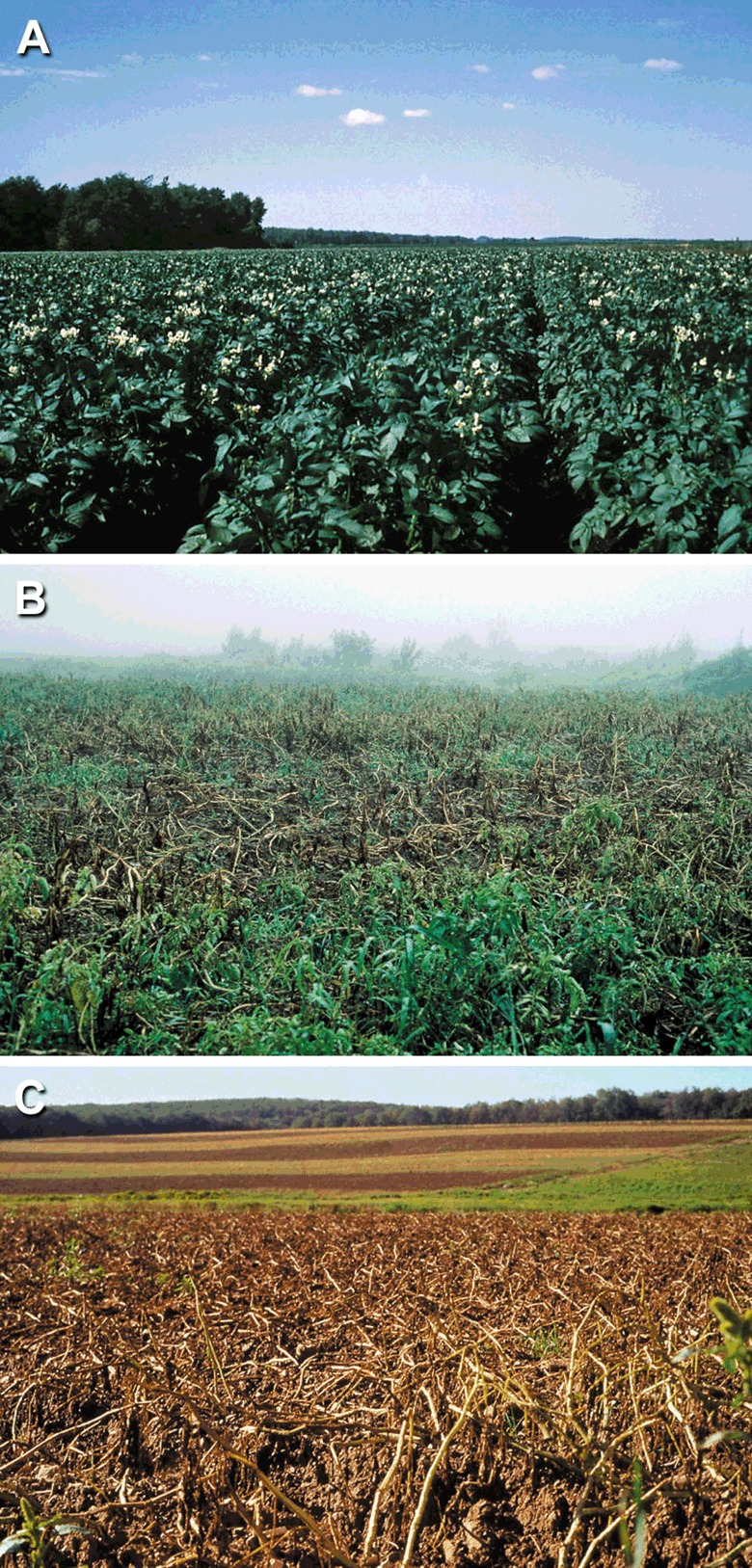
The speed with which late blight can destroy a field of potatoes is impressive. A field that appeared ‘healthy’ on one week (A) can be visibly severely diseased in the next week (B), and within another week can be totally destroyed (C).
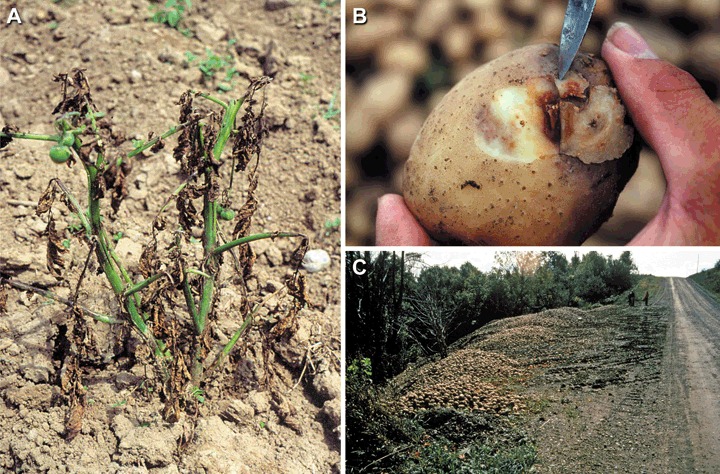
Leaves, stems (A) and tubers (B) are susceptible. Sporangia wash from foliage lesions to contact tubers in the soil. Infected tubers are particularly vulnerable to damage from soft rot, so that if infected potatoes are harvested during warm wet weather, soft rot can cause nearly complete destruction. The potatoes in (C) were discarded from storage within 2 weeks of harvest because late blight infections enabled soft rotting bacteria to destroy the majority of the tubers.
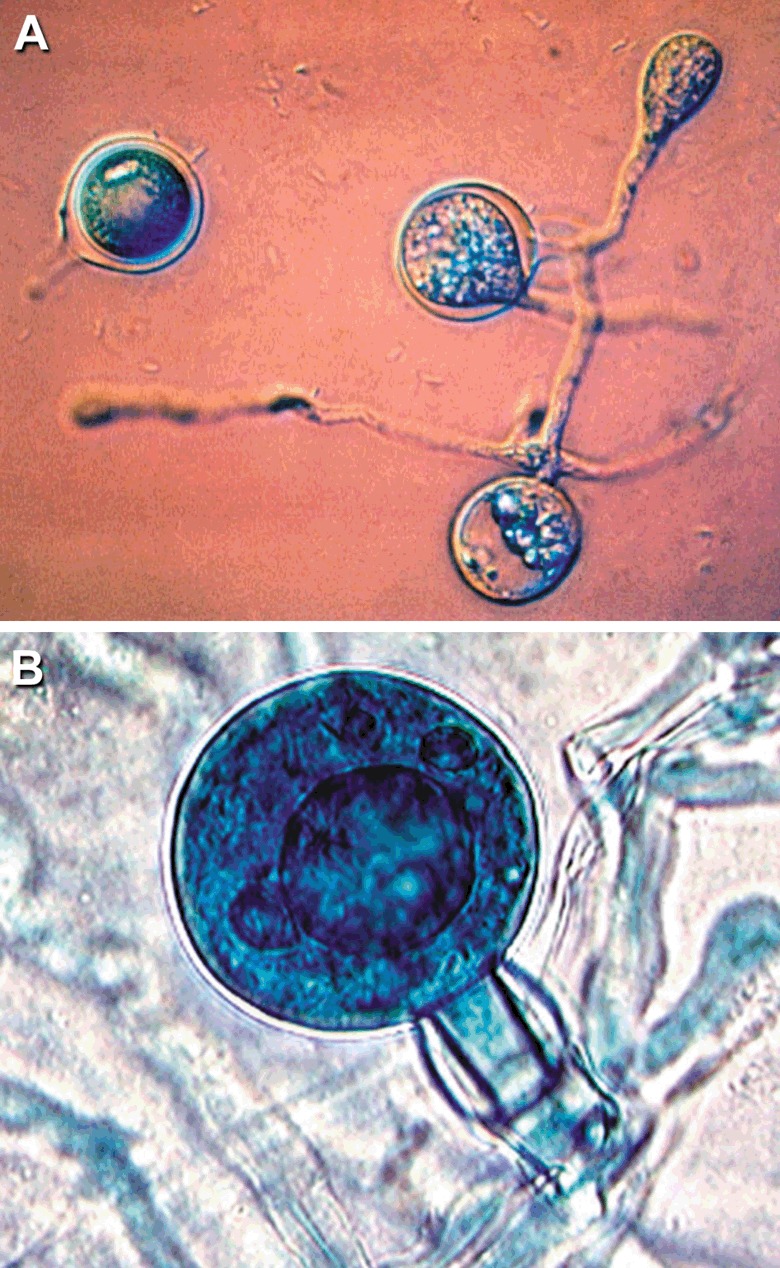
Oospores, oogonia and antheridia of P. infestans. (A) Germinating oospores (photo by Richard Shattock). (B) The female transgenic parent was expressing GUS (blue), but the non‐transgenic male parent was not, indicating an outcrossing sexual interaction (from Judelson, 1997a, and reproduced with permission).
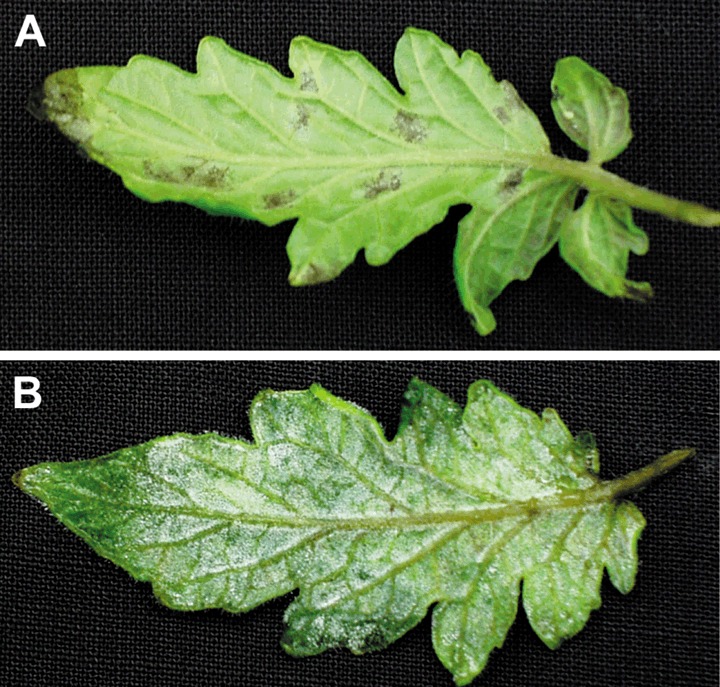
Phenotype of a tomato‐unspecialized isolate (A), and a tomato‐specialized isolate (B) infection on tomato (Smart et al., 2003). The tomato‐specialized isolate was sporulating profusely with no evidence of necrosis. The figures are from Smart et al. (2003).
References
-
- Abad, Z.G. and Abad, J.A. (1995) Historical evidence on the occurrence of late blight of potato, tomato, and pear melon in the Andes of South America In: Phytophthora Infestans, Vol. 150 (Dowley L.J., Bannon E., Cooke L.R., Keane T. and O'Sullivan E., eds), pp. 36–41. Dublin: Boole Press Ltd.
-
- Adl, S.M. , Simpson, A.G.B. , Farmer, M.A. , Andersen, R.A. , Anderson, O.R. , Barta, J.R. , Bowser, S.S. , Brugerolle, G.U.Y. , Fensome, R.A. , Fredericq, S. , James, T.Y. , Karpov, S. , Kugrens, P. , Krug, J. , Lane, C.E. , Lewis, L.A. , Lodge, J. , Lynn, D.H. , Mann, D.G. , McCourt, R.M. , Mendoza, L. , Moestrup, O. , Mozley‐Standridge, S.E. , Nerad, T.A. , Shearer, C.A. , Smirnov, A.V. , Spiegel, F.W. and Taylor, M.F.J.R. (2005) The new higher level classification of eukaryotes with emphasis on the taxonomy of protists. J. Eukaryot. Microbiol. 52, 399–451. - PubMed
-
- Ah Fong, A.M.V. and Judelson, H.S. (2003) Cell cycle regulator Cdc14 is expressed during sporulation but not hyphal growth in the fungus‐like oomycete Phytophthora infestans . Mol. Microbiol. 50, 487–494. - PubMed
-
- Andersson, B. , Sandstrom, M. and Stromberg, A. (1998) Indications of soil borne inoculum of Phytophthora infestans. Potato Res. 41, 305–310.
-
- Andrivon, D. (1996) The origin of Phytophthora infestans populations present in Europe in the 1840s: a critical review of the historical and scientific evidence. Plant Pathol. 45, 1027–1035.
Publication types
MeSH terms
LinkOut - more resources
Full Text Sources
Other Literature Sources
