


Relapse to smoking after 1 year of abstinence: a meta-analysis
- PMID: 18706769
- PMCID: PMC2577779
- DOI: 10.1016/j.addbeh.2008.05.012
Relapse to smoking after 1 year of abstinence: a meta-analysis
Abstract
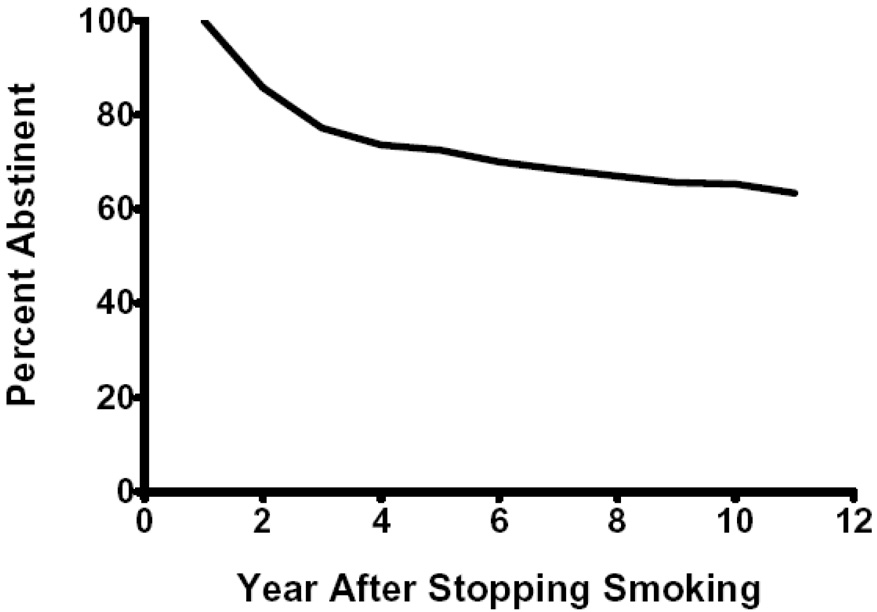
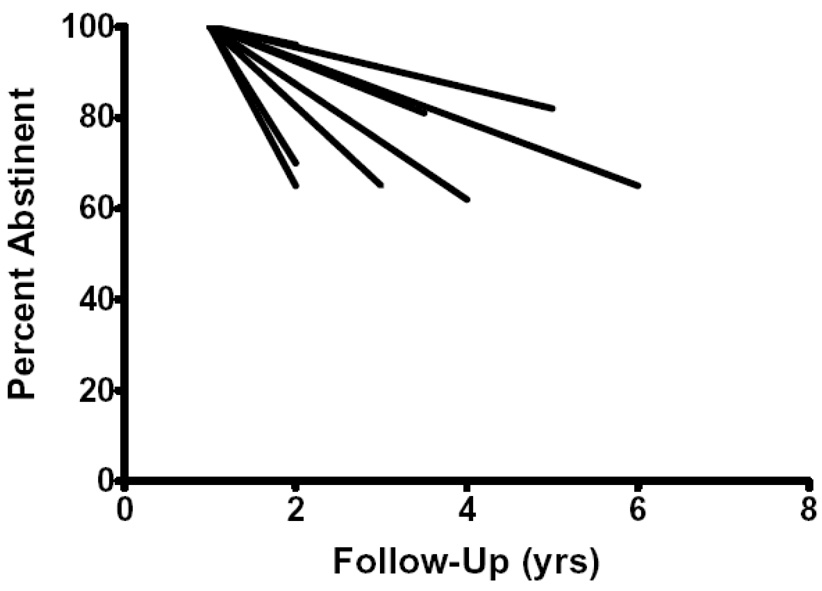
Most clinical trials use 6 months or 1 year follow-ups as proxies for life-time smoking cessation. Retrospective studies have estimated 2-15% of smokers relapse each year after the first year of abstinence, but these have methodological problems such as memory bias. We searched for prospective studies of adult quitters that reported the number of participants abstinent at 1 yr follow-up and who remained abstinent at >or=2 year follow-ups. We included studies that reported the percent which remained lapse-free, did not continue treatment after 1 year, and had <or=10% lost-to-follow-up. We did not locate any population-based studies but did locate eight randomized, controlled trials, all testing nicotine medications. After deleting one trial with outlier results, a meta-analysis estimated the annual incidence of relapse after 1 year to be 10%; however, the small sample sizes resulted in a wide 95% confidence interval (5-17%) suggesting this estimate is not very accurate. We conclude a non-significant amount of relapse occurs after 1 year. Better quantification of this relapse rate is important to improve estimates of life-long abstinence and reductions in morbidity and mortality from smoking cessation.
Figures
References
-
- Anthonisen NR, Connett JE, Kiley JP, Altose MD, Bailey WC, Buist AS, Conway WA, Jr, Enright PL, Kanner RE, O'Hara P, Owens GR, Scanlon PD, Tashkin DP, Wise RA. Effects of smoking intervention and the use of an inhaled anticholinergic bronchodilator on the rate of decline of FEV. Journal of the American Medical Association. 1994;272:1497–1505. - PubMed
-
- Blondal T. Controlled trial of nicotine polacrilex gum with supportive measures. Archives of Internal Medicine. 1989;149:1818–1821. - PubMed
-
- Blondal T, Franzon M, Westin A. A double-blind randomized trial of nicotine nasal spray as an aid in smoking cessation. European Respiratory Journal. 1997;10:1585–1590. - PubMed
-
- Burns D. Population impact of smoking cessation: Proceedings of a conference on what works to influence cessation in the general population; Bethesda, MD: National Cancer Institute; 2000.
Publication types
MeSH terms
Grants and funding
LinkOut - more resources
Full Text Sources
Medical
