


Review
doi: 10.1016/j.tcb.2008.07.001.
Epub 2008 Aug 14.
Chromophore-assisted laser inactivation in cell biology
Affiliations
- PMID: 18706812
- PMCID: PMC4445427
- DOI: 10.1016/j.tcb.2008.07.001
Item in Clipboard
Review
Chromophore-assisted laser inactivation in cell biology
Trends Cell Biol.
2008 Sep.
Abstract
Chromophore-assisted laser inactivation (CALI) is a technique whereby engineered proteins and dye molecules that produce substantial amounts of reactive oxygen species upon absorption of light are used to perturb biological systems in a spatially and temporally defined manner. CALI is an important complement to conventional genetic and pharmacological manipulations. In this review, we examine the applications of CALI to cell biology and discuss the underlying photochemical mechanisms that mediate this powerful technique.
Figures

CALI of EGFP-CP induces the formation of dorsal ruffles and filopodia. (a) Fluorescence (left) and differential interference contrast (DIC) (right) images of Rat2 fibroblasts expressing EGFP-CP before CALI; the irradiated area is indicated with a black circle (diameter: 24 μm). (b) Fluorescence immediately after CALI (left) and DIC (middle) and dorsal surface F-actin (right) (stained by Alexa Fluor 568-labeled phalloidin) 3 min after CALI. Numerous actin-rich dorsal ruffles and filopodia are locally formed after irradiation.

Potential photodamage pathways in CALI.
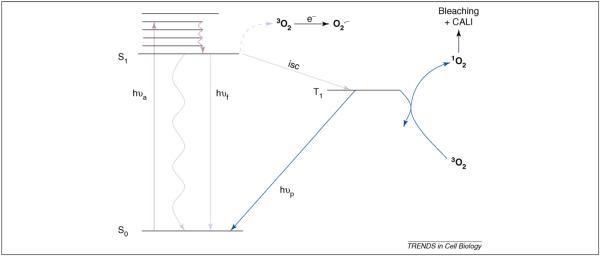
ROS production in terms of simplified energy-level diagram. Excitation (denoted by absorption of a photon, hυa) occurs to one of several higher vibronic states followed by rapid internal conversion (compact squiggly arrow) resulting in the molecule dropping to the lowest excited singlet state (S1) in which it exists for several nanoseconds. From this state, several fates are possible: the excited chromophore can emit (denoted by emission of a photon, hυf), transfer its energy to the solvent without emission (extended squiggly arrow), stimulate electron transfer from 3O2 (depicted as the broken line from S1 to 3O2) to produce superoxide anion (O2•−) or undergo intersystem crossing (isc) to the triplet manifold. (Note, to simplify the diagram, generation of 1O2 from the chromophore single state is not depicted.) The triplet state is long lived and, for this reason, much photochemistry proceeds from it, including ROS production; emission from the triplet state is called phosphorescence (denoted by emission of a photon, hυp).
References
-
- Wang FS, Jay DG. Chromophore-assisted laser inactivation (CALI): probing protein function in situ with a high degree of spatial and temporal resolution. Trends Cell Biol. 1996;6:442–445. - PubMed
-
- Dougherty TJ, et al. Photoradiation therapy for the treatment of malignant tumors. Cancer Res. 1978;38:2628–2635. - PubMed
Publication types
MeSH terms
Substances
Grants and funding
LinkOut - more resources
Full Text Sources
Other Literature Sources
