The human papillomavirus infection in men study: human papillomavirus prevalence and type distribution among men residing in Brazil, Mexico, and the United States
- PMID: 18708396
- PMCID: PMC3471778
- DOI: 10.1158/1055-9965.EPI-08-0151
The human papillomavirus infection in men study: human papillomavirus prevalence and type distribution among men residing in Brazil, Mexico, and the United States
Abstract
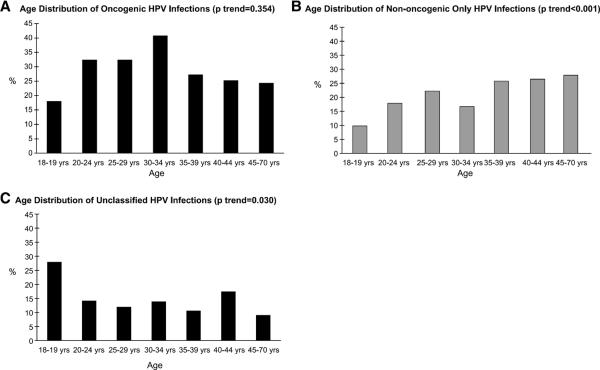
Male sexual behavior influences the rates of cervical dysplasia and invasive cervical cancer, as well as male human papillomavirus (HPV) infection and disease. Unfortunately, little is known regarding male HPV type distribution by age and across countries. In samples combined from the coronal sulcus, glans penis, shaft, and scrotum of 1,160 men from Brazil, Mexico, and the United States, overall HPV prevalence was 65.2%, with 12.0% oncogenic types only, 20.7% nononcogenic types only, 17.8% both oncogenic and nononcogenic, and 14.7% unclassified infections. Multiple HPV types were detected in 25.7% of study participants. HPV prevalence was higher in Brazil (72.3%) than in the United States (61.3%) and Mexico (61.9%). HPV16 (6.5%), HPV51 (5.3%), and HPV59 (5.3%) were the most commonly detected oncogenic infections, and HPV84 (7.7%), HPV62 (7.3%), and HPV6 (6.6%) were the most commonly detected nononcogenic infections. Overall HPV prevalence was not associated with age. However, significant associations with age were observed when specific categories of HPV, nononcogenic, and unclassified HPV infections were considered. Studies of HPV type distribution among a broad age range of men from multiple countries is needed to fill the information gap internationally with respect to our knowledge of HPV infection in men.
Figures
References
-
- Agarwal SS, Sehgal A, Sardana S, Kumar A, Luthra UK. Role of male behavior in cervical carcinogenesis among women with one lifetime sexual partner. Cancer. 1993;72:1666–9. - PubMed
-
- Buckley JD, Harris RW, Doll R, Vessey MP, Williams PT. Case-control study of the husbands of women with dysplasia or carcinoma of the cervix uteri. Lancet. 1981;2:1010–5. - PubMed
-
- Thomas DB, Ray RM, Pardthaisong T, et al. Prostitution, condom use, and invasive squamous cell cervical cancer in Thailand. Am J Epidemiol. 1996;143:779–86. - PubMed
-
- Zunzunegui MV, King MC, Coria CF, Charlet J. Male influences on cervical cancer risk. Am J Epidemiol. 1986;123:302–7. - PubMed
-
- Bosch FX, Castellsague X, Munoz N, et al. Male sexual behavior and human papillomavirus DNA: key risk factors for cervical cancer in Spain. J Natl Cancer Inst. 1996;88:1060–7. - PubMed
Publication types
MeSH terms
Grants and funding
LinkOut - more resources
Full Text Sources
Miscellaneous