B-vitamin intake, one-carbon metabolism, and survival in a population-based study of women with breast cancer
- PMID: 18708404
- PMCID: PMC2673236
- DOI: 10.1158/1055-9965.EPI-07-2900
B-vitamin intake, one-carbon metabolism, and survival in a population-based study of women with breast cancer
Abstract
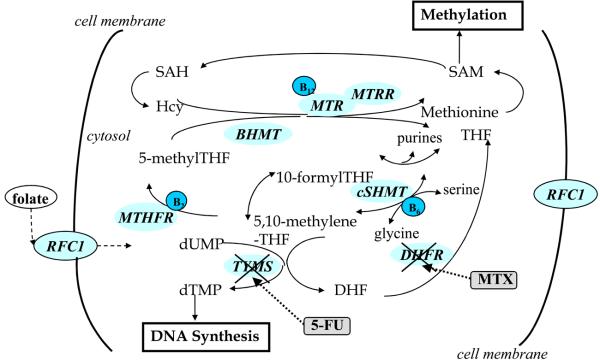
Breast cancer is the second leading cause of cancer mortality among women. Given its important role in DNA methylation and synthesis, one-carbon metabolism may affect breast cancer mortality. We used a population-based cohort of 1,508 women with breast cancer to investigate possible associations of dietary intake of B vitamins before diagnosis as well as nine polymorphisms of one-carbon metabolizing genes and subsequent survival. Women newly diagnosed with a first primary breast cancer in 1996 to 1997 were followed for vital status for an average of 5.6 years. Kaplan-Meier survival and Cox proportional hazard regression analyses were used to evaluate the association between dietary intakes of B vitamins (1,479 cases), genotypes ( approximately 1,065 cases), and all-cause as well as breast cancer-specific mortality. We found that higher dietary intake of vitamin B(1) and B(3) was associated with improved survival during the follow-up period (P(trend) = 0.01 and 0.04, respectively). Compared with the major genotype, the MTHFR 677 T allele carriers have reduced all-cause mortality and breast cancer-specific mortality in a dominant model [hazard ratio (95% confidence interval): 0.69 (0.49-0.98) and 0.58 (0.38-0.89), respectively]. The BHMT 742 A allele was also associated with reduced all-cause mortality [hazard ratio, 0.70 (0.50-1.00)]. Estrogen receptor/progesterone receptor status modified the association between the MTHFR C677T polymorphism and survival (P = 0.05). The survival associations with one-carbon polymorphisms did not differ with the use of chemotherapy, although study power was limited for examining such effect modification. Our results indicate that one-carbon metabolism may be an important pathway that could be targeted to improve breast cancer survival.
Figures
References
-
- Landis SH, Murray T, Bolden S, Wingo PA. Cancer statistics, 1999. CA Cancer J Clin. 1999 Jan-Feb;49(1):8,31, 1. - PubMed
-
- Greenlee RT, Murray T, Bolden S, Wingo PA. Cancer statistics, 2000. CA Cancer J Clin. 2000 Jan-Feb;50(1):7–33. - PubMed
-
- Carter CL, Allen C, Henson DE. Relation of tumor size, lymph node status, and survival in 24,740 breast cancer cases. Cancer. 1989 Jan 1;63(1):181–7. - PubMed
-
- Page DL, Jensen RA, Simpson JF. Routinely available indicators of prognosis in breast cancer. Breast Cancer Res Treat. 1998;51(3):195–208. - PubMed
-
- Osborne CK. Steroid hormone receptors in breast cancer management. Breast Cancer Res Treat. 1998;51(3):227–38. - PubMed
Publication types
MeSH terms
Substances
Grants and funding
LinkOut - more resources
Full Text Sources
Medical
Research Materials
Miscellaneous