Self and other in schizophrenia: a cognitive neuroscience perspective
- PMID: 18708487
- PMCID: PMC6857930
- DOI: 10.1176/appi.ajp.2008.07111806
Self and other in schizophrenia: a cognitive neuroscience perspective
Abstract
Objective: Recent basic science data indicate that in healthy individuals, self-referential processing and social cognition rely on common neural substrates. The authors assessed self-referential source memory and social cognition in a large sample of schizophrenia outpatients and healthy comparison subjects in order to compare how these critical processes are associated in the two groups.
Method: Ninety-one schizophrenia outpatients and 30 healthy comparison subjects were assessed on measures of basic social cognition and source memory for previously learned word items: self-generated, externally presented, and new words. Partial correlations and multiple regression analysis were used to test the association between social cognition measures and source memory performance and the contributions of source memory and general cognitive abilities to a social cognition composite score.
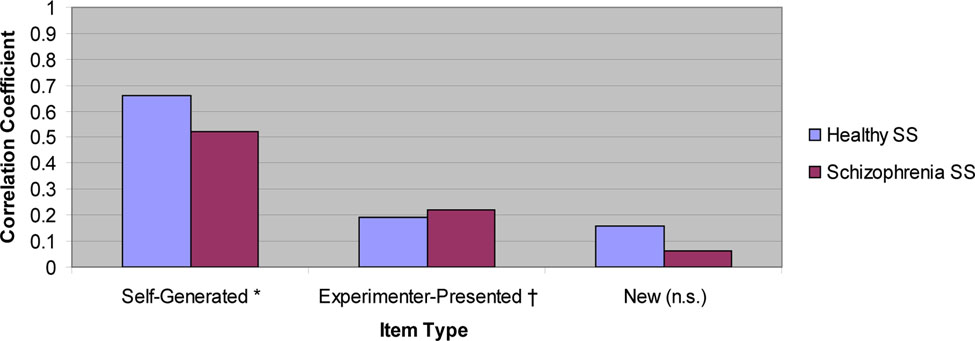
Results: Schizophrenia patients demonstrated significantly lower source memory for self-generated items (self-referential source memory) relative to comparison subjects but showed intact external source memory. In both groups, self-referential source memory and social cognition showed strong correlations. When the effects of general cognitive abilities were controlled for, these correlations were attenuated in the schizophrenia patients. Regression analysis revealed discrepancies between groups in the cognitive functions contributing to social cognition performance.
Conclusions: Impaired self-referential source memory represents a unique cognitive deficit in schizophrenia. Moreover, the strong association between self-referential source memory and social cognition seen in healthy subjects is reduced in schizophrenia and is moderated by general cognitive abilities. Impairments in the neurocognitive system that underlies both self-referential and social cognition provide a parsimonious explanation for the disturbances in the sense of self and other that characterize schizophrenia.
Figures
References
-
- Arieti S: Interpretation of Schizophrenia. New York, Basic Books, 1974
-
- Green MF, Olivier B, Crawley JN, Penn DL, Silverstein S: Social cognition in schizophrenia: recommendations from the measurement and treatment research to improve cognition in schizophrenia new approaches conference. Schizophr Bull 2005; 31(4):882–7 - PubMed
-
- Poole JH, Tobias FC, Vinogradov S: The functional relevance of affect recognition errors in schizophrenia. J Int Neuropsychol Soc 2000; 6(6):649–58 - PubMed
-
- Bryson G, Bell M, Lysaker P: Affect recognition in schizophrenia: a function of global impairment or a specific cognitive deficit. Psychiatry Res 1997; 71(2):105–13 - PubMed
-
- Brune M: Emotion recognition, ‘theory of mind,’ and social behavior in schizophrenia. Psychiatry Res 2005; 133(2–3):135–47 - PubMed