. 2008 Oct;190(20):6646-59.
doi: 10.1128/JB.00466-08. Epub 2008 Aug 15.

Interplay between cyclic AMP-cyclic AMP receptor protein and cyclic di-GMP signaling in Vibrio cholerae biofilm formation

Affiliations

Interplay between cyclic AMP-cyclic AMP receptor protein and cyclic di-GMP signaling in Vibrio cholerae biofilm formation

Jiunn C N Fong et al. J Bacteriol. 2008 Oct.

Abstract

Vibrio cholerae is a facultative human pathogen. The ability of V. cholerae to form biofilms is crucial for its survival in aquatic habitats between epidemics and is advantageous for host-to-host transmission during epidemics. Formation of mature biofilms requires the production of extracellular matrix components, including Vibrio polysaccharide (VPS) and matrix proteins. Biofilm formation is positively controlled by the transcriptional regulators VpsR and VpsT and is negatively regulated by the quorum-sensing transcriptional regulator HapR, as well as the cyclic AMP (cAMP)-cAMP receptor protein (CRP) regulatory complex. Transcriptome analysis of cyaA (encoding adenylate cyclase) and crp (encoding cAMP receptor protein) deletion mutants revealed that cAMP-CRP negatively regulates transcription of both VPS biosynthesis genes and genes encoding biofilm matrix proteins. Further mutational and expression analysis revealed that cAMP-CRP negatively regulates transcription of vps genes indirectly through its action on vpsR transcription. However, negative regulation of the genes encoding biofilm matrix proteins by cAMP-CRP can also occur independent of VpsR. Transcriptome analysis also revealed that cAMP-CRP regulates the expression of a set of genes encoding diguanylate cyclases (DGCs) and phosphodiesterases. Mutational and phenotypic analysis of the differentially regulated DGCs revealed that a DGC, CdgA, is responsible for the increase in biofilm formation in the Deltacrp mutant, showing the connection between of cyclic di-GMP and cAMP signaling in V. cholerae.


Figures
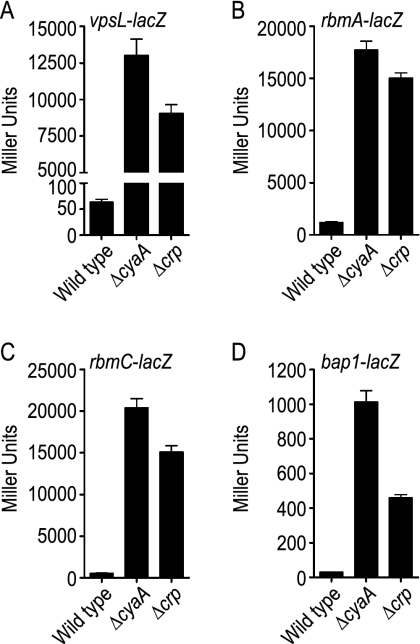
FIG. 1.
FIG. 1.
cAMP-CRP negatively regulates expression of genes involved in VPS biosynthesis and biofilm matrix protein production. β-Galactosidase assays of wild-type, ΔcyaA, and Δcrp strains harboring (A) vpsL-lacZ, (B) rbmA-lacZ, (C) rbmC-lacZ, and (D) bap1-lacZ fusion constructs were performed. The data are representative of at least two independent experiments. The error bars indicate standard deviations.
FIG. 2.
FIG. 2.
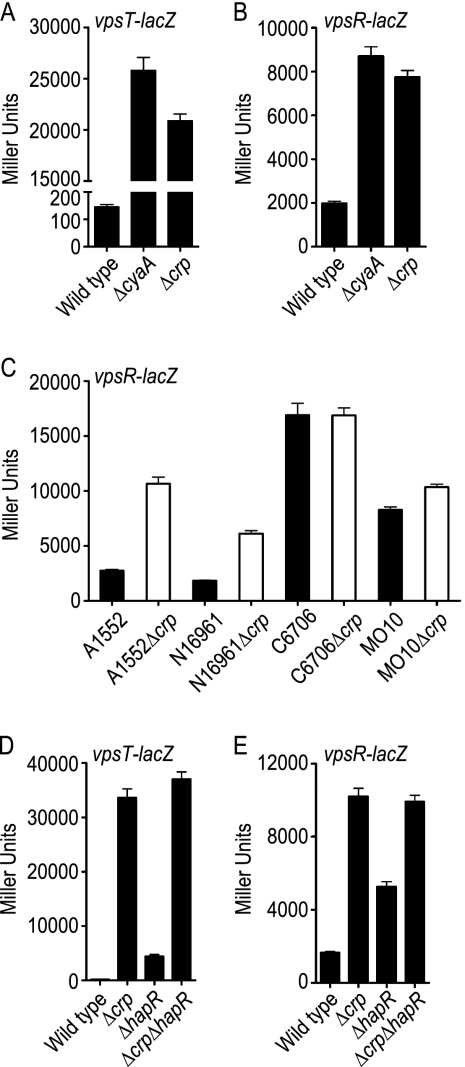
cAMP-CRP negatively regulates vpsT and vpsR expression. (A and B) β-Galactosidase assays of wild-type strain A1552 and ΔcyaA and Δcrp mutants harboring (A) vpsT-lacZ and (B) vpsR-lacZ fusion constructs. (C) β-Galactosidase assays of different V. cholerae strains (A1552, N16961, C6706, and MO10) and Δcrp deletion strains harboring the vpsR-lacZ fusion construct. (D and E) β-Galactosidase assays of wild-type, Δcrp, ΔhapR, and Δcrp ΔhapR strains harboring (D) vpsT-lacZ and (E) vpsR-lacZ fusion constructs. The data are representative of at least two independent experiments. The error bars indicate standard deviations.
FIG. 3.
FIG. 3.
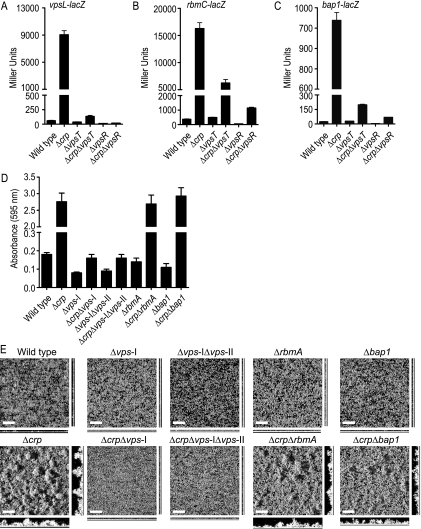
Analysis of the cAMP-CRP contribution to VpsR regulation of rbmC and bap1 expression. (A to C) β-Galactosidase assays of wild-type, Δcrp, ΔvpsT, Δcrp ΔvpsT, ΔvpsR, and Δcrp ΔvpsR strains harboring (A) vpsL-lacZ, (B) rbmC-lacZ, and (C) bap1-lacZ fusion constructs. The data are representative of at least two independent experiments. The error bars indicate standard deviations. (D) Quantitative comparison of biofilm formation by wild-type, Δcrp, Δvps-I, Δcrp Δvps-I, Δvps-I Δvps-II, Δcrp Δvps-I Δvps-II, ΔrbmA, Δcrp ΔrbmA, Δbap1, and Δcrp Δbap1 strains. The data are representative of two independent experiments. The error bars indicate standard deviations. (E) Biofilms formed after 8 h of incubation at 30°C in a non-flow-cell system by the wild-type, Δcrp, Δvps-I, Δcrp Δvps-I, Δvps-I Δvps-II, Δcrp Δvps-I Δvps-II, ΔrbmA, Δcrp ΔrbmA, Δbap1, and Δcrp Δbap1 strains. Biofilms were stained with SYTO9, and images were acquired by CLSM. The large images are images of the upper surfaces of biofilms, and the images below and to right of the large images are orthogonal views. Bars = 40 μm.
FIG. 4.
FIG. 4.
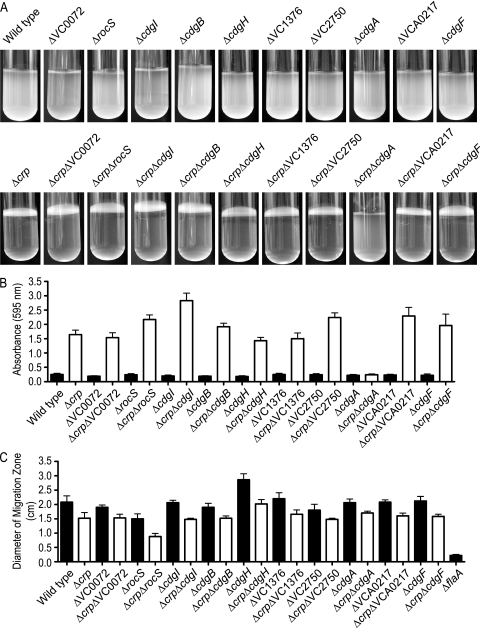
Phenotypic characterization of GGDEF deletion mutants and GGDEF crp double-deletion mutants. (A) Pellicle formation, (B) quantitative comparison of biofilm formation, and (C) motility assays for the wild type, for Δcrp and GGDEF single-deletion mutants, and for mutants with GGDEF deletions generated in the Δcrp genetic background. The data are representative of two independent experiments. The error bars indicate standard deviations.
FIG. 5.
FIG. 5.
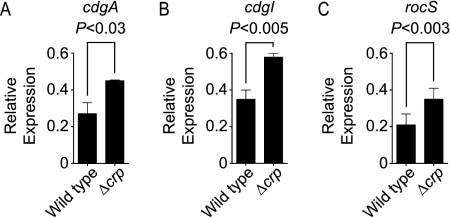
qPCR analysis of cdgA, cdgI, and rocS message levels in the Δcrp mutant: quantification of relative repression of (A) cdgA, (B) cdgI, and (C) rocS in the wild type and the Δcrp mutant, normalized using recA. The results are from three independent biological replicates. The error bars indicate standard deviations. P values (two-tailed t test) are indicated at the top.
FIG. 6.
FIG. 6.
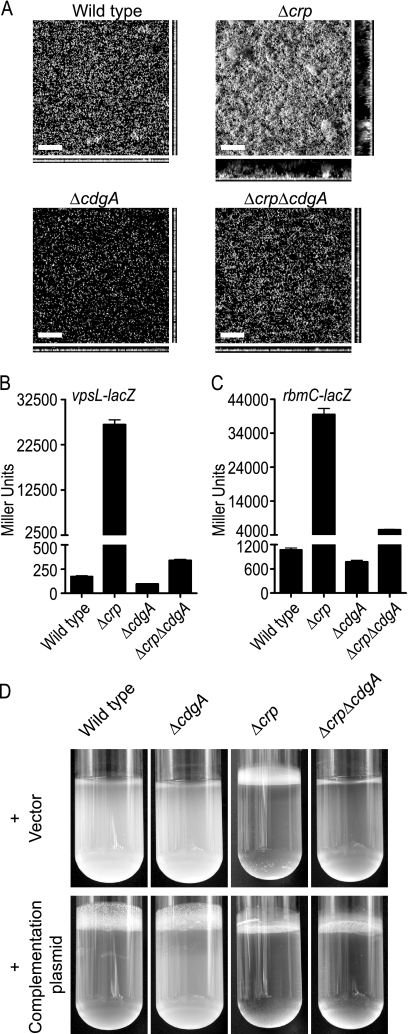
Phenotypic characterization of Δcrp, ΔcdgA, and Δcrp ΔcdgA mutants. (A) Biofilms of wild-type, Δcrp, ΔcdgA, and Δcrp ΔcdgA strains formed after 8 h of incubation at 30°C in a non-flow-cell system. Images were acquired by CLSM. The large images are images of the upper surfaces of biofilms, and the images below and to right of the large images are orthogonal views. Bars = 40 μm. (B and C) β-Galactosidase assays for the wild-type, Δcrp, ΔcdgA, and Δcrp ΔcdgA strains harboring (B) vpsL-lacZ and (C) rbmC-lacZ fusion constructs. The data are representative of two independent experiments. The error bars indicate standard deviations. (D) Pellicle formation in the wild-type, Δcrp, ΔcdgA, and Δcrp ΔcdgA strains harboring the vector or the cdgA complementation plasmid.
FIG. 7.
FIG. 7.
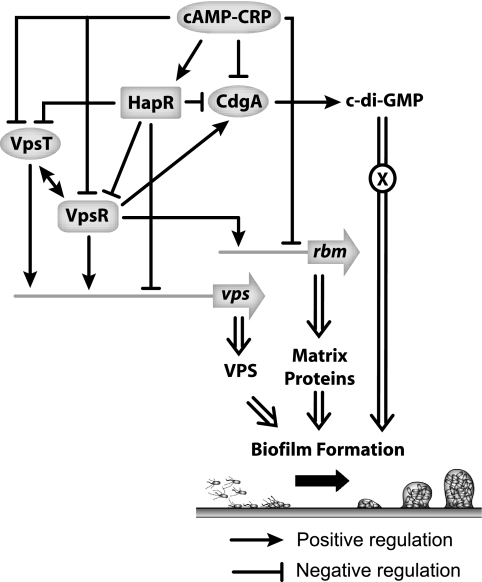
Model of cAMP-CRP regulation of biofilm formation in V. cholerae. cAMP-CRP regulates biofilm formation at multiple levels. Expression of vps and rbm genes is negatively regulated by cAMP-CRP through positive regulation of hapR expression and through negative regulation of vpsR and vpsT expression. In turn, VpsR and VpsT positively regulate vps and rbm gene expression, while HapR negatively regulates vps and rbm gene expression. VpsR, VpsT, and HapR regulation of vps and rbm gene expression also involves c-di-GMP signaling, where cdgA expression is negatively regulated by HapR and positively regulated by VpsR and VpsT. An increase in cdgA transcription leads to an increase in the c-di-GMP level, which in turn could interact with an effector protein(s) to positively regulate biofilm formation. We have a very limited understanding of the link between c-di-GMP pools and the signaling that leads to biofilm formation in V. cholerae. In addition, cAMP-CRP may also directly regulate vpsR, cdgA, and rbmC expression and indirectly regulate vpsT expression.

References

    1. Bao, Y., D. P. Lies, H. Fu, and G. P. Roberts. 1991. An improved Tn7-based system for the single-copy insertion of cloned genes into chromosomes of gram-negative bacteria. Gene 109167-168. - PubMed
    1. Beyhan, S., K. Bilecen, S. R. Salama, C. Casper-Lindley, and F. H. Yildiz. 2007. Regulation of rugosity and biofilm formation in Vibrio cholerae: comparison of VpsT and VpsR regulons and epistasis analysis of vpsT, vpsR, and hapR. J. Bacteriol. 189388-402. - PMC - PubMed
    1. Beyhan, S., A. D. Tischler, A. Camilli, and F. H. Yildiz. 2006. Transcriptome and phenotypic responses of Vibrio cholerae to increased cyclic di-GMP level. J. Bacteriol. 1883600-3613. - PMC - PubMed
    1. Beyhan, S., and F. H. Yildiz. 2007. Smooth to rugose phase variation in Vibrio cholerae can be mediated by a single nucleotide change that targets c-di-GMP signalling pathway. Mol. Microbiol. 63995-1007. - PubMed
    1. Botsford, J. L., and J. G. Harman. 1992. Cyclic AMP in prokaryotes. Microbiol. Rev. 56100-122. - PMC - PubMed

Publication types

MeSH terms

LinkOut - more resources