


Review
doi: 10.1128/AEM.00501-08.
Epub 2008 Aug 15.
Role of polyphosphates in microbial adaptation to extreme environments
Affiliations
- PMID: 18708516
- PMCID: PMC2565944
- DOI: 10.1128/AEM.00501-08
Item in Clipboard
Review
Role of polyphosphates in microbial adaptation to extreme environments
Appl Environ Microbiol.
2008 Oct.
No abstract available
Figures
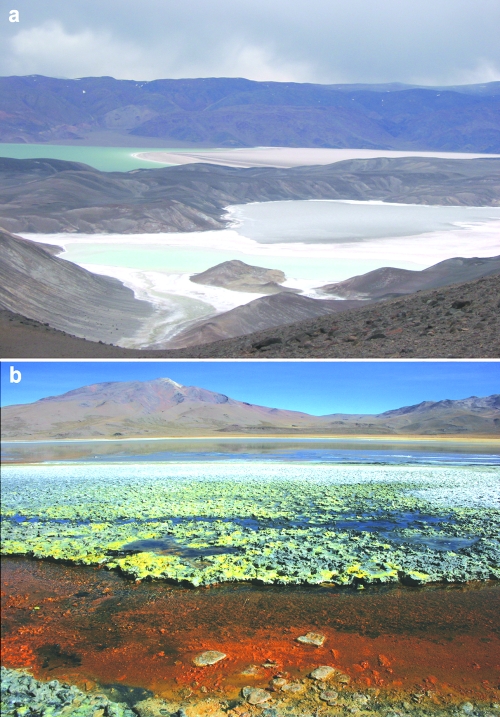
HAAW ecosystem wetland in northwestern Argentinean Andes. (a) Salar de la Laguna Verde at 4,400 m above sea level; the HAAW ecosystem lakes are hypersaline and shallow, are separated by salar pads, and contain high levels of arsenic. (b) Laguna Vilama, at 4,600 m above sea level, has gradients of salinity along with microbial mats.
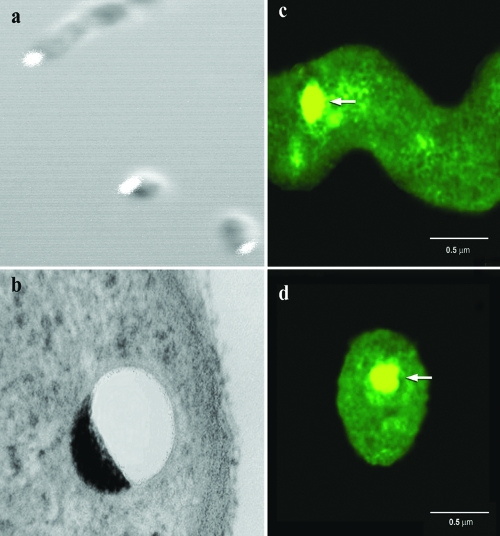
Confocal immunofluorescence and ultrastructural analysis of the acidocalcisomes of A. tumefaciens and R. rubrum. (a) Analysis of the H+-V- PPase of A. tumefaciens using polyclonal antibodies against the H+-PPase of Trypanosoma cruzi. Labeling is at one pole of the cells, where acidocalcisomes are located. (b) Thin-section micrograph of an acidocalcisome volutin granule of A. tumefaciens showing a partially empty vacuole that corresponds to an acidocalcisome containing electron-dense material. (c) Confocal immunofluorescence image of the H+-V- PPase of R. rubrum. Arrows show labeling of the acidocalcisomes. (d) Confocal thin section of R. rubrum. Arrows show the internal label of the acidocalcisome. Bars, 0.5 μm. (Panels c and d are reprinted from reference .)
References
-
- Aguilar, A. 1996. Extremophile research in the European Union: from fundamental aspects to industrial expectations. FEMS Microbiol. Rev. 18:89-92.
-
- Akiyama, M., E. Crooke, and A. Kornberg. 1992. The polyphosphate kinase gene of Escherichia coli. Isolation and sequence of the ppk gene and membrane location of the protein. J. Biol. Chem. 267:22556-22561. - PubMed
-
- Al-Maghrebi, M. A., and L. T. Benov. 2001. Polyphosphate accumulation and oxidative DNA damage in superoxide dismutase-deficient Escherichia coli. Free Radic. Biol. Med. 31:1352-1359. - PubMed
-
- Ayraud, S., B. Janvier, A. Labigne, C. Ecobichon, C. Burucoa, and J. L. Fauchere. 2005. Polyphosphate kinase: a new colonization factor of Helicobacter pylori. FEMS Microbiol. Lett. 243:45-50. - PubMed
Publication types
MeSH terms
Substances
LinkOut - more resources
Full Text Sources
