. 2008 Aug 15;22(16):2204-14.
doi: 10.1101/gad.1675908.

Clustering of yeast tRNA genes is mediated by specific association of condensin with tRNA gene transcription complexes

Affiliations

Clustering of yeast tRNA genes is mediated by specific association of condensin with tRNA gene transcription complexes

Rebecca A Haeusler et al. Genes Dev. .

Abstract

The 274 tRNA genes in Saccharomyces cerevisiae are scattered throughout the linear maps of the 16 chromosomes, but the genes are clustered at the nucleolus when compacted in the nucleus. This clustering is dependent on intact nucleolar organization and contributes to tRNA gene-mediated (tgm) silencing of RNA polymerase II transcription near tRNA genes. After examination of the localization mechanism, we find that the chromosome-condensing complex, condensin, is involved in the clustering of tRNA genes. Conditionally defective mutations in all five subunits of condensin, which we confirm is bound to active tRNA genes in the yeast genome, lead to loss of both pol II transcriptional silencing near tRNA genes and nucleolar clustering of the genes. Furthermore, we show that condensin physically associates with a subcomplex of RNA polymerase III transcription factors on the tRNA genes. Clustering of tRNA genes by condensin appears to be a separate mechanism from their nucleolar localization, as microtubule disruption releases tRNA gene clusters from the nucleolus, but does not disperse the clusters. These observations suggest a widespread role for condensin in gene organization and packaging of the interphase yeast nucleus.


Figures
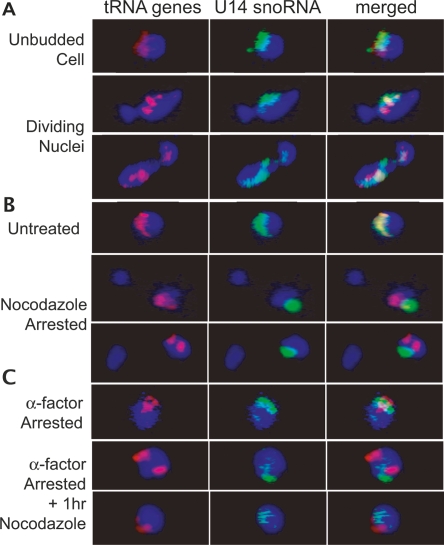
Figure 1.
Figure 1.
In situ hybridization of unsynchronized and nocodazole-treated cells. In each panel, fluorescent oligonucleotide probes complementary to the U14 snoRNA (green) or 10 tRNALeu(CAA) genes (red) were used for hybridization. Blue represents DAPI staining of nucleoplasmic DNA. (A) Nuclei from unsynchronized cells show that the tRNA gene signal (red) consistently overlaps the nucleolar signal (green) prior to and throughout division of the nucleus. (B) Depolymerization of microtubules by arrest in nocodazole causes partially divided nuclei in which tRNA genes remain clustered, but clusters are divorced from the nucleolus. (C) This effect is not due to nocodozole blockage prior to nuclear division, as demonstrated by the release of tRNA gene clusters from the nucleolus by depolymerization of microtubules in cells arrested in G1 by α factor.
Figure 2.
Figure 2.
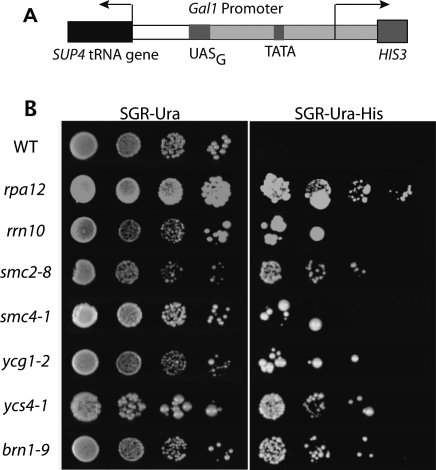
Condensin mutants release tgm silencing. Strains containing mutations in each condensin subunit were transformed with a plasmid containing a tgm silencing test construct (shown in A) (Hull et al. 1994; Kendall et al. 2000; L. Wang et al. 2005), where the SUP4 tRNA gene silences HIS3 expression in wild-type cells. Cells with defective tgm silencing are able to grow on media lacking histidine (SGR-Ura-His) (B). Growth at semi-permissive temperature for the temperature-sensitive mutants (30°C) is shown, although growth at 23°C gave similar results (data not shown). All five condensin mutants release tgm silencing to varying extents, similar to deletions of RNA polymerase I components Δrpa12 and Δrrn10, strains that are known to release tgm silencing (L. Wang et al. 2005).
Figure 3.
Figure 3.
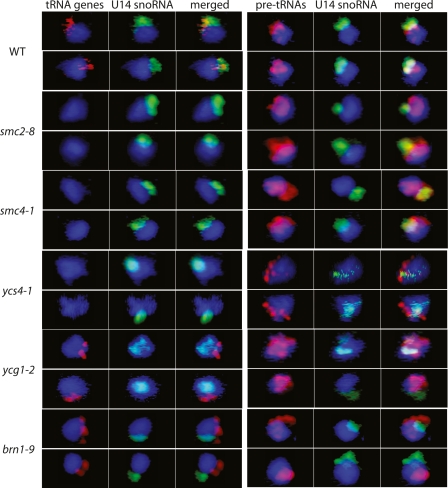
Condensin mutants show loss of tRNA gene and pre-tRNA nucleolar localization. Fluorescence in situ hybridization to the tRNALeu genes and the early precursor tRNAs (pre-tRNALeu) in wild-type cells shows the genes and their transcripts clustered at the nucleolus, as described previously (Bertrand et al. 1998; Kendall et al. 2000; Thompson et al. 2003; L. Wang et al. 2005). However, mutations in condensin subunits change the patterns of tRNA gene clusters. In some cases, the tRNA genes disperse (smc2-8, smc4-1, ycs4-1) such that the fluorescent signal is no longer detectable above the background, and in other cases, they mislocalize outside of the nucleolus (ycg1-2, brn1-9). Pre-tRNA positions are also altered, in some cases localizing near the nuclear periphery (ycs4-1, brn1-9) and in others diffusely in the nucleoplasm (smc2-8, smc4-1, ycg1-2).
Figure 4.
Figure 4.
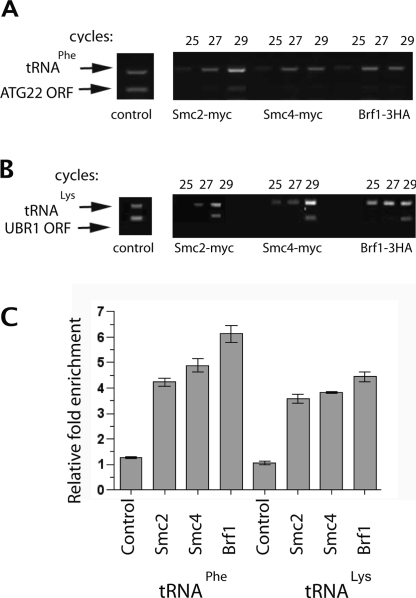
Condensin subunits Smc2 and Smc4 interact with tRNA genes. (A,B) ChIPs were performed using epitope-tagged versions of Smc2, Smc4, and Brf1. Twenty-five, 27, or 29 rounds of PCR are shown with primers that simultaneously amplify a tRNAPhe gene and the ATG22 ORF segment (A) or a tRNALys gene and a UBR1 ORF segment (B). Controls show representative signals rounds of PCR performed in parallel precipitations for which the primary antibodies were omitted (29–33 rounds to amplify background). Pulldowns using anti-myc primary antibody in untagged strains also did not enrich for tRNA genes (data not shown). (C) Ratios of relative signal intensity were quantified for each tRNA/ORF pair at subsaturating points (29 cycles in the examples shown). Error bars represent the standard deviation for four amplifications in two experiments.
Figure 5.
Figure 5.
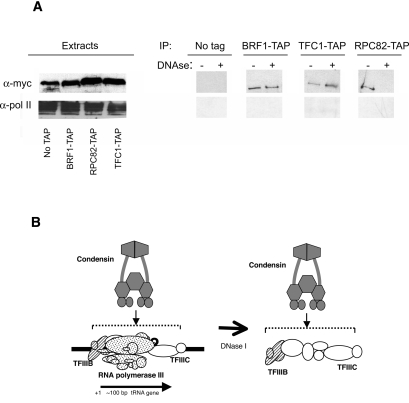
Condensin subunits Smc2 and Smc4 interact with subunits of RNA pol III and its transcription factors. (A) Strains containing a Myc-tagged SMC subunit and either no TAP-tagged protein, or a TAP-tagged subunit of RNA pol III, TFIIIB, or TFIIIC were lysed, and TAP-containing complexes were affinity isolated and probed for Myc-tagged condensin. Whole extracts blotted with anti-Myc antibody to detect condensin subunits or anti-pol II (large subunit C-terminal domain) are shown on the left. A portion of the condensin found in the extracts coisolated with each of the pol III complexes, whereas little or none of the pol II control did. (Faint signals of pol II large subunit were reproducible in the TFC1-tagged strain pulldown.) Aggressive DNase I treatment removed pol III, as well as DNA, from the complexes while leaving condensin associated with TFIIIB and TFIIIC. (B) A model for the association of condensin with the known complex of pol III transcription factors TFIIIC and TFIIIB. Although the DNase resistance of the complex suggests a direct and stable protein–protein association, it does not rule out contact of condensin with the DNA as well.

References

    1. Bartholomew B., Kassavetis G.A., Geiduschek E.P. Two components of Saccharomyces cerevisiae transcription factor IIIB (TFIIIB) are stereospecifically located upstream of a tRNA gene and interact with the second-largest subunit of TFIIIC. Mol. Cell. Biol. 1991;11:5181–5189. - PMC - PubMed
    1. Bartova E., Kozubek S. Nuclear architecture in the light of gene expression and cell differentiation studies. Biol. Cell. 2006;98:323–336. - PubMed
    1. Bertrand E., Houser-Scott F., Kendall A., Singer R.H., Engelke D.R. Nucleolar localization of early tRNA processing. Genes & Dev. 1998;12:2463–2468. - PMC - PubMed
    1. Bhalla N., Biggins S., Murray A.W. Mutation of YCS4, a budding yeast condensin subunit, affects mitotic and nonmitotic chromosome behavior. Mol. Biol. Cell. 2002;13:632–645. - PMC - PubMed
    1. Brickner J.H., Walter P. Gene recruitment of the activated INO1 locus to the nuclear membrane. PLoS Biol. 2004;2:e342. doi: 10.1371/journal.pbio.0020342. - DOI - PMC - PubMed

Publication types

MeSH terms