. 2008 Oct 24;283(43):28996-9003.
doi: 10.1074/jbc.M804782200. Epub 2008 Aug 16.

Phosphomimetic mutations increase phospholamban oligomerization and alter the structure of its regulatory complex

Affiliations

Phosphomimetic mutations increase phospholamban oligomerization and alter the structure of its regulatory complex

Zhanjia Hou et al. J Biol Chem. .

Abstract

To investigate the effect of phosphorylation on the interactions of phospholamban (PLB) with itself and its regulatory target, SERCA, we measured FRET from CFP-SERCA or CFP-PLB to YFP-PLB in live AAV-293 cells. Phosphorylation of PLB was mimicked by mutations S16E (PKA site) or S16E/T17E (PKA+CaMKII sites). FRET increased with protein concentration up to a maximum (FRET(max)) that was taken to represent the intrinsic FRET of the bound complex. The concentration dependence of FRET yielded dissociation constants (K(D)) for the PLB-PLB and PLB-SERCA interactions. PLB-PLB FRET data suggest pseudo-phosphorylation of PLB increased oligomerization of PLB but did not alter PLB pentamer quaternary structure. PLB-SERCA FRET experiments showed an apparent decrease in binding of PLB to SERCA and an increase in the apparent PLB-SERCA binding cooperativity. It is likely that these changes are secondary effects of increased oligomerization of PLB; a change in the inherent affinity of monomeric PLB for SERCA was not detected. In addition, PLB-SERCA complex FRET(max) was reduced by phosphomimetic mutations, suggesting the conformation of the regulatory complex is significantly altered by PLB phosphorylation.


Figures
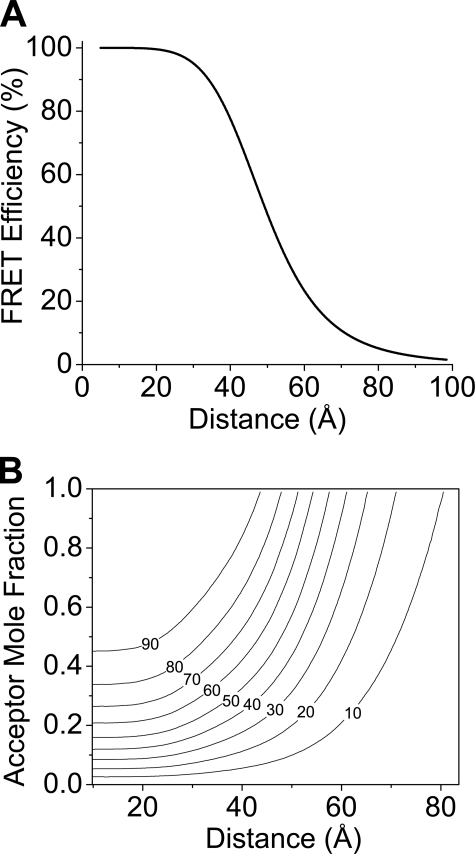
FIGURE 1.
FIGURE 1.
Theoretical models for interpretation of FRET. A, simulated dependence of FRET on probe separation distance for the PLB-SERCA regulatory complex. B, simulated dependence of FRET (contours, %) on probe separation distance and acceptor mol fraction for the PLB pentamer.
FIGURE 2.
FIGURE 2.
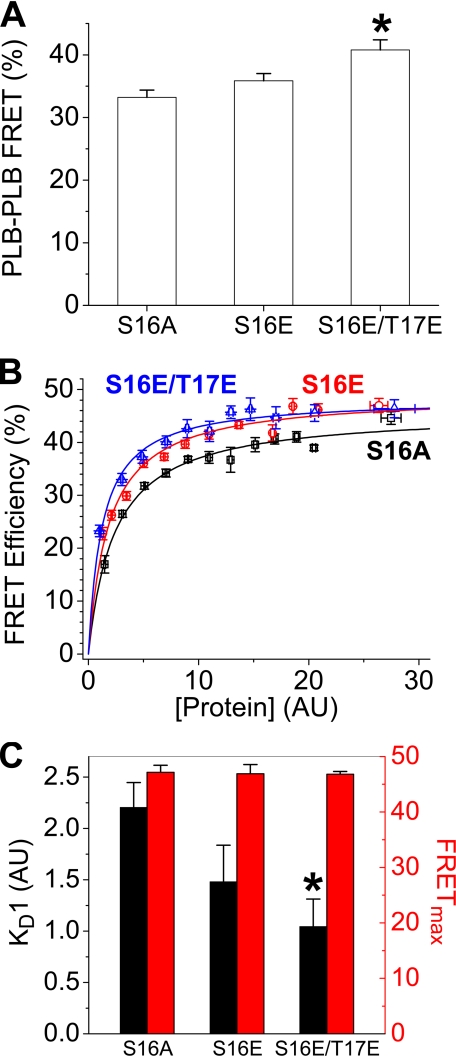
Effects of phosphomimetic mutations on PLB-PLB FRET. A, mean intrapentameric FRET increases with pseudo-phosphorylation. B, concentration dependence of FRET for S16A (black squares), S16E (red circles), and S16E/T17E (blue triangles). C, mean KD1 and FRETmax parameters obtained by hyperbolic fitting of data as in B. * indicates p < 0.05 versus S16A.
FIGURE 3.
FIGURE 3.
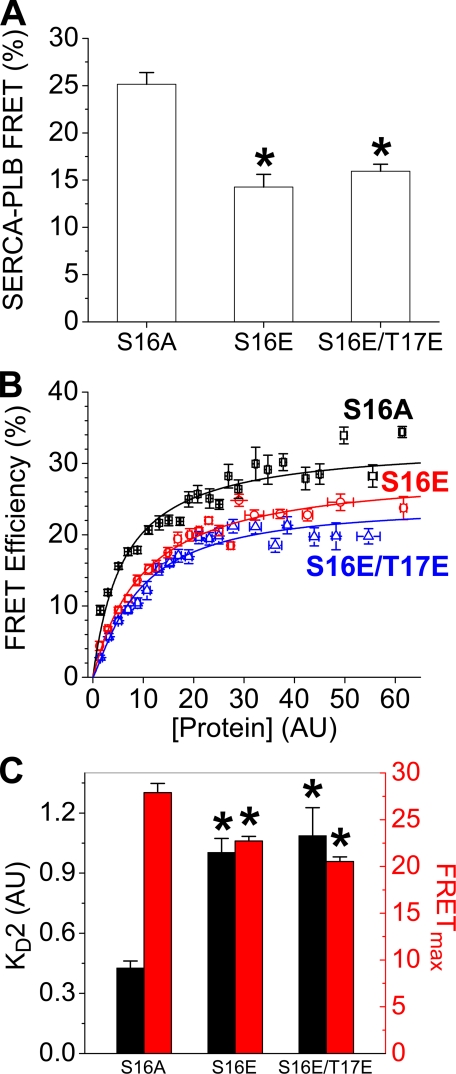
Effects of phosphomimetic mutations on SERCA-PLB FRET. A, regulatory complex mean FRET decreases with pseudo-phosphorylation. B, concentration dependence of FRET for S16A (black squares), S16E (red circles), and S16E/T17E (blue triangles). C, mean KD2 and FRETmax parameters obtained by hyperbolic fits of S16A data or Hill function regression of S16E and S16E/T17E. * indicates p < 0.05 versus S16A.
FIGURE 4.
FIGURE 4.
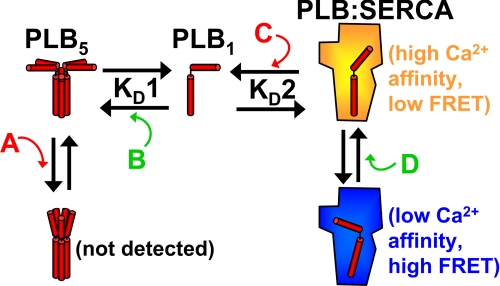
A scheme for regulation of SERCA by PLB. Proposed effects of phosphorylation on PLB pentamer structure (A), oligomerization affinity (B), affinity for SERCA (C), and regulatory complex structure (D). Effects shown in B and D are supported by the present data. The compact conformation of PLB5 was not detected, nor was there evidence for a direct effect on the affinity of PLB1 for SERCA.
FIGURE 5.
FIGURE 5.
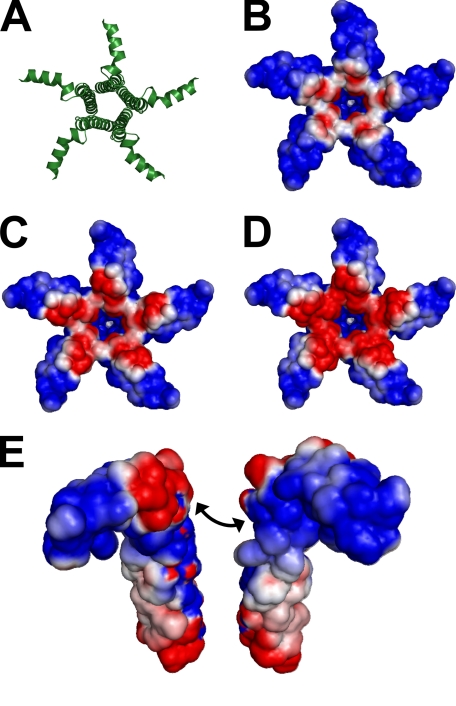
Computational modeling of PLB electrostatic potential. A, PLB pentamer structure 1XNU. B, surface potentials of WT-PLB showing –1 (red) and +1 kT/e (blue) charges. C, S16E. D, S16E/T17E. The model suggests that charges are well localized at physiological salt concentrations, and electrostatic repulsion between cytoplasmic domains is unlikely to define the quaternary conformation of the pentamer. E, an exploded view of two adjacent S16E/T17E pentamer subunits shows a bipolar charge distribution on S16E/T17E-PLB cytoplasmic domains that could contribute to oligomerization.

References

    1. Traaseth, N. J., Verardi, R., Torgersen, K. D., Karim, C. B., Thomas, D. D., and Veglia, G. (2007) Proc. Natl. Acad. Sci. U. S. A. 104 14676–14681 - PMC - PubMed
    1. Zamoon, J., Mascioni, A., Thomas, D. D., and Veglia, G. (2003) Biophys. J. 85 2589–2598 - PMC - PubMed
    1. MacLennan, D. H., and Kranias, E. G. (2003) Nat. Rev. Mol. Cell. Biol. 4 566–577 - PubMed
    1. Tada, M., Kirchberger, M. A., and Katz, A. M. (1975) J. Biol. Chem. 250 2640–2647 - PubMed
    1. Wegener, A. D., Simmerman, H. K., Lindemann, J. P., and Jones, L. R. (1989) J. Biol. Chem. 264 11468–11474 - PubMed

Publication types

Substances