


Impact of changing from cyclosporine to tacrolimus on pharmacokinetics of mycophenolic acid in renal transplant recipients with diabetes
- PMID: 18708992
- PMCID: PMC2783237
- DOI: 10.1097/FTD.0b013e3181858169
Impact of changing from cyclosporine to tacrolimus on pharmacokinetics of mycophenolic acid in renal transplant recipients with diabetes
Abstract
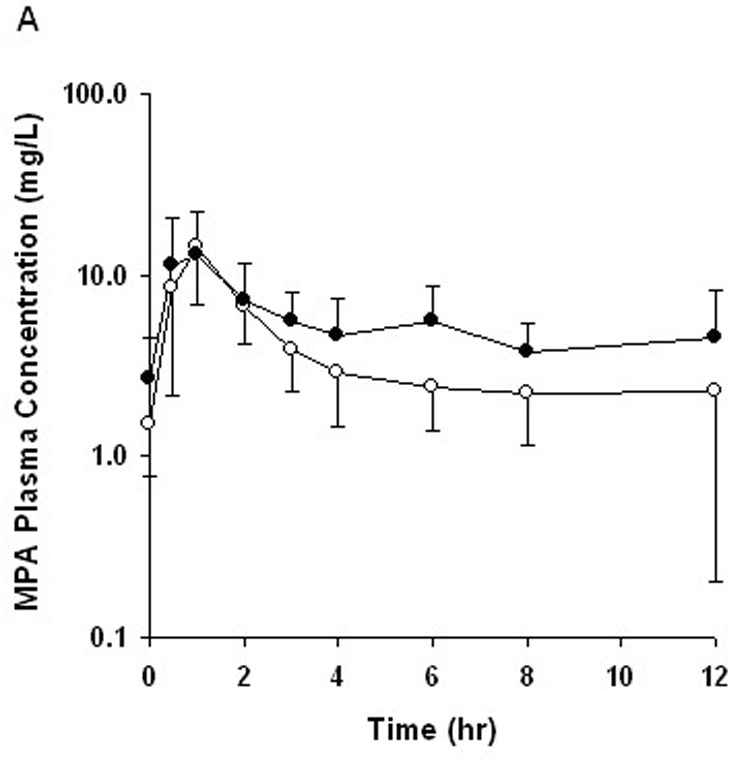
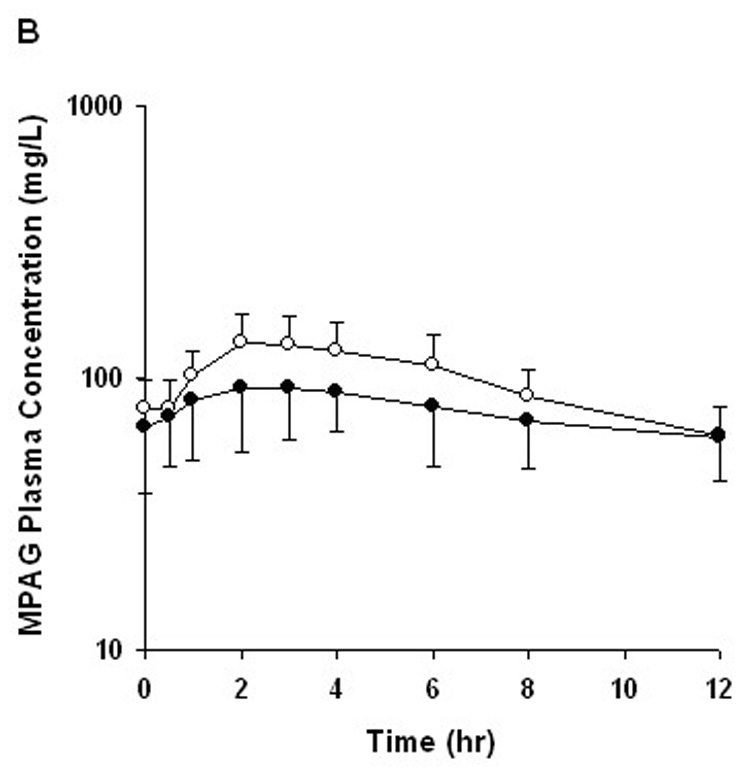
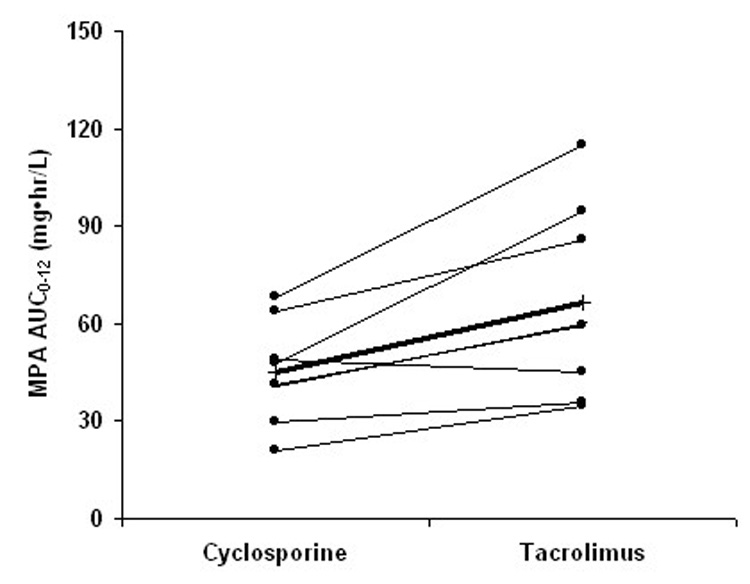
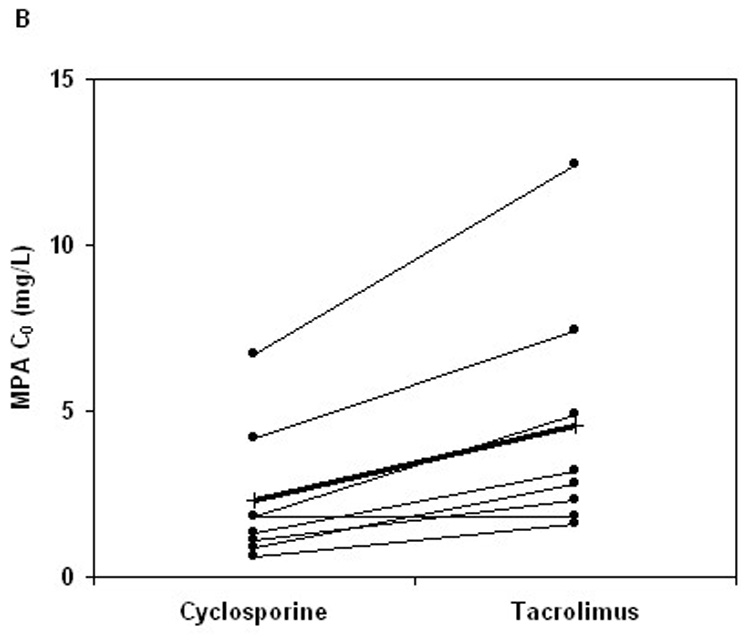
The rate of mycophenolic acid (MPA) absorption after oral administration of mycophenolate mofetil (MMF) is delayed in patients with diabetes. Cyclosporine (CsA) decreases MPA exposure by inhibiting enterohepatic recirculation of MPA/MPA glucuronide, and tacrolimus (TRL) may alter the rate and extent of MPA absorption due to its prokinetic properties especially in patients with diabetic gastroparesis. This study evaluated the effect of changing from CsA to TRL on pharmacokinetics of MPA in stable renal transplant recipients with long-standing diabetes. Eight patients were switched from a stable dose of CsA to TRL while taking MMF 1 g twice daily. The 12-hour steady-state total plasma concentration-time profiles of MPA and MPA glucuronide were obtained after oral administration of MMF on 2 occasions: first while taking CsA and second after changing to TRL. Pharmacokinetic parameters of MPA were calculated by the noncompartmental method. Changing from CsA to TRL resulted in significantly increased MPA exposure (area under the concentration-time curve from 0 to 12 hours, AUC0-12) by 46 +/- 32% (P = 0.012) and MPA predose concentration (C0) by 121 +/- 67% (P = 0.008). The magnitude of change in MPA exposure did not correlate well with MPA-C0 or CsA trough concentration. Switching to TRL had minimal impact on peak concentration of MPA (15.0 +/- 6.9 mg/L with CsA versus 16.1 +/- 9.7 mg/L with TRL, P = 0.773) and time to reach the peak concentration (1.0 +/- 0.4 hours with CsA versus 1.2 +/- 0.8 hours with TRL, P = 0.461). Highly variable and unpredictable changes in MPA exposure among renal transplant patients with diabetes do not support a strategy of preemptively adjusting MMF dose when switching calcineurin inhibitors in this population.
Figures
References
-
- Zucker K, Rosen A, Tsaroucha A, et al. Unexpected augmentation of mycophenolic acid pharmacokinetics in renal transplant patient receiving tacrolimus and mycophenolate mofetil in combination therapy, and analogous in vitro findings. Transplant Immunol. 1997;5:225–232. - PubMed
-
- Hübner GI, Eismann R, Sziegoleit W. Drug interaction between mycophenolate mofetil and tacrolimus detectable within therapeutic mycophenolic acid monitoring in renal transplant patients. Ther Drug Monit. 1999;21:536–539. - PubMed
-
- Smak Gregoor PJH, de Sévaux RGL, Hené RJ, et al. Effect of cyclosporine on mycophenolic acid trough levels in kidney transplant recipients. Transplantation. 1999;68:1603–1606. - PubMed
-
- Pou L, Brunet M, Cantarell C, et al. Mycophenolic acid plasma concentrations: influence of comedication. Ther Drug Monit. 2001;23:35–38. - PubMed
-
- Shipkova M, Armstrong VW, Kuypers D, et al. Effect of cyclosporine withdrawal on mycophenolic acid pharmacokinetics in kidney transplant recipients with deteriorating renal function: preliminary report. Ther Drug Monit. 2001;23:717–721. - PubMed
Publication types
MeSH terms
Substances
Grants and funding
LinkOut - more resources
Full Text Sources
Medical
