Comparative Study
. 2008 Nov;12(11):1951-60.
doi: 10.1007/s11605-008-0640-6. Epub 2008 Aug 16.

Hepatic neuroendocrine metastases: chemo- or bland embolization?

Affiliations
Comparative Study

Hepatic neuroendocrine metastases: chemo- or bland embolization?

Susan C Pitt et al. J Gastrointest Surg. 2008 Nov.

Abstract

Introduction: Aggressive management of hepatic neuroendocrine (NE) metastases improves symptoms and prolongs survival. Because of the rarity of these tumors, however, the best method for hepatic artery embolization has not been established. We hypothesized that in patients with hepatic NE metastases, hepatic artery chemoembolization (HACE) would result in better symptom improvement and survival compared to bland embolization (HAE).

Methods: Retrospective review identified all patients with NE hepatic metastases managed by HACE or HAE at three institutions from January 1996 through December 2007.

Results: We identified 100 patients managed by HACE (n = 49) or HAE (n = 51) that were similar with respect to age, gender, and primary tumor type. The percentage of patients experiencing morbidity, 30-day mortality, and symptom improvement were similar between the two groups (HACE vs. HAE: 2.4% vs. 6.6%; 0.8% vs. 1.8%; and 88% vs. 83%, respectively.) No differences in the median overall survival were observed between HACE and HAE from the time of the first embolization procedure (25.5 vs. 25.7 months, p = 0.79). Multivariate analysis revealed that resection of the primary tumor predicted survival (73.8 vs. 19.4 months, p < 0.04).

Conclusions: These data suggest that morbidity, mortality, symptom improvement, and overall survival are similar in patients with hepatic neuroendocrine metastases managed by chemo- or bland hepatic artery embolization.


Figures
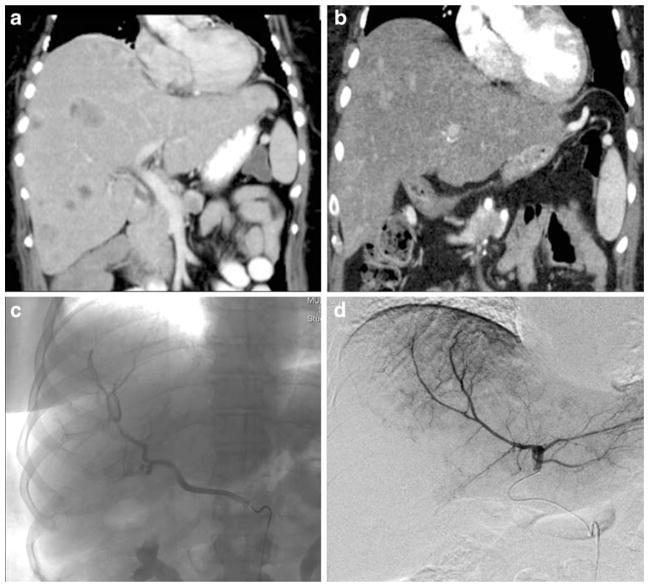
Figure 1
Figure 1
CT imaging of a patient with multiple, bilobar NE hepatic metastases before (a) and after (b) bland HAE. This patient underwent sequential embolizations of her replaced right (c) and left (d) hepatic arteries with subsequent symptom improvement.
Figure 2
Figure 2
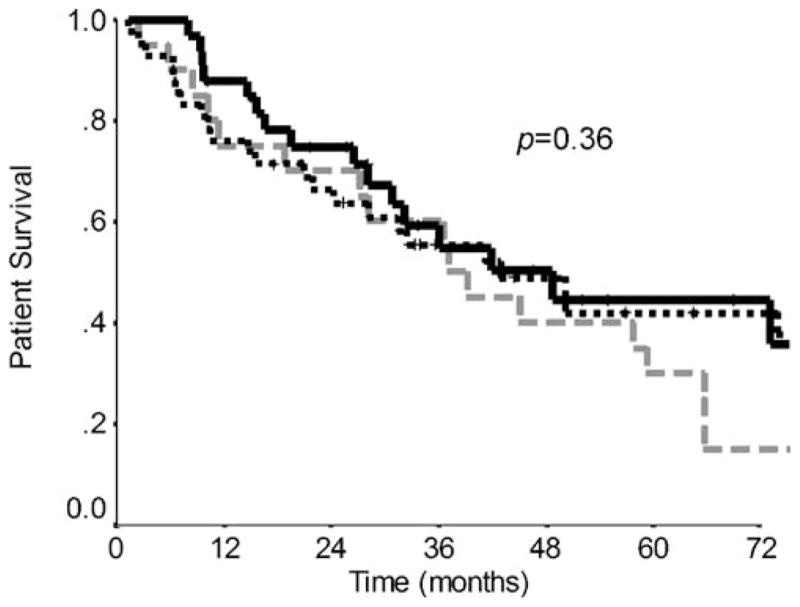
Overall survival calculated from the time of metastases diagnosis reveals no differences among the three institutions involved in this study: IU (solid line—median survival 48.7 months), UW (dashed grey line—median survival 37.0 months), and MCW (dotted line—median survival 42.9 months; p=0.23).
Figure 3
Figure 3
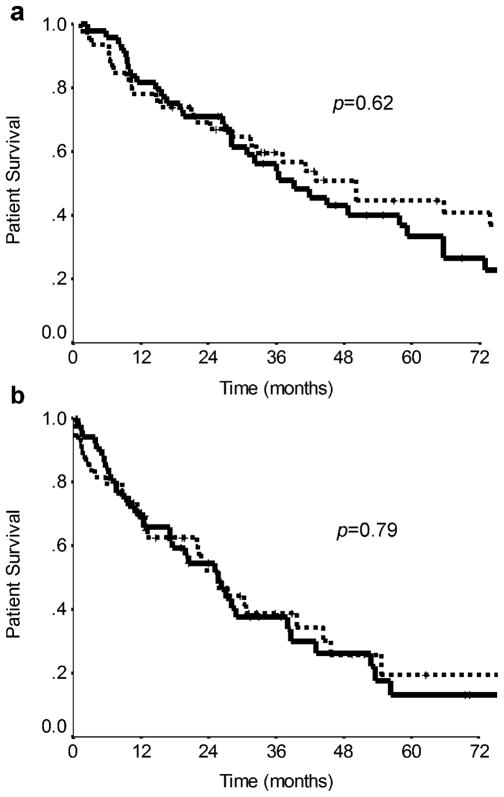
Kaplan–Meier curves comparing overall survival from a the time of diagnosis of metastases (median survival 50.1 vs. 39.1 months, respectively, p=0.62) and b the time of first embolization procedure (median survival 25.5 vs. 25.7 months, respectively, p=0.79) between patients treated by HACE (dotted line) or HAE (solid line).
Figure 4
Figure 4
Overall survival in patients who underwent resection of their primary tumor (solid line) was significantly longer compared to those whose primary tumors remained intact (dotted line) (median survival 73.1 vs. 28.0 months, respectively, p=0.0002). Survival was calculated from the time of diagnosis of metastatic disease.
Figure 5
Figure 5
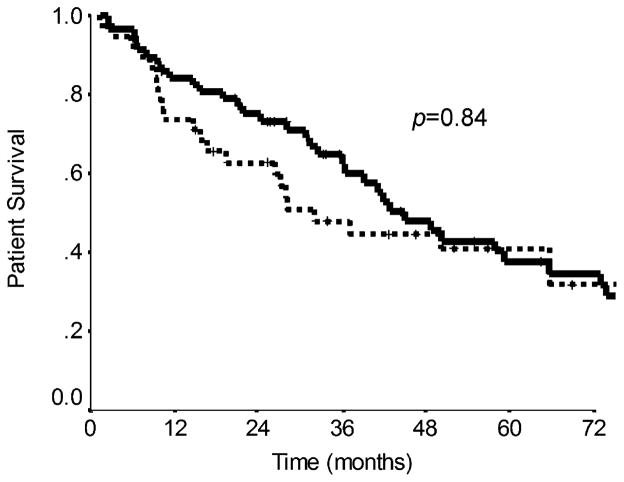
Patient overall survivals by primary tumor type: median survival for carcinoids (solid line) was 45.0 months while islet cell tumors (dotted line) had a median survival of 32.0 months. This difference was not statistically significant (p=0.84).

References

    1. Chen H, Hardacre J, Uzar A, Cameron J, Choti M. Isolated liver metastases from neuroendocrine tumors: does resection prolong survival? J Am Coll Surg. 1998;187:88–93. doi: 10.1016/S1072-7515(98)00099-4. - DOI - PubMed
    1. Touzios JG, Kiely JM, Pitt SC, Rilling WS, Quebbeman EJ, Wilson SD, et al. Neuroendocrine hepatic meastases: does aggressive management improve survival? Ann Surg. 2005;241:776–785. doi: 10.1097/01.sla.0000161981.58631.ab. - DOI - PMC - PubMed
    1. Musunuru S, Chen H, Rajpal S, Stephani N, McDermott JC, Holen K, et al. Metastatic neuroendocrine hepatic tumors: resection improves survival. Arch Surg. 2006;141:1000–1004. doi: 10.1001/archsurg.141.10.1000. - DOI - PubMed
    1. Yoa KA, Talamonti MS, Nemeck A, Angelos P, Chrisman H, Skarda J, et al. Indications and results of liver resection and hepatic chemoembolization for metastastic gastrointestinal neuroendocrine tumors. Surgery. 2001;130:677–685. doi: 10.1067/ msy.2001.117377. - DOI - PubMed
    1. Woodside KJ, Townsend CM, Jr, Evers MB. Current management of gastrointestinal carcinoid tumors. J Gastrointest Surg. 2004;8:742–756. doi: 10.1016/j.gassur.2004.04.010. - DOI - PubMed

Publication types

MeSH terms