


Development of a broad-host-range sacB-based vector for unmarked allelic exchange
- PMID: 18710539
- PMCID: PMC2518277
- DOI: 10.1186/1756-0500-1-1
Development of a broad-host-range sacB-based vector for unmarked allelic exchange
Abstract
Background: Although genome sequences are available for an ever-increasing number of bacterial species, the availability of facile genetic tools for physiological analysis have generally lagged substantially behind traditional genetic models.
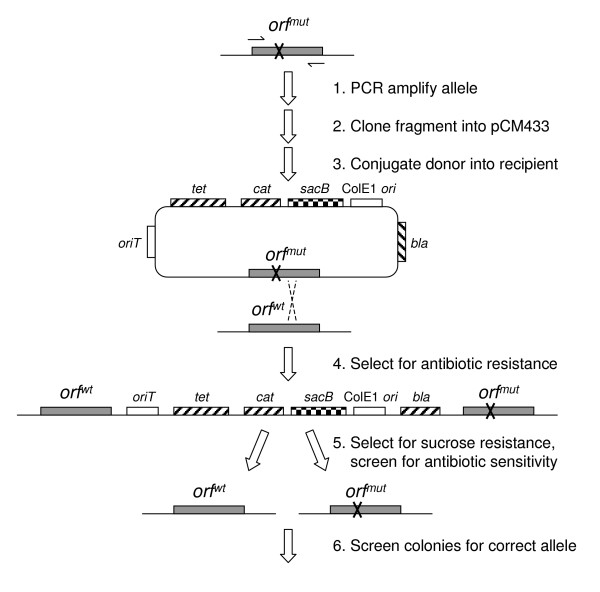
Results: Here I describe the development of an improved, broad-host-range "in-out" allelic exchange vector, pCM433, which permits the generation of clean, marker-free genetic manipulations. Wild-type and mutant alleles were reciprocally exchanged at three loci in Methylobacterium extorquens AM1 in order to demonstrate the utility of pCM433.
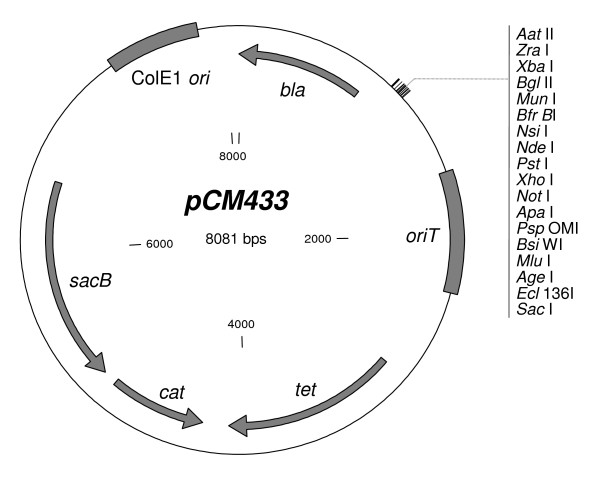
Conclusion: The broad-host-range vector for marker-free allelic exchange described here, pCM433, has the advantages of a high copy, general Escherichia coli replicon for easy cloning, an IncP oriT enabling conjugal transfer, an extensive set of restriction sites in its polylinker, three antibiotic markers, and sacB (encoding levansucrase) for negative selection upon sucrose plates. These traits should permit pCM433 to be broadly applied across many bacterial taxa for marker-free allelic exchange, which is particularly important if multiple manipulations or more subtle genetic manipulations such as point mutations are desired.
Figures
References
-
- Ayres EK, Thomson VJ, Merino G, Balderes D, Figurski DH. Precise deletions in large bacterial genomes by vector-mediated excision (VEX). The trfA gene of promiscuous plasmid RK2 is essential for replication in several gram-negative hosts. J Mol Biol. 1993;230:174–185. doi: 10.1006/jmbi.1993.1134. - DOI - PubMed
-
- Hoang TT, Karkhoff-Schweizer RR, Kutchma AJ, Schweizer HP. A broad-host-range Flp-FRT recombination system for site-specific excision of chromosomally-located DNA sequences: application for isolation of unmarked Pseudomonas aeruginosa mutants. Gene. 1998;212:77–86. doi: 10.1016/S0378-1119(98)00130-9. - DOI - PubMed
-
- Marx CJ, Lidstrom ME. Broad-host-range cre-lox system for antibiotic marker recycling in gram-negative bacteria. BioTechniques. 2002;33:1062–1067. - PubMed
LinkOut - more resources
Full Text Sources
Other Literature Sources
Research Materials
