. 2008 Aug 26;105(34):12134-9.
doi: 10.1073/pnas.0802105105. Epub 2008 Aug 18.

Water-stable organic transistors and their application in chemical and biological sensors

Affiliations

Water-stable organic transistors and their application in chemical and biological sensors

Mark E Roberts et al. Proc Natl Acad Sci U S A. .

Abstract

The development of low-cost, reliable sensors will rely on devices capable of converting an analyte binding event to an easily read electrical signal. Organic thin-film transistors (OTFTs) are ideal for inexpensive, single-use chemical or biological sensors because of their compatibility with flexible, large-area substrates, simple processing, and highly tunable active layer materials. We have fabricated low-operating voltage OTFTs with a cross-linked polymer gate dielectric, which display stable operation under aqueous conditions over >10(4) electrical cycles using the p-channel semiconductor 5,5'-bis-(7-dodecyl-9H-fluoren-2-yl)-2,2'-bithiophene (DDFTTF). OTFT sensors were demonstrated in aqueous solutions with concentrations as low as parts per billion for trinitrobenzene, methylphosphonic acid, cysteine, and glucose. This work demonstrates of reliable OTFT operation in aqueous media, hence opening new possibilities of chemical and biological sensing with OTFTs.


Conflict of interest statement

The authors declare no conflict of interest.

Figures
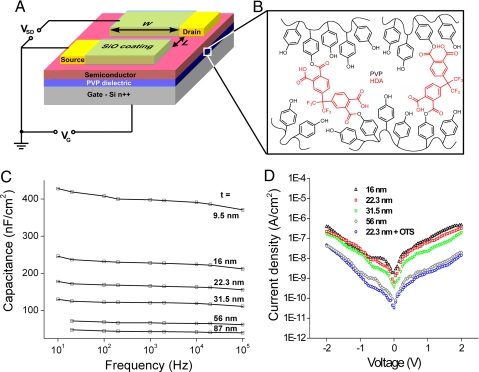
Fig. 1.
Fig. 1.
Cross-linked polymer gate insulator and its corresponding electrical properties. (A) Structure of the top-contact OTFT sensor. (B) Chemical structure of cross-linked PVP with HDA. (C) Capacitance vs. frequency. (D) Leakage current vs. voltage for various PVP-HDA films.
Fig. 2.
Fig. 2.
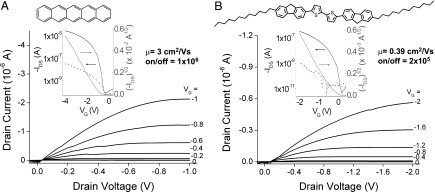
Electrical characteristics of p-channel OTFTs with a PVP-HDA insulator layer and a source-drain electrode geometry of W/L = 20. Output and transfer (Inset) characteristics of OTFTs with 40-nm thermally evaporated films of pentacene on OTS (A) and DDFTTF (B). The gate current is shown in dashed lines.
Fig. 3.
Fig. 3.
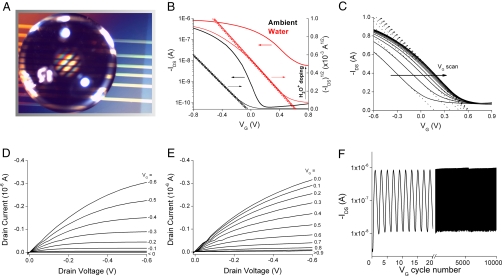
DDFTTF OTFT operation in aqueous media. (A) Optical micrograph of an OTFT with DDFTTF and 22-nm PVP-HDA under aqueous conditions. (B) Transfer characteristics (VDS = −0.6 V) in ambient (black) and water (red). The right axis shows the semilog plot of IDS vs. VG and the left axis shows IDS1/2 vs. VG. (C) Transfer characteristics recorded sequentially after the addition of water. (D) Output characteristics (IDS vs. VDS) in ambient. (E) Output characteristics under water. (F) IDS vs. VG (0.3 to −1 V) at a VDS = −0.6 V measured over 104 cycles (over a period of 12 h) with the initial 20 cycles expanded.
Fig. 4.
Fig. 4.
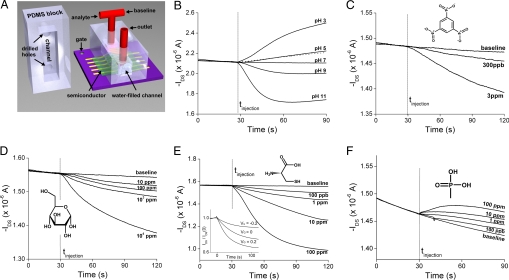
Chemical detection in aqueous systems based on OTFTs (VG = −1 V, VDS = −0.6 V). (A) Schematic showing an OTFT with DDFTTF in flow cell for aqueous-phase sensing. (B) Drain current, IDS, response of a DDFTTF OTFT to pH. IDS response curves for the pH 5 solution were measured before (solid) and after (dashed) the exposure to other pH solutions. (C–F) IDS response to different analytes: trinitrobenzene (TNB) (C), glucose (D), cysteine (E), and methylphosphonic acid (MPA) (F). (E Inset) IDS response for 10-ppm cysteine as a function of VG. The magnitude of the change in current, referenced to the drain current at time 0 s (the baseline current varies with VG), increases as VG is changed from 0.2 to 0 to −0.2 V.
Fig. 5.
Fig. 5.
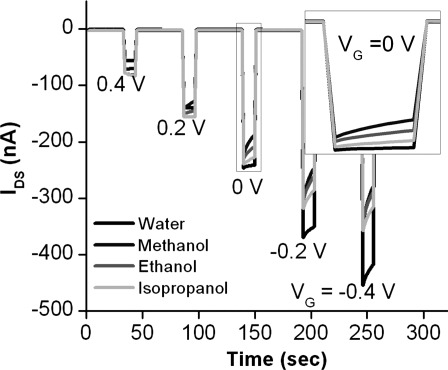
OTFT drain current sensitivity to 1 part per thousand (ppth) solutions of MeOH (dark gray), EtOH (gray), i-PrOH (light gray), and water (black) for VG switching on and off (1 V), etc., for “on” VG of 0.4, 0.2, 0, −0.2, and −0.4 V. (Inset) Expansion of OTFT drain current from around VG = 0 V.

References

    1. Johnson KS, Needoba JA, Riser SC, Showers WJ. Chemical sensor networks for the aquatic environment. Chem Rev. 2007;107:623–640. - PubMed
    1. Voiculescu I, et al. Micropreconcentrator for enhanced trace detection of explosives and chemical agents. IEEE Sens J. 2006;6:1094–1104.
    1. Wang L, et al. Nanoscale organic and polymeric field-effect transistors as chemical sensors. Anal Bioanal Chem. 2006;384:310–321. - PubMed
    1. Carlen ET, van den Berg A. Nanowire electrochemical sensors: Can we live without labels? Lab Chip. 2007;7:19–23. - PubMed
    1. Janata J, Josowicz M. Conducting polymers in electronic chemical sensors. Nat Mater. 2003;2:19–24. - PubMed

Publication types

MeSH terms