


Indulgent feeding style and children's weight status in preschool
- PMID: 18714209
- PMCID: PMC2769986
- DOI: 10.1097/DBP.0b013e318182a976
Indulgent feeding style and children's weight status in preschool
Abstract
Purpose: The primary aim of this study was to examine whether parent affect and child temperament characteristics differ across feeding styles in low-income families, given suggestive evidence. The secondary aim was to examine whether feeding styles were still related to children's body mass index independent of parent affect, child temperament, and known correlates.
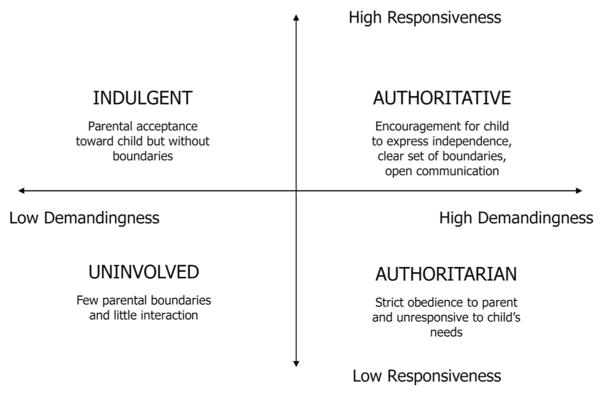
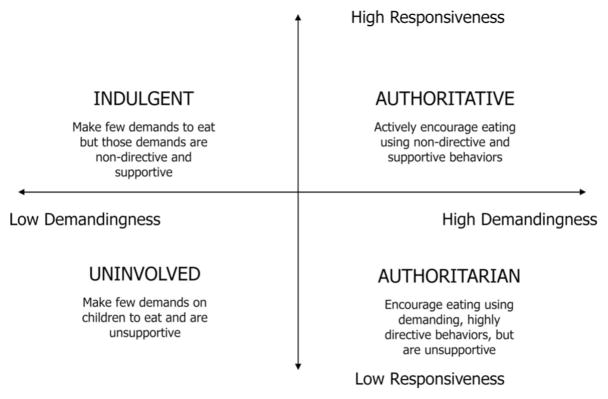
Methods: Participants in this study were 718 parents of children attending Head Start programs across two sites (Texas and Alabama). Parents were categorized into feeding styles of authoritative (n = 118), authoritarian (n = 219), indulgent (n = 240) and uninvolved (n = 141) using a parent-report questionnaire characterizing feeding in a general parenting paradigm. Parents completed questionnaires and measured height and weight was obtained from parents and children.
Results: Differences were found across feeding styles on parent affect and child temperament characteristics. Indulgent parents reported lower Negative Affect for themselves and lower Negative Affectivity for their children. The indulgent feeding style was significantly associated with higher child body mass index after controlling for parent affect, child temperament, and correlates (ethnicity, child age, parent body mass index).
Conclusions: The results of this study not only show a robust association between the indulgent feeding style and weight status of low-income preschool children, but also suggest how congruence between parent emotional affect and child temperament characteristics may contribute to excess consumption among children of indulgent parents.
Figures
References
-
- Baumrind D. Current patterns of parental authority. Development Psychology Monographs. 1971;4:101–103.
-
- Darling N, Steinberg I. Parenting style as context: an integrative model. Psychol Bull. 1993;113:487–496.
-
- Steinberg L. Beyond the Classroom: Why School Reform has Failed and what Parents Need to Do. New York, NY: Simon & Schuster; 1996.
-
- Rhee KE, Lumeng JC, Appugliese DP, et al. Parenting styles and overweight status in first grade. Pediatrics. 2006;117:2047–2054. - PubMed
-
- Ogden CL, Carroll MD, Curtin LR, et al. Prevalence of overweight and obesity in the United States, 1999–2004. JAMA. 2006;295:1549–1555. - PubMed
Publication types
MeSH terms
Grants and funding
LinkOut - more resources
Full Text Sources
Medical
