. 2008 Nov;57(11):2977-91.
doi: 10.2337/db08-0161. Epub 2008 Aug 20.

Peripheral, but not central, CB1 antagonism provides food intake-independent metabolic benefits in diet-induced obese rats

Affiliations

Peripheral, but not central, CB1 antagonism provides food intake-independent metabolic benefits in diet-induced obese rats

Ruben Nogueiras et al. Diabetes. 2008 Nov.

Abstract

Objective: Blockade of the CB1 receptor is one of the promising strategies for the treatment of obesity. Although antagonists suppress food intake and reduce body weight, the role of central versus peripheral CB1 activation on weight loss and related metabolic parameters remains to be elucidated. We therefore specifically assessed and compared the respective potential relevance of central nervous system (CNS) versus peripheral CB1 receptors in the regulation of energy homeostasis and lipid and glucose metabolism in diet-induced obese (DIO) rats.

Research design and methods: Both lean and DIO rats were used for our experiments. The expression of key enzymes involved in lipid metabolism was measured by real-time PCR, and euglycemic-hyperinsulinemic clamps were used for insulin sensitivity and glucose metabolism studies.

Results: Specific CNS-CB1 blockade decreased body weight and food intake but, independent of those effects, had no beneficial influence on peripheral lipid and glucose metabolism. Peripheral treatment with CB1 antagonist (Rimonabant) also reduced food intake and body weight but, in addition, independently triggered lipid mobilization pathways in white adipose tissue and cellular glucose uptake. Insulin sensitivity and skeletal muscle glucose uptake were enhanced, while hepatic glucose production was decreased during peripheral infusion of the CB1 antagonist. However, these effects depended on the antagonist-elicited reduction of food intake.

Conclusions: Several relevant metabolic processes appear to independently benefit from peripheral blockade of CB1, while CNS-CB1 blockade alone predominantly affects food intake and body weight.


Figures
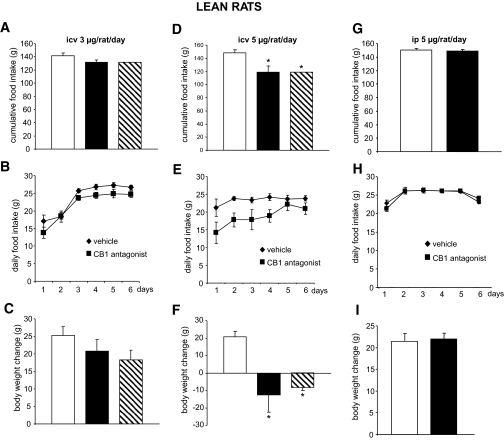
FIG. 1.
FIG. 1.
Effects of CB1 antagonism on food intake and body weight in lean rats. A and B: Effect of a 6-day intracerebroventricular (icv) CB1 antagonist (3 μg/day) infusion on food intake in lean rats. C: Effect of a 6-day intracerebroventricular CB1 antagonist (3 μg/day) infusion on body weight in lean rats. D and E: Effect of a 6-day intracerebroventricular CB1 antagonist (5 μg/day) infusion on food intake in lean rats. F: Effect of a 6-day intracerebroventricular CB1 antagonist (5 μg/day) infusion on body weight in lean rats. G and H: Effect of a 6-day intraperitoneal (ip) CB1 antagonist (5 μg/day) infusion on food intake in lean rats. I: Effect of a 6-day intraperitoneal CB1 antagonist (5 μg/day) infusion on body weight in lean rats. Values are means ± SE of 5–7 animals per group. *P < 0.05. A and D: □, vehicle; ▪, CB1 antagonist;formula image, vehicle-pf. B, E, and H: ♦, vehicle; ▪, CB1 antagonist.
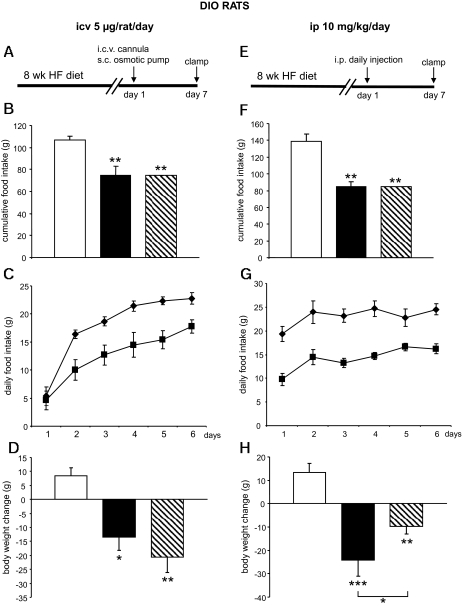
FIG. 2.
FIG. 2.
Effect of CB1 antagonism on food intake and body weight in DIO rats. A: Experimental timeline of intracerebroventricular (icv) studies. HF, high fat; s.c., subcutaneous. B and C: Effect of a 6-day intracerebroventricular CB1 antagonist (5 μg/day) infusion on food intake in DIO rats. D: Effect of a 6-day intracerebroventricular CB1 antagonist (5 μg/day) infusion on body weight in DIO rats. E: Experimental timeline of intraperitoneal (ip) studies. F and G: Effect of a 6-day intraperitoneal CB1 antagonist (10 mg/kg) administration on food intake in DIO rats. H: Effect of a 6-day intraperitoneal CB1 antagonist (10 mg/kg) administration on body weight in DIO rats. Values are means ± SE of five to seven animals per group. *P < 0.05; **P < 0.01; ***P < 0.001. B, F, D, and H: □, vehicle; ▪, CB1 antagonist;formula image, vehicle-pf. C and G: ♦, vehicle; ▪, CB1 antagonist.
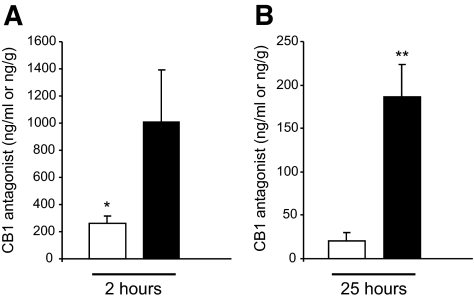
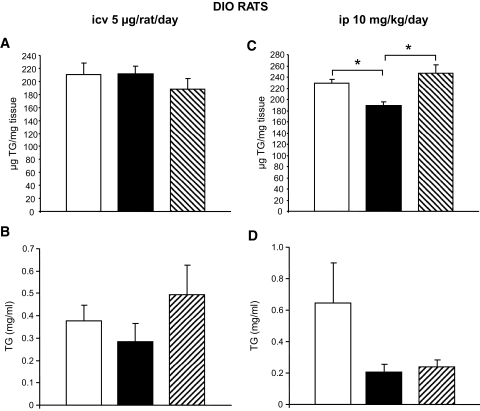
FIG. 3.
FIG. 3.
Concentrations of Rimonabant in serum and brain. The levels of the compound were determined following intraperitoneal dosing once daily for 10 days at 10 mg/kg. On the final day, mice were injected with compound and killed at ∼2 h (A) and ∼25 h (B) postdose and serum and brain collected and processed. □, serum; ▪, brain. *P < 0.05; **P < 0.01.
FIG. 4.
FIG. 4.
Effect of CB1 antagonism on triglyceride levels in DIO rats. A: Effect of a 6-day intracerebroventricular (icv) CB1 antagonist (5 μg/day) infusion on triglyceride (TG) content in WAT in DIO rats. B: Effect of a 6-day intracerebroventricular CB1 antagonist (5 μg/day) infusion on circulating TG levels of DIO rats. C: Effect of a 6-day intraperitoneal (ip) CB1 antagonist (10 mg/kg) administration on TG content in the WAT of DIO rats. D: Effect of a 6-day intraperitoneal CB1 antagonist (10 mg/kg) administration on circulating TG levels of DIO rats. Values are means ± SE of five to seven animals per group. *P < 0.05. □, vehicle; ▪, CB1 antagonist;formula image, vehicle-pf.
FIG. 5.
FIG. 5.
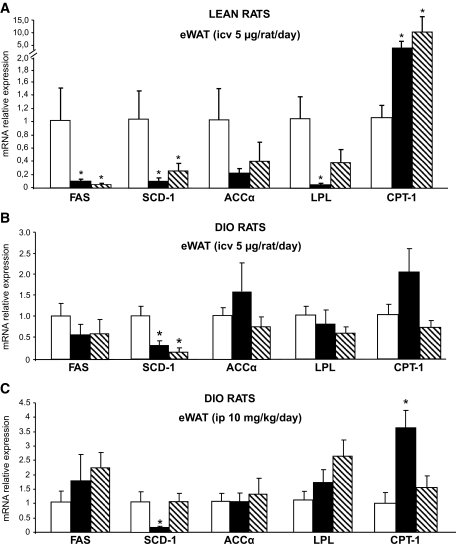
Effect of CB1 antagonism on peripheral lipid metabolism. A: Effect of a 6-day intracerebroventricular (icv) CB1 antagonist (5 μg/day) infusion on epidydimal white adipose tissue mRNA expression of FAS, SCD-1, ACCα, LPL, and CPT-1 in lean rats. B: Effect of a 6-day intracerebroventricular (icv) CB1 antagonist (5 μg/day) infusion on eWAT mRNA expression of FAS, SCD-1, ACCα, LPL, and CPT-1 in DIO rats. C: Effect of a 6-day intraperitoneal (ip) CB1 antagonist (10 mg/kg) administration on eWAT mRNA expression of FAS, SCD-1, ACCα, LPL, and CPT-1 in DIO rats. D: Effect of a 6-day intracerebroventricular CB1 antagonist (5 μg/day) infusion on liver mRNA expression of FAS, SCD-1, ACCα, LPL, and CPT-1 in lean rats. E: Effect of a 6-day intracerebroventricular CB1 antagonist (5 μg/day) infusion on liver mRNA expression of FAS, SCD-1, ACCα, LPL, and CPT-1 in DIO rats. F: Effect of a 6-day intraperitoneal CB1 antagonist (10 mg/kg) administration on liver mRNA expression of FAS, SCD-1, ACCα, LPL, and CPT-1 in DIO rats. Values are means ± SE of five to seven animals per group. *P < 0.05. □, vehicle; ▪, CB1 antagonist;formula image, vehicle-pf.
FIG. 5.
FIG. 5.
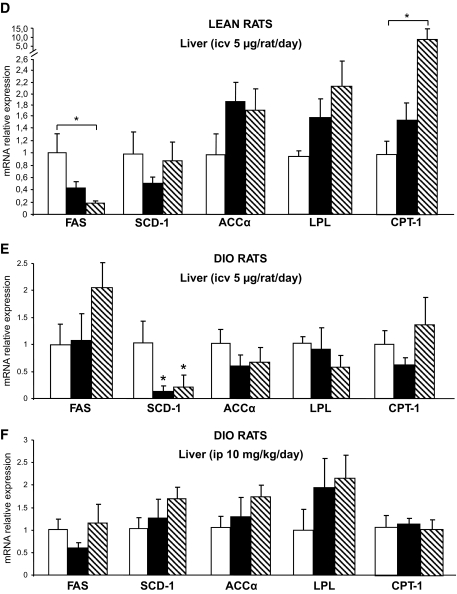
Effect of CB1 antagonism on peripheral lipid metabolism. A: Effect of a 6-day intracerebroventricular (icv) CB1 antagonist (5 μg/day) infusion on epidydimal white adipose tissue mRNA expression of FAS, SCD-1, ACCα, LPL, and CPT-1 in lean rats. B: Effect of a 6-day intracerebroventricular (icv) CB1 antagonist (5 μg/day) infusion on eWAT mRNA expression of FAS, SCD-1, ACCα, LPL, and CPT-1 in DIO rats. C: Effect of a 6-day intraperitoneal (ip) CB1 antagonist (10 mg/kg) administration on eWAT mRNA expression of FAS, SCD-1, ACCα, LPL, and CPT-1 in DIO rats. D: Effect of a 6-day intracerebroventricular CB1 antagonist (5 μg/day) infusion on liver mRNA expression of FAS, SCD-1, ACCα, LPL, and CPT-1 in lean rats. E: Effect of a 6-day intracerebroventricular CB1 antagonist (5 μg/day) infusion on liver mRNA expression of FAS, SCD-1, ACCα, LPL, and CPT-1 in DIO rats. F: Effect of a 6-day intraperitoneal CB1 antagonist (10 mg/kg) administration on liver mRNA expression of FAS, SCD-1, ACCα, LPL, and CPT-1 in DIO rats. Values are means ± SE of five to seven animals per group. *P < 0.05. □, vehicle; ▪, CB1 antagonist;formula image, vehicle-pf.
FIG. 6.
FIG. 6.
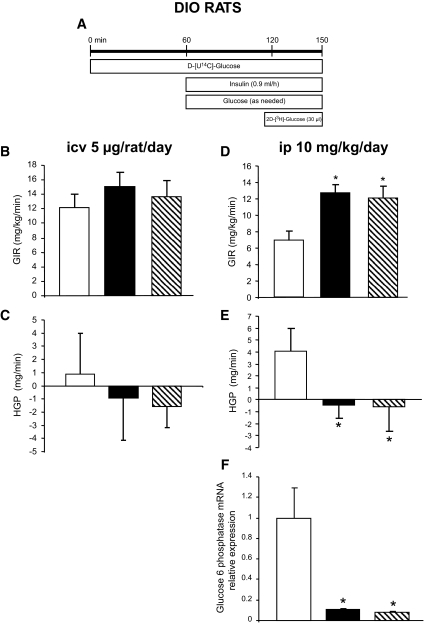
Effect of CB1 antagonism in the regulation of insulin action and hepatic glucose production in DIO rats. A: Schematic representation of the euglycemic-hyperinsulinemic clamps. B: Effect of a 6-day intracerebroventricular (icv) CB1 antagonist (5 μg/day) infusion on GIR in DIO rats. C: Effect of a 6-day intracerebroventricular CB1 antagonist (5 μg/day) infusion on hepatic glucose production (HPG) in DIO rats. D: Effect of a 6-day intraperitoneal (ip) CB1 antagonist (10 mg/kg) administration on GIR in DIO rats. E: Effect of a 6-day intraperitoneal CB1 antagonist (10 mg/kg) administration on hepatic glucose production (HPG) in DIO rats. F: Effect of a 6-day intraperitoneal CB1 antagonist (10 mg/kg) administration on liver mRNA expression of glucose 6 phosphatase in DIO rats. Values are means ± SE of five to seven animals per group. *P < 0.05. BF: □, vehicle; ▪, CB1 antagonist;formula image, vehicle-pf.
FIG. 7.
FIG. 7.
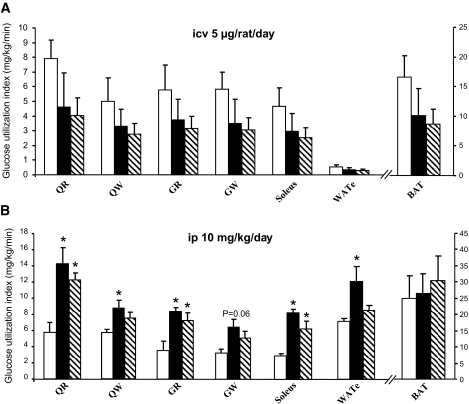
Effect of CB1 antagonism on peripheral glucose uptake in DIO rats. A: Effect of a 6-day intracerebroventricular (icv) CB1 antagonist (5 μg/day) infusion on insulin-stimulated glucose utilization measured during euglycemic-hyperinsulinemic clamps in several types of muscles: quadriceps red (QR), quadriceps white (QW), gastrocnemius red (GR), gastrocnemius white (GW), soleus, eWAT, and brown adipose tissue (BAT) of DIO rats. B: Effect of a 6-day intraperitoneal (ip) CB1 antagonist (10 mg/kg) administration on insulin-stimulated glucose utilization measured during euglycemic-hyperinsulinemic clamps in several types of muscles: quadriceps red, quadriceps white, gastrocnemius red (GR), gastrocnemius white, soleus, eWAT, and brown adipose tissue of DIO rats. Values are means ± SE of five to seven animals per group. *P < 0.05. □, vehicle; ▪, CB1 antagonist;formula image, vehicle-pf.
FIG. 8.
FIG. 8.
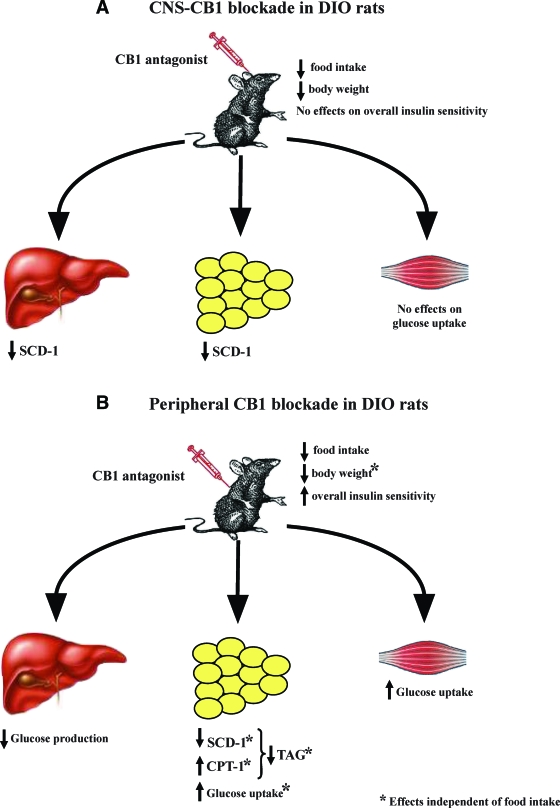
A: Schematic overview summarizing the metabolic effects of CNS-CB1 receptor blockade on peripheral tissues. Blockade of CNS-CB1 decreases the expression of the lipid-promoting enzyme SCD-1 in liver and WAT, whereas it does not alter glucose utilization. B: Schematic overview summarizing the metabolic effects of peripheral CB1 receptor blockade on peripheral tissues. Blockade of peripheral CB1 decreases hepatic glucose production, promotes lipid mobilization independent of food intake, and increases glucose utilization. Combined, these parallel metabolic changes in multiple tissues represent a synergistic shift in substrate choice and nutrient partitioning, resulting in decreased energy storage. TAG, triglycerides.

References

    1. Williams CM, Kirkham TC: Anandamide induces overeating: mediation by central cannabinoid (CB1) receptors. Psychopharmacology (Berl) 143: 315–317, 1999 - PubMed
    1. Di Marzo V, Goparaju SK, Wang L, Liu J, Batkai S, Jarai Z, Fezza F, Miura GI, Palmiter RD, Sugiura T, Kunos G: Leptin-regulated endocannabinoids are involved in maintaining food intake. Nature 410: 822–825, 2001 - PubMed
    1. Breivogel CS, Sim LJ, Childers SR: Regional differences in cannabinoid receptor/G-protein coupling in rat brain. J Pharmacol Exp Ther 282: 1632–1642, 1997 - PubMed
    1. Tsou K, Brown S, Sanudo-Pena MC, Mackie K, Walker JM: Immunohistochemical distribution of cannabinoid CB1 receptors in the rat central nervous system. Neuroscience 83: 393–411, 1998 - PubMed
    1. Van Gaal LF, Rissanen AM, Scheen AJ, Ziegler O, Rossner S: Effects of the cannabinoid-1 receptor blocker rimonabant on weight reduction and cardiovascular risk factors in overweight patients: 1-year experience from the RIO-Europe study. Lancet 365: 1389–1397, 2005 - PubMed

Publication types

MeSH terms