. 2008 Aug 26;105(34):12533-8.
doi: 10.1073/pnas.0706999105. Epub 2008 Aug 21.

Nucleus accumbens AGS3 expression drives ethanol seeking through G betagamma

Affiliations

Nucleus accumbens AGS3 expression drives ethanol seeking through G betagamma

M Scott Bowers et al. Proc Natl Acad Sci U S A. .

Abstract

Approximately 90% of alcoholics relapse within 4 years, in part because of an enhanced motivation to seek alcohol (EtOH). A novel G protein modulator (Gpsm1/AGS3) was up-regulated in the rat nucleus accumbens core (NAcore) but not in other limbic nuclei during abstinence from operant EtOH self-administration. Furthermore, NAcore AGS3 knockdown reduced EtOH seeking to pre-abstinence levels in a novel rat model of compulsive, human EtOH seeking. AGS3 can both inhibit G protein G i alpha-mediated signaling and stimulate G betagamma-mediated signaling. Accordingly, sequestration of G betagamma, but not G i alpha knockdown, significantly reduced EtOH seeking to pre-abstinence levels. Thus, AGS3 and G betagamma are hypothesized to gate the uncontrolled motivation to seek EtOH during abstinence. AGS3 up-regulation during abstinence may be a key determinant of the transition from social consumption to compulsion-like seeking during relapse.


Conflict of interest statement

The authors declare no conflict of interest.

Figures
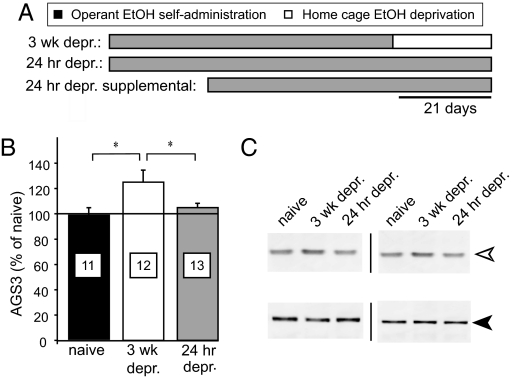
Fig. 1.
Fig. 1.
AGS3 protein expression increased in the NAcore during EtOH abstinence. (A) Schematic demonstrating the self-administration and abstinence paradigm, wherein rats self-administered EtOH for 45–50 contiguous days, followed by 3 wk of EtOH abstinence (“3 wk depr.”) or followed by a further 3 wk of self-administration (“24 h depr.”), or were started 3 wk later (“24 h depr.”; data in SI Results). (B and C) AGS3 expression in the NAcore, normalized to expression in naïve rats (n = 11), was elevated in 3 wk depr (n = 12) but not 24 h depr (n = 13) rats. Representative blots of AGS3 and calnexin, to control for loading, transfer, and blotting conditions across the gel, are shown in C. The open arrowhead indicates AGS3 at ≈72 kDa; the filled arrowhead at ≈90 kDa indicates calnexin. Optical density data were normalized to percent of naïve values within each blot compared with intralane calnexin immunoreactivity. Data represent mean ± SEM. *, P < 0.05—comparing 3 wk depr to EtOH-naïve and 24 h depr rats by using a one-way ANOVA with Scheffé post hoc comparisons.
Fig. 2.
Fig. 2.
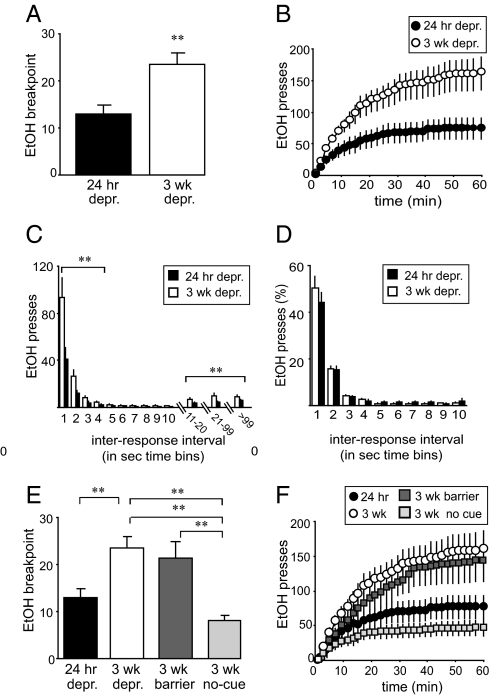
Abstinence-induced enhancement of EtOH seeking. (A) Three weeks of EtOH abstinence significantly enhanced the breakpoint under a PR (3 wk depr: n = 18; 24 h depr: n = 18). (B) Cumulative response timeline showing that enhanced EtOH seeking during abstinence was apparent throughout the session. (C and D) Increased EtOH seeking manifested as an increased number of both fast and slow interresponse intervals (C), but there was no difference in the response pattern when the number of interresponse intervals in each time bin was expressed as a percentage of total responses (D). (E) EtOH-seeking behavior was not impeded by a physical barricade that prevented access to EtOH (“3 wk barrier,” dark gray squares, n = 9) but was significantly blunted by removal of EtOH and all EtOH-associated cues (“3 wk no-cue,” light gray squares, n = 10). (F) Cumulative response data from experiments in E overlain with data from B. Data represent mean ± SEM. *, P < 0.05; **, P < 0.01—using ANOVA with Scheffé post hoc comparisons.
Fig. 3.
Fig. 3.
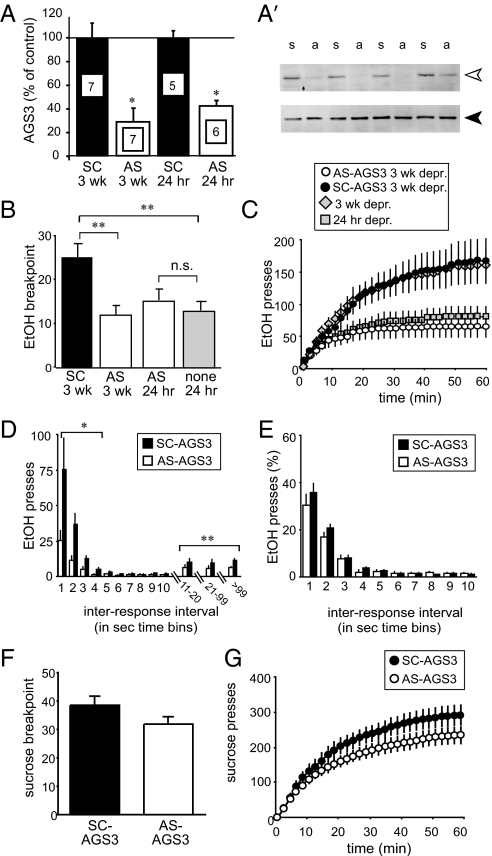
AGS3 knockdown reduced the enhanced EtOH seeking during abstinence. (A) Virus expression of antisense was used to knock down AGS3 in the NAcore of 3-wk-EtOH-deprived rats (SC-AGS3: n = 7; AS-AGS3: n = 7) and in 24 h depr rats (SC-AGS3: n = 6; AS-AGS3: n = 6). Representative AGS3 and calnexin control blots at 3 wk depr are shown in (A′). (B) AGS3 knockdown (AS-AGS3) reduced EtOH seeking in 3 wk depr rats to 24 h depr levels (n = 12), with no effect in 24 h depr rats (n = 12), whereas a scrambled control construct (SC-AGS3) had no effect on breakpoint at 3 wk depr (n = 15). (C and D) Reduced motivation to seek EtOH in 3 wk depr rats was also evident throughout the PR testing period in terms of reduced cumulative responding (C) and in decreased number of fast and slow interresponse intervals (D). (E) No difference in response pattern. (F and G) AGS3 knockdown failed to reduce breakpoint or responding for 5% sucrose, a reinforcing substance not commonly thought to be addictive (AS-AGS3, sucrose: n = 17; SC-AGS3, sucrose: n = 17). The open arrowhead in A′ AGS3 at ≈72 kDa; the filled arrowhead in A′ at ≈90 kDa indicates calnexin. Data represent mean ± SEM. s, scrambled; a, antisense. *, P < 0.05; **, P < 0.01—using ANOVA with Scheffé post hoc comparisons.
Fig. 4.
Fig. 4.
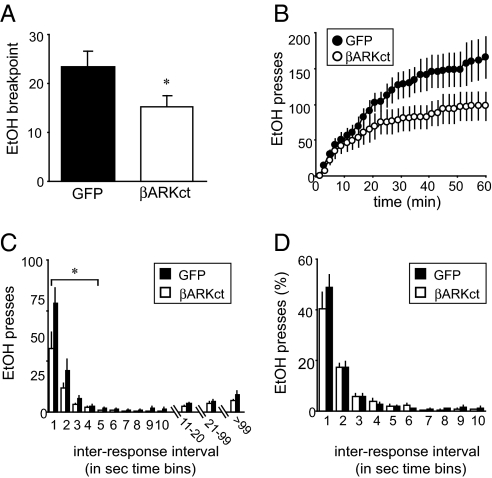
Gβγ inhibition reduced EtOH seeking during abstinence. (A and B) Gβγ sequestration in the NAcore by overexpression of the βARKct minigene significantly reduced the breakpoint (A) and cumulative responding (B) in 3-wk-EtOH-deprived rats compared with controls overexpressing GFP (βARKct: n = 8; GFP: n = 6). (C and D) βARKct overexpression reduced the number of fast (<5 sec) responses exhibited (C), but did not reduce motoric capacity (D). Data represent mean ± SEM. *, P < 0.05; **, P < 0.01—using ANOVA with Scheffé post hoc comparisons.

References

    1. Larimer ME, Palmer RS, Marlatt GA. Relapse prevention. An overview of Marlatt's cognitive-behavioral model. Alcohol Res Health. 1999;23:151–160. - PMC - PubMed
    1. Sanchis-Segura C, Spanagel R. Behavioural assessment of drug reinforcement and addictive features in rodents: An overview. Addict Biol. 2006;11:2–38. - PubMed
    1. Kalivas PW, Volkow ND. The neural basis of addiction: A pathology of motivation and choice. Am J Psychiatry. 2005;162:1403–1413. - PubMed
    1. Burish TG, Maisto SA, Cooper AM, Sobell MB. Effects of voluntary short-term abstinence from alcohol on subsequent drinking patterns of college students. J Stud Alcohol. 1981;42:1013–1020. - PubMed
    1. Weerts EM, Goodwin AK, Kaminski BJ, Hienz RD. Environmental cues, alcohol seeking, and consumption in baboons: Effects of response requirement and duration of alcohol abstinence. Alcoholism Clin Exp Res. 2006;30:2026–2036. - PubMed

Publication types

Substances