. 2008 Oct;1781(10):618-26.
doi: 10.1016/j.bbalip.2008.07.006. Epub 2008 Aug 5.

Cold acclimation induces physiological cardiac hypertrophy and increases assimilation of triacylglycerol metabolism through lipoprotein lipase

Affiliations

Cold acclimation induces physiological cardiac hypertrophy and increases assimilation of triacylglycerol metabolism through lipoprotein lipase

Y Cheng et al. Biochim Biophys Acta. 2008 Oct.

Abstract

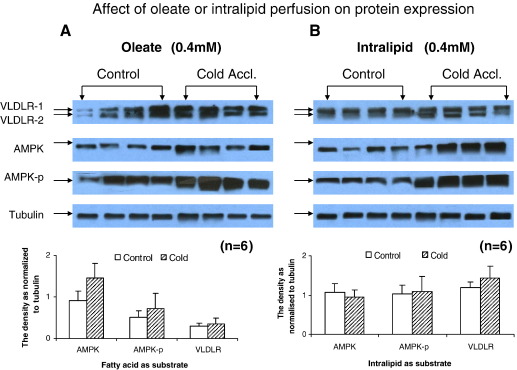
The contribution of triacylglycerol to energy provision in the hypertrophied heart, mediated through lipoprotein lipase (LPL) is largely unknown and the contribution of very-low-density lipoprotein (VLDL) receptor to control of LPL presentation at the endothelium is unclear. For isolated perfused rat hearts, cold acclimation (CA) induced volume-overload hypertrophy, with decreased developed pressure (P<0.01), increased end-diastolic volume of the left ventricle (P<0.001) and a loss of contractile reserve in response to dobutamine challenge (P<0.01). Oleate utilisation by perfused hearts was unchanged by CA, however uptake of intralipid emulsion increased 3-fold (P<0.01). CA increased the proportion of lipid deposited in tissue lipids from 10% in euthermic controls to 40% (P<0.01) although the overall contribution of individual lipid classes was unaffected. Cold acclimation significantly increased heparin-releasable LPL (P<0.05) and tissue residual LPL (P<0.01). Western blot analysis indicated preserved expression of proteins coding for SERCA2, muscle-CPT1 and VLDL-receptor following CA, while AMPKalpha2 and phospho-AMPKalpha2 were unaffected. These observations indicate that for physiological hypertrophy AMPK phosphorylation does not mediate the enhanced translocation of LPL to cardiac endothelium.


Figures
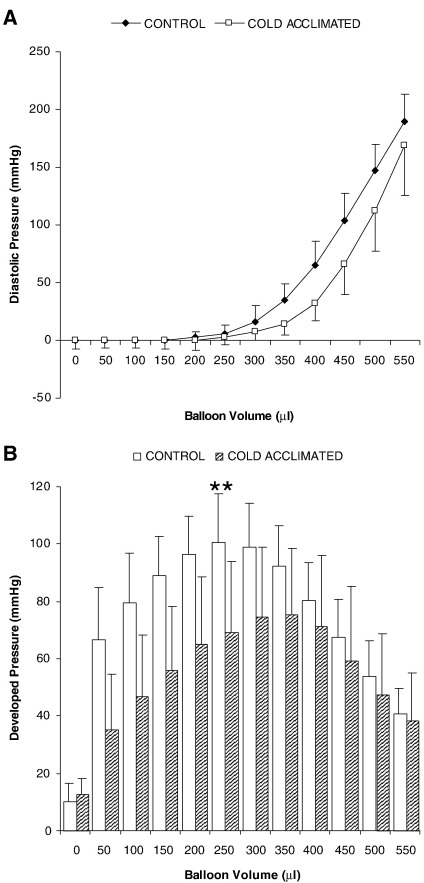
Fig. 1
Fig. 1
Diastolic performance (A) and developed pressure (B) for Langendorff-perfused rat hearts from control or CA-rats. Results represent mean ± SD (n = 6 hearts in all groups). Statistical significance indicated as: Effect of cold acclimation ⁎⁎P < 0.01.
Fig. 2
Fig. 2
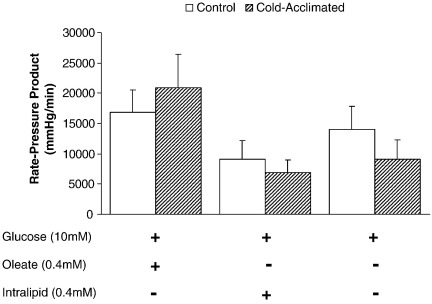
Influence of substrate on rate-pressure product for control and cold-acclimated rat hearts. Results represent mean ± SD (n = 6 hearts in all groups). Statistical significance set at P < 0.05.
Fig. 3
Fig. 3
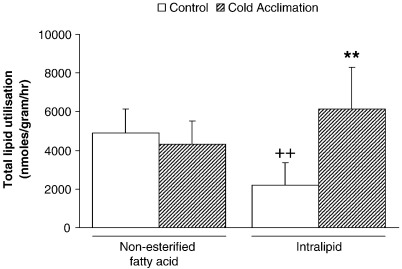
Total lipid utilisation for control and cold-acclimated hearts perfused with either oleate or intralipid. Results represent mean ± SD (n = 6 hearts in all groups). Statistical significance indicated as: Effect of perfusion with intralipid ++P < 0.01; Effect of cold acclimation ⁎⁎P < 0.01.
Fig. 4
Fig. 4
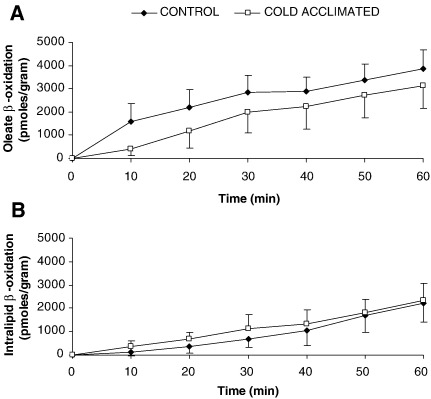
Estimation of fatty acid β-oxidation from oleate and intralipid with time for control or cold-acclimated rat hearts. Results represent mean ± SD (n = 6 hearts in all groups). Statistical significance set at P < 0.05.
Fig. 5
Fig. 5
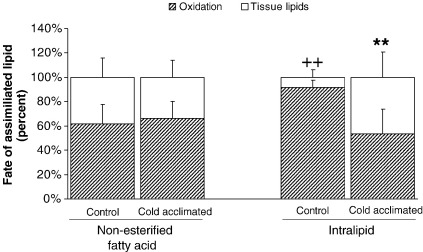
Fate of assimilated lipid taken up by perfused hearts after 60 min perfusion. Control and cold-acclimated hearts were perfused with either oleate or intralipid. Results represent mean ± SD (n = 6 hearts in all groups). Statistical significance indicated as: Effect of perfusion with intralipid ++P < 0.01; Effect of cold acclimation ⁎⁎P < 0.01.
Fig. 6
Fig. 6
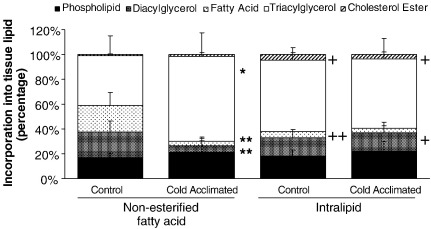
Distribution of tissue lipid between different lipid classes following perfusion with either oleate or intralipid. Results represent mean ± SD (n = 6 hearts in all groups). Statistical significance indicated as: Effect of perfusion with intralipid +P < 0.05, ++P < 0.01; Effect of cold acclimation ⁎P < 0.05, ⁎⁎P < 0.01.
Fig. 7
Fig. 7
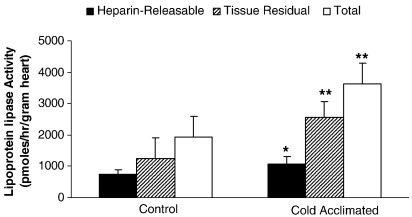
Cardiac lipoprotein lipase activity for heparin-releasable, tissue residual or total LPL. Results represent mean ± SD (n = 6 hearts in all groups). Statistical significance indicated as: Effect of cold acclimation ⁎P < 0.05, ⁎⁎P < 0.01.
Fig. 8
Fig. 8
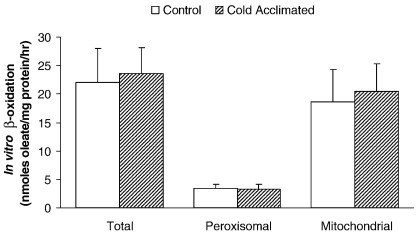
Estimation of in vitro β-oxidation of oleate by homogenates of cardiac tissue following cold acclimation. Results represent mean ± SD (n = 6 hearts in all groups). Statistical significance set at P < 0.05.
Fig. 9
Fig. 9
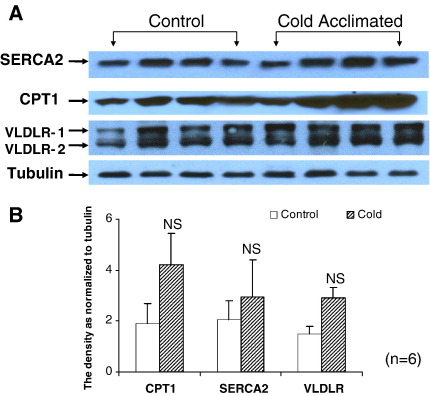
Analysis of the effect of cold acclimation on protein expression by Western blot for SERCA2, CPT1 and VLDL-receptor proteins. (A) Representative western blots from cardiac tissue homogenates. (B) Densitometric analysis of Western blots for estimation of expression of different proteins. Results represent mean ± SD (n = 6 hearts in all groups). Statistical significance set at P < 0.05.
Fig. 10
Fig. 10
Analysis of the effect of perfusion substrate on protein expression by Western blot for VLDL-receptor, AMPKα2 and threonine 172 phospho-AMPKα2 proteins. (A) Representative western blots from cardiac tissue perfused with oleate. (B) Representative western blots from cardiac tissue perfused with intralipid. Densitometric analysis of Western blots carried out for estimation of expression of different proteins. Results represent mean ± SD (n = 6 hearts in all groups). Statistical significance set at P < 0.05.

References

    1. Lopaschuk G.D., Belke D.D., Gamble J., Itoi T., Schonekess B.O. Regulation of fatty acid oxidation in the mammalian heart in health and disease. Biochim. Biophys. Acta. 1994;1213:263–267. - PubMed
    1. Hauton D., Bennett M.J., Evans R.D. Utilisation of triacylglycerol and non-esterified fatty acid by the working rat heart: myocardial lipid substrate preference. Biochim. Biophys. Acta. 2001;1533:99–109. - PubMed
    1. Augustus A.S., Kako Y., Yagyu H., Goldberg I.J. Routes of FA delivery to cardiac muscle: modulation of lipoprotein lipolysis alters uptake of TG-derived FA. Am. J. Physiol. 2003;284:E331–E339. - PubMed
    1. O'Brien K.D., Ferguson M., Gordon D., Deeb S.S., Chait A. Lipoprotein lipase is produced by cardiac myocytes rather than interstitial cells in human myocardium. Arterioscler. Thromb. 1994;14:1445–1451. - PubMed
    1. Sambandam N., Abrahani M.A., St Pierre E., Al-Atar O., Cam M.C., Rodrigues B. Localisation of lipoprotein lipase in the diabetic heart: regulation by acute changes in insulin. Arterioscler. Thromb. Vasc. Biol. 1999;19:1526–1534. - PubMed

Publication types

MeSH terms

LinkOut - more resources